Continuing on, X.T.M says that “India’s post-Independence settlement created structural ambiguity” and cites four factors in particular:
Upper-caste Hindu political dominance at the center
Muslim demographic concentrations with limited elite integration
A constitutional secularism that promised equality while leaving communal structures intact
No acknowledgment that the Muslim League’s victory posed a legitimacy problem
I think his key insight is this: “The constitution guaranteed rights. It could not guarantee renewed political consent.”
The issue as I see it is that the Indian state took the most half-hearted, wishy-washy approach towards the problem of integration. It allowed Muslims to construct bastions of political power while at the same time dividing Hindus along caste and linguistic lines. It allowed criminal elements, many from a Muslim background, to dominate perhaps its most significant sector — the arts — and spread messages of the innate goodness of Indian Muslims and Pakistanis (which is only being suppressed due to both governments’ actions) and the need for peace between Hindus and Muslims, thereby constructing an illusory palace to beguile secularized urban Hindus, while behind the silver screen they fund terrorist attacks in India. The murder of Gulshan Kumar comes to mind as (seemingly) among the least of these crimes, but that he was killed outside a temple is like having salt poured into the wound and mud slung at one’s face. What to speak of 26/11 which has already been talked about, especially recently.
Again, as I mentioned previously, I don’t think the overwhelming issue is that Muslims were allowed to maintain particular political fiefdoms — it’s that Hindus were stymied from establishing systems of political power based on traditional models. When talking about ‘independence’, Moldbug (2008) in chapter 2 of An Open Letter to Open-Minded Progressives suggests that:
“One test we can apply for independence, which should be pretty conclusive, is that the structures of government in a genuinely independent country should tend to resemble the structures that existed before it was subjugated—rather than the structures of some other country on which it may happen to be, um, dependent. These structures should be especially unlikely to resemble structures in other newly independent countries, with which it presumably has nothing in common.”
Let’s take a look at the other theses put forth by X.T.M in this piece.
His second thesis is that “The Muslim League won. Then most Muslims stayed.”
How should we understand this? It could be said the sons of Abraham — and perhaps especially those in the line of Ishmael — are meant to stay untethered from bonds to the land upon which they live, seeing as they are (at least supposedly), nomads from the sand? I think the best description of the Islamic invaders of India comes from Deleuze & Guattari’s Anti-Oedipus (1972/1977). Speaking of the ‘Barbarian Despotic Machine’ which supplants the ‘Primitive Territorial Machine’ (which I take to be synonymous with localized Hindu communities, even if it isn’t a perfect fit):
“The founding of the despotic machine or the barbarian socius can be summarized in the following way: a new alliance and direct filiation. The despot challenges the lateral alliances and the extended filiations of the old community. He imposes a new alliance system and places himself in direct filiation with the deity: the people must follow. A leap into a new alliance, a break with the ancient filiation—this is expressed in a strange machine, or rather a machine of the strange whose locus is the desert…” (p. 192)
Arkacandra Jayasimha · December 13, 2025 · 10 comments
This post by X.T.M has brought up some important points that Indians (and, by extension, Hindus) need to wrestle with. The author’s foundational hypothesis is that “India’s central trauma is not diversity. It is Partition.”
I don’t think I’ve ever read such a succinct diagnosis trying to get to the root of India’s issues, much less such a novel one (at least to me). For these reasons, if nothing else, I think X.T.M’s idea merits a deeper look.
I am largely in agreement with the author that diversity in and of itself is not at the heart of India’s troubles if only because it seems to have always been a factor in Indian society for as far back as we have history. Indeed, “diversity” and differentiation seem to me to be a mark of the continuity of Indian civilization from the earliest days of our forefathers. If this, our patrimonial diversity, has become a bane to India, it is to the India that plays at being a modern nation-state, democracy, and republic — not to the India of uncountable Gods, saints, and heroes, each at the heart of their world, ruling over the innumerable hamlets that dot the country and the uncountable kindreds that dwell within them. As Diana Eck (2012) puts it: “The profusion of divine manifestation is played in multiple keys as the natural counterpart of divine infinity, incapable of being limited to any name or form, and therefore expressible only through multiplication and plurality.” (India: A Sacred Geography, p. 48).
It is the second half of the author’s initial hypothesis that I think is the most important bit to dissect. Something about this diagnosis does not strike me as entirely accurate.
It is true that Partition split the Indian folk, namely, Hindus and Muslims, but the shape that this split took is a rather curious and, at least for me, unexpected one. According to the Pew Research Center’s June 29, 2021 report titled Religion in India: Tolerance and Segregation (Sahgal et al.), when asked whether Partition was a good or a bad thing for Hindu-Muslim relations in a 2019 survey, 43% of Indian Hindus saw it as good while 37% of them saw it as bad. Indian Muslims? Quite the opposite. Only a third (30%) of them saw it as helping communal relations while almost half (48%) saw it as actually harmful.
While Partition may have been the bloody birth pangs of the Indian State and been a very real source of deep pain to the actual humans affected by it, what ails the folks of India is, I think, altogether something else. As to what exactly this is, I will come back to it towards the end of this essay.
X.T.M’s second hypothesis is something I actually agree with. such as the idea that the “two peoples” (Hindus and Muslims) could have lived together. We have seen time and time again that incomers to India have, over time, flowed into the great folksea that ebbs and flows upon our lands like trickles of glacial melt joining with the ocean, at once both one and sundry.
There is data to support this as well. In the same Pew report I cited above (Sehgal et al., 2021), the researchers found that while both Hindus and Muslims wish for segregation in their personal lives, as can be seen in the high percentage (over two-thirds) of both groups who want to stop intermarriage, the fact that most Indians’ friends tend to be from their own religious communities, and 45% of Hindus would not want a neighbour from at least one of the other major religions (Hindu, Sikh, Jain, Buddhist, Muslim, & Christian) — a figure matched by 36% of Muslims, when it comes to what folks believe, there seems to be a surprising degree of similarity that crosses religious lines. The report revealed that an equal percentage of Indian Muslims believed in karma as did Indian Hindus (77%), along with over half of Indian Christians (54%), two-thirds of Buddhists and Sikhs, and 75% of Jains. Around one-third of Muslims and Christians said they believed in reincarnation as opposed to (and I found this very weird) only 40% of Hindus, 18% of Buddhists and Sikhs, and 23% of Jains). A similar level of belief in the purifying power of the Ganga was found among the two Abrahamic faiths. Needless to say that none of these ideas could be considered orthodox doctrine in any tradition of Islam or Christianity, and any adherence to them by followers of those religions in India immediately opens up a flood of questions one could ask.
Could it be the result of a superimposition of a Muslim or Christian layer onto a Hindu-Buddhist base such as happens when a linguistic superstrate is built atop a conquered population leading to the adoption of vocabulary and grammatical features from the linguistic substrate? Or, could it be like the speculated spread of retroflex consonants, which, while found in languages in many parts of the world, are particularly concentrated in India? Perhaps it’s a consequence of Hindu demographic domination over the last several decades causing it to serve as a sort of ‘prestige dialect’ among Indian religions? In any case, I don’t think we can discount the probability that a generally convivial attitude between Hindus and Muslims could have been maintained prior to Partition.
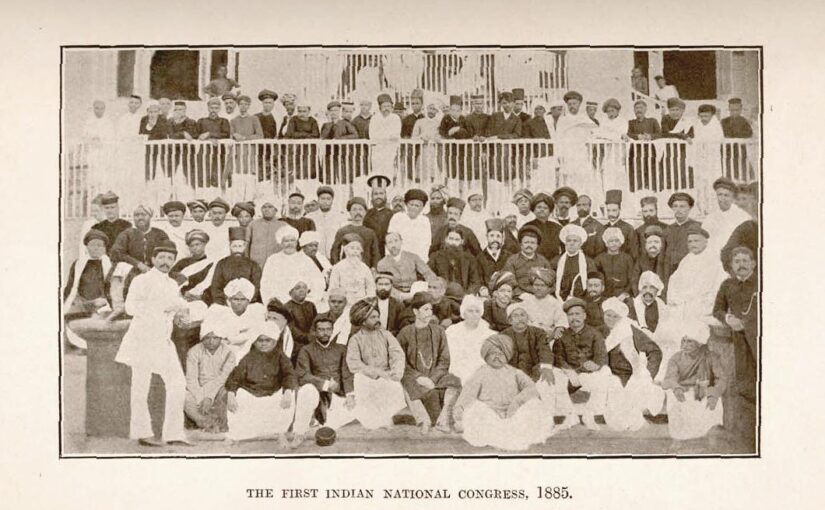
As such, I am generally in agreement with X.T.M’s argument that what happened was largely because of the will of the political elite. What I do take issue with is the rather ludicrous oversimplification of the so-called ‘Hindu’ side as the “Brahminical–Congress elite”, not only because it is patently untrue in terms of the actual people who led the Congress. Let’s take a look at some of the founding and early members. There are: Continue reading Musings on & Answers to “The Partition of Elites: India, Pakistan, and the Unfinished Trauma of 1947” (Part 1)
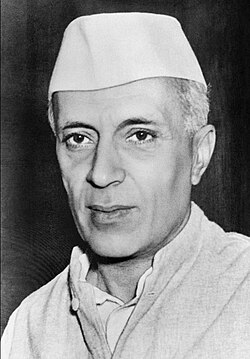
Kabir’s defence of Nehru as the moral compass of the Indian republic reveals something deeper than nostalgia for secularism. It exposes how much of India’s founding moment was shaped by a single man whose class background insulated him from the material and psychological stakes of Partition; stakes that Gandhi, Jinnah, Bose, Ambedkar, and even Savarkar understood far more viscerally.
Nehru was unique among the major players of his era. He was the only one born into national leadership, the only one who inherited a political position, and the only one whose life had been marked not by struggle but by access. While others were shaped by jail, exile, poverty, or ideological intensity, Nehru was shaped by privilege, and privilege has its own blind spots.
This matters because 1947 was not a moment for abstract idealism. It was a moment for negotiation between communities whose elites no longer trusted one another. On that task, Nehru was the least prepared of the principal actors.
I. Nehru’s Privilege Was a Constraint, Not a Qualification
Let’s just ask it plainly: if the Muslim League got what it wanted—a Muslim-majority Pakistan—then what, exactly, is the problem with the RSS wanting a Hindu-majority India? This isn’t a provocation. It’s a genuine question.
The Muslim League, by the end, wasn’t fighting for shared rule. It wanted partition. It wanted sovereignty. It wanted to exit the Hindu-majority consensus that the Congress represented. And it succeeded—through law, politics, and eventually blood.
The RSS, for its part, never pretended to want pluralism. It’s been consistent for nearly a century: it wants India to have a Hindu character, spine, and center. If the League could ask for a state that reflects Muslim political interests, why is it unthinkable for the RSS to want the same, flipped?
This is where I struggle with a certain kind of liberal-istan logic—found across both India and Pakistan. You’ll hear:
“India must stay secular! Modi is destroying Nehru’s dream!”
But what was Q.E.A-Jinnah’s dream? Was Pakistan built as a pluralist utopia? Or was it built—openly, unapologetically—as a Muslim homeland?
If Pakistan’s existence is predicated on Muslim majoritarianism, then India’s tilt toward Hindu majoritarianism isn’t an anomaly. It’s symmetry. Maybe even inevitability.
So either we all agree that majoritarianism won in the subcontinent—and everyone adjusts accordingly. Or we all agree that the Congress secular ideal was the better one—and try, equally, to hold both India and Pakistan to it.
But it can’t be:
Muslim nationalism is liberation
Hindu nationalism is fascism
That math doesn’t work. And yes, the Muslim League had more polish. Jinnah smoked, drank, defended pork eaters in court. The RSS wore khaki and read Manu Smriti. But don’t be fooled by aesthetics. At the core, both movements rejected the idea of a shared national project. They just took different exits off the same imperial highway.
So pick one: Either Nehru and Gandhi were right—and so was Maulana Azad. Or everyone else was right—and we all now live in our chosen majorities. But don’t demand secularism from Delhi while praying for Muslim unity in Lahore. That’s not secularism. That’s selective memory.
Another Browncast is up. You can listen on Libsyn, Apple, Spotify (and a variety of other platforms). Probably the easiest way to keep up the podcast since we don’t have a regular schedule is to subscribe to one of the links above!
In this podcast we gathered together a band of brownpundits (Mukunda Raghavan, Srikanth Krishnamachary, Maneesh Taneja, Gaurav Lele, KJ and myself) and talked about the Indian elections in details. As expected the BJP’s setbacks get a lot of play, but we discuss much more than that and hope to follow up with more focused episodes on some issues (such as the future of Hindu Nationalism).
How many fires are there, how many suns? How many dawns? How many waters?
I ask this, O fathers, not to challenge. O Sages, I ask it to know
In the run up to Indian parliamentary elections in 2024, there is excitement in some sections of social media about “freemarket” ideas espoused by C Rajagopalachari (Rajaji) and the Swantantra Party he helped found in 1959.
Sharing a piece here I wrote on Rajaji’s ideological relevance in contemporary politics. This was written after visiting and reporting from the many institutions he built pre and post 1947 for the now defunct Pragati Magazine in 2018.
And the food-and-agriculture-focussed independent media platform called the ThePlate.in I run.
Here goes…
Rajaji: Our Forgotten Hero
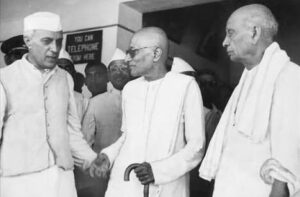
Among the leaders in the front ranks of the freedom movement, and those counted as the makers of modern India, Chakravarthi Rajagopalachari (Rajaji) is perhaps the man most forgotten. Gandhi is the ‘Father of the nation’; the very existence of India as a modern democracy, and lately all its faults—from clogged drains to currency fluctuation—are credited to Jawaharlal Nehru’s side of the ledger; the race to usurp Vallabhbhai Patel’s legacy has given India a Guinness record for the world’s tallest statue; Bhimrao Ambedkar is not only a Moses-like lawgiver who framed the constitution but also the messiah of marginalized; Maulana Azad, now firmly located in Indian-Muslim politics, finds an occasional ode to his prescience about the fallacy of Pakistan and subsequent fate of subcontinental Muslims. Rajaji is less lucky than Azad. Continue reading Rajaji: Our forgotten hero
Jayaraman Krishnamurthy · January 21, 2024 · 1 comment
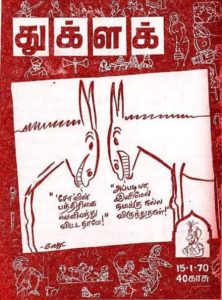
The late “Cho” Ramaswamy was a Indian actor, comedian, editor, political satirist, playwright, film director , Member of Parliament and lawyer . in 1970 he had an argument with his friends who dared him to start a magazine and to win the bet , he launched a political magazine that turned 54 this year. The first issue had this iconic cartoon where one donkey says to the other ” Looks like this Cho fellow has launched a magazine” and the other replies “Great , we will have a feast then!”. The cartoon donkeys make their appearance once in a few years while all of us readers have been reading Thuglaq for decades !
I happened to attend the 54th annual meet of Thuglaq, the one-of-a-kind event where the entire rank and file of the magazine meet with its readers, on Pongal day ,as it always happens. This unique practice was started by Cho and after his death in 2016, S. Gurumurthy, the Chartered Accountant, Journalist and RSS Idealogue has been successfully running the magazine while maintaining such traditions as well. Cho, while his sympathies for the right wing and Modi was always transparent , also was known for changing his views as the situation on the ground demanded and did not hesitate to critique even sharply the parties he supported. He was famously responsible for the TMC (Tamil Manila Congress – Moopanar and P.C Chidambaram led) formation and TMC – DMK alliance and helped in shaping the BJP-DMK Alliance during Vajpayee’s time as well when he went against his childhood friend Jayalalitha. Under Gurumurthy, while Thuglaq retains most of the founding tenets of the magazine, discussing mostly only politics and a sliver of spirituality, the irrepressible and at times irreverent humor of Cho is definitely missing. Gurumurthy seems to have almost made it a dry right leaning political magazine to the mild disappointment of long-time readers like me.
In spite of the strong shift to the right, Gurumurthy has retained and even strengthened some unique features of Thuglaq. One being inviting political leaders of all hues including the ones he opposes like DMK, Congress, Communists to share their experiences and points of view in the magazine. And to continue and strengthen this annual unique event on Pongal day when the Editor of the magazine and his entire staff meet and interact with all the readers and invite political leaders to address and interact with the audience as well. Who’s who of Indian politics have attended these meetings – Advani, Modi and most of the BJP Leaders, the erstwhile Janata leaders like VP Singh, senior communist leaders and Tamil Nadu leaders across political parties.
For this year’s event, the two main guests were Shashi Tharoor from Congress and K Annamalai, the firebrand BJP Tamil Nadu Chief. Sadly, since Annamalai was coming in from a meeting at Delhi, his flight was delayed and by the time he entered the Music Academy Hall, Shashi had finished his speech and had left. The program began the way it always does, with the editor introducing the entire staff of the magazine on stage starting from the veteran reporters like Ramesh whom most of Tamil Nadu knows to the attenders. This is again a unique gesture that surely must be appreciated. Then selected readers from the audience come to the stage and make their comments, queries and criticisms to which Gurumurthy replies. This year, apart from the regular questions about state and national politics , there were a few questions and concerns regarding the Maldives standoff and Guru gave his opinion and also deferred to the veteran diplomat and politician and ex Minister that Shashi is and requested him to give his point of view when his turn came. The audience as expected was mostly sympathetic to BJP’s cause.
Shashi spoke well, noting down all the key concerns and objections raised by the audience against Congress and addressed them valiantly. He also accused Modi government of subsidizing North at the cost of the South, lamented the subjugation of federalism and also explained the Maldives situation in an objective way without blaming the BJP government but cautioning it to be careful not to push Maldives into the axis of China. Ram temple issue being a topical one, he took it head on saying that he will visit the temple but not on the 22nd as he has in any case not been invited and would not want to go even if he were as he felt it was made into a political event. This caused some unrest in the audience as it did when he was overly critical of Modi. Overall, it was a measured speech, fully knowing it was a partisan audience who were against his world view, Shashi Tharoor, I felt stood his ground gracefully. It was comforting to see Gurumurthy come up to the stage after and admonishing the audience for interrupting Tharoor’s speech, commenting that since Dr Shashi Tharoor maintained the decorum of the forum, it behooves the audience too to do the same even if they believe he is all wrong.
Then came the star of the show, Annamalai who has caught the imagination of the public in the state especially those who desire an alternative to the Dravidian parties. His was a systematic take down of the DMK, its history and all that he felt was wrongs done by them. He also attempted to answer all the criticisms laid by Dr Tharoor, replying to the preferential treatment to the North charge, gave a population-based defense of the budget allocations favoring the North. He explained the BJP’s plans for the south and Tamil Nadu in particular. Gurumurthy too jumped on to the same North – South subject later and gave a historical perspective based on argument that the north suffered more from the partition which at least I could not buy fully.
A few broad inferences for me from the event
For Congress, it appears as though this boycotting of hostile TV Channels and media is a petulant and self-defeating act. I too cannot stand some of these loud TV Channels and can understand the reasoning but if one is running a political party, surely one needs a thicker skin and like Shashi Tharoor showed, one can hold their point of view even among a partisan hostile crowd and come out with head held high! I overheard a lot of the audience commenting that “Tharoor is a good leader but will he survive in the Congress”. It is up to the Congress to convince people of that and give such leaders more responsibilities and have them engage with people more.
For BJP, this preferential treatment of North over South and the damage to the federal structure narrative is hitting home to the audiences in this part of the world and even to those who are favorably disposed towards it. The narratives countering it, the ones I heard from Annamalai and Gurumurthy were not entirely convincing. There have been other arguments on this subject which have featured in BP Podcasts by folks like Maneesh about Freight Equalization policies and such which seems to have some merit in them but are seldom heard here. Are those too nuanced and complex arguments, am not sure but the ones that I listened to now still leave me with the feeling that we in the south have been hard done by both the Congress and more so by the BJP Government.
Interacting with the audience live, especially if it is a large one and answering them impromptu seems to be a rare occurrence and should be celebrated more. The audience too needs to learn to respect the speaker and not jeer if an opposing point is presented. The audience in this event have been that historically and when they went a bit haywire, they were immediately pulled up. Politicians, those who are well qualified (Please note I do not say educated!) and passionate about a subject can still convey their stances without resorting to name calling and hyperbole. Both Shashi Tharoor and Annamalai were strong but objective and respectful in their speeches.
The argumentative Indian can also be objective and respectful and can engage in constructive dialogue and achieve much more!

 In the run up to Indian parliamentary elections in 2024, there is excitement in some sections of social media about “freemarket” ideas espoused by C Rajagopalachari (Rajaji) and the Swantantra Party he helped found in 1959.