
Author: X.T.M


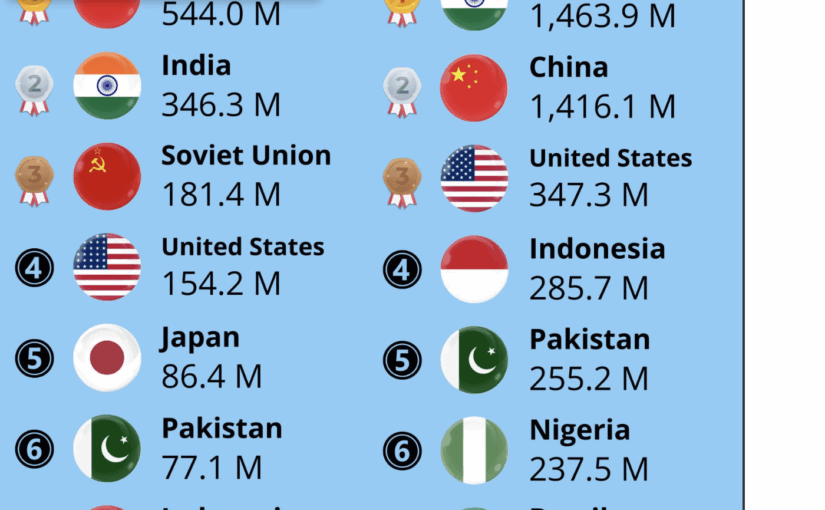
The Changing Demographics of Undivided India (1900–2025)
South Asia’s demography is one of the great untold stories of the modern world. Too often we look at the subcontinent through today’s partitions — India, Pakistan, Bangladesh — but the real insight comes when we view the region as a single whole. Across 125 years, the balance of populations has shifted dramatically.
📊 1900: A Baseline
At the turn of the twentieth century, Muslims made up about 20% of undivided India’s population. The rest were overwhelmingly Hindu, with significant Sikh, Christian, Jain, and other minorities.
📊 1950: Partition and Realignment Continue reading The Changing Demographics of Undivided India (1900–2025)

Travelling – Open Thread
🔗 Links shared from the comments
-
Indian rupee slides to all-time low on US visa hike & subdued foreign flows: Visa fee hikes and US tariffs are compounding pressures on the rupee, with concerns about equity flows into India’s IT sector.
-
Why the Pakistan–Saudi Arabia defence pact is unsettling India: Riyadh’s commitment to treat aggression against Pakistan as aggression against itself is seen as a direct security challenge to India.
-
Doug Macgregor thread on the Saudi–Pakistan Strategic Mutual Defense Pact: Macgregor outlines how Saudi–Pakistani defense ties, backed by China and linked to Iran, could reshape the balance of power in Asia.
-
World Bank warns of Pakistan’s failing growth model: The World Bank says Pakistan’s growth model no longer supports poverty reduction, with income gains stalling and poverty at an eight-year high.
-
Rail-based Agni Prime missile test-fired: India successfully tested a rail-mounted Agni Prime ICBM, underscoring advances in indigenous missile technology and delivery systems.
💬 Keep the links and thoughts coming — BP works best when the Commentariat bring their own sources into the mix.
On Islamism, the Oneness of Mankind, and the Burden of Public Bahá’ís
For too long, the term Islamism has functioned as a lazy shorthand in Western discourse; one that often sanitizes the dehumanization and securitization of Muslim bodies. And when it’s used by those claiming spiritual insight, especially from within a global Faith like the Bahá’í Faith, it becomes more than just a rhetorical misstep. It becomes a betrayal.
This week, a prominent British Bahá’í comedian made such a misstep.
A Moment of Caution — Dismissed
When Omid Djalili posted a news clip, which gently reframed the Bahá’í concept of the Oneness of Mankind, I appreciated the gesture. In fact, I said so. The “toe-stubbing” analogy was clever, and there was something moving in seeing profound principles gently repackaged for a wider audience.
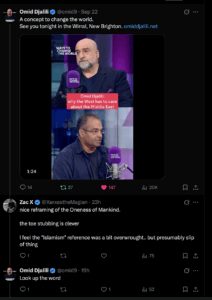
But I raised one concern: the reference to Islamism. It was, I suggested, overwrought, unnecessary, and ultimately unwise. I proposed an alternative: perhaps rephrasing the same concern as “security anxieties around mass migration” or similar language that doesn’t dog-whistle. This wasn’t a condemnation. It was, as any Bahá’í should recognize, consultation. An invitation to reflection.
Instead, I was told: “Look up the word.”
The Burden of Bahá’ís in Public
It’s not about semantics. It’s about responsibility. And especially so when one is invoking sacred teachings, teachings that thousands upon thousands have died for; on public platforms. The Bahá’í Faith is not a marketing device to win over a Western liberal audience by soft-launching its principles in the language of border panic and counter-terrorism.
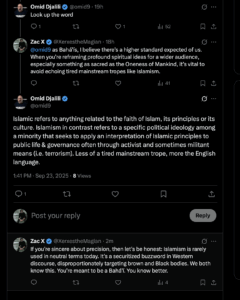
To reduce Islamism to a “technical English-language distinction” is disingenuous. The term has never been neutral. In nearly all Western contexts, it has become a floating signifier for violence, extremism, and “dangerous Muslims.” It serves to other, to isolate, and to justify state and vigilante violence often against entirely innocent people (Afghanistan, Iraq & Palestine).
And when Bahá’ís, of all people, repeat that language without self-awareness, without contrition, and without consultation, we should all be worried.
The Problem Isn’t the Joke. It’s the Response.
I understand the pressures of performance. I’ve done media. I know how easy it is to slip. What matters is what happens next. When another Bahá’í, someone you know, someone with many mutual connects, raises a concern gently and in good faith, the correct response isn’t smugness. It isn’t defensiveness. It certainly isn’t “learn English.”
That response is hurtful, racist, and deeply contrary to the values we both claim to serve. And that’s what cut. Not the line in the show but the refusal to listen afterwards. The arrogance of elite Bahá’ís who believe proximity to celebrity, applause, or power gives them carte blanche to reframe revelation in their own image.
This Is Why We Need to Talk
As Brown Pundits reshapes itself, I’m re-examining my own priors, too. What voices we platform. What values we uphold. Who gets to speak for our communities and under what banner.
So I say this plainly: The oneness of mankind cannot be proclaimed by marginalizing Muslims. And Bahá’ís, especially public ones, must hold themselves to the standard of humility, consultation, and truthfulness we profess to believe in. We cannot serve justice while echoing injustice. We cannot preach unity while casually reinscribing division. The world is watching. Let’s be worthy of what we claim.
The Ilhan Omar of Brown Pundits
Every movement has its lightning rods. In American politics, Ilhan Omar is one: progressive, unyielding, often correct in substance but polarizing in style. She calls out genuine injustices, but her timing and tone can sometimes drown out the very points she is trying to make.
I’ve begun to realize that Kabir plays a similar role on Brown Pundits. Like Ilhan, he often raises necessary truths (for instance Israel has just killed an American family in Lebanon). Like Ilhan, he brings traffic, visibility, and energy. But also like Ilhan, he has a way of inflaming rather than persuading.
Charlie Kirk’s remarks illustrate why Ilhan Omar’s critiques resonate, even if her tone divides. When Kirk sneers that there are “no tall buildings left in Gaza,” or jokes that Palestinians are “stupid Muslims” for resisting, he is not just making political commentary. He is engaging in dog-whistling — racialized, sexist, Islamophobic rhetoric that devalues human life. Combined with his earlier comments about the supposed lack of “brain processing power” among prominent Black women, the pattern is unmistakable. One does not have to be a progressive to see that such speech corrodes the civic space. At the same time, none of this justifies violence: the murders of Charlie Kirk and Irina Zarutska are deplorable and must be condemned without qualification.
The Progressive Dilemma Continue reading The Ilhan Omar of Brown Pundits
Pakistan: The Realpolitik State
In a recent exchange, Kabir suggested that Pakistanis often feel unwelcome in our discussions on Brown Pundits, and that constant criticism of their country creates a sense of unease. It is worth pausing to reflect on this. Pakistanis, like all of us, are shaped by history and circumstance. And yet, there is something in the cultural tenor of Pakistan that makes open engagement difficult.
I say this not to provoke but to observe. Pakistan, as a society, often leans heavily on hierarchism, patronage, and a culture of deference. To borrow an old saying about the Somalis, that every man thinks himself a Sulṭán, one might say that Pakistanis often view themselves through the prism of status and validation. This instinct is hardly unique; Indians, too, have their caste-bound privileges and invisible hierarchies. But in India, these structures are embedded in a dense cultural fabric; family, caste, neighbourhood, ritual, that, for all their flaws, anchor society. Pakistan, by contrast, feels less rooted. It is a younger country (with old traditions), with fewer inherited cultural layers to draw on.
This is not simply an abstract point. When I married, we drew freely from Hindu rituals (dual ceremonies, Bahá’í incl.), Persian customs, and Sindhi traditions, blending them into something whole. But I realised there was nothing distinctly “Pakistani” to contribute; no cultural motif that stood outside India or Iran (we didn’t do a Walima, which is Muslim). Pakistan is, in many ways, a derivation: a state forged through separation, rather than a civilization with deep roots of its own. The cultural space it occupies has been overlaid with militant nationalism and, too often, Hindu-phobia (Kabir is so inured to it that he isn’t able to recognise that but on the flipside so is the Commentariat towards Islam).
To acknowledge this is not to deny the prejudices of Indians toward Muslims, which are very real and enduring. Nor is it to ignore the deracinated, secular archetype embodied by figures like Benazir Bhutto, who seemed neither fully Muslim nor fully Western, suspended between worlds and who are the cultural elite of Pakistan (what they give up on their bridge is their Hindu origins; more than being half-Persian, Benazir’s nani was Hindu). It is simply to note that Pakistan’s cultural story remains unsettled & thus interesting.
Validation and Audience Continue reading Pakistan: The Realpolitik State
H1B Open Thread
I’ll add as I go along but this seems quite topical..
I do see the Persian Gulf States emerging as a hyper-conduit between capital, labour and technology. The West is raising up its walls.
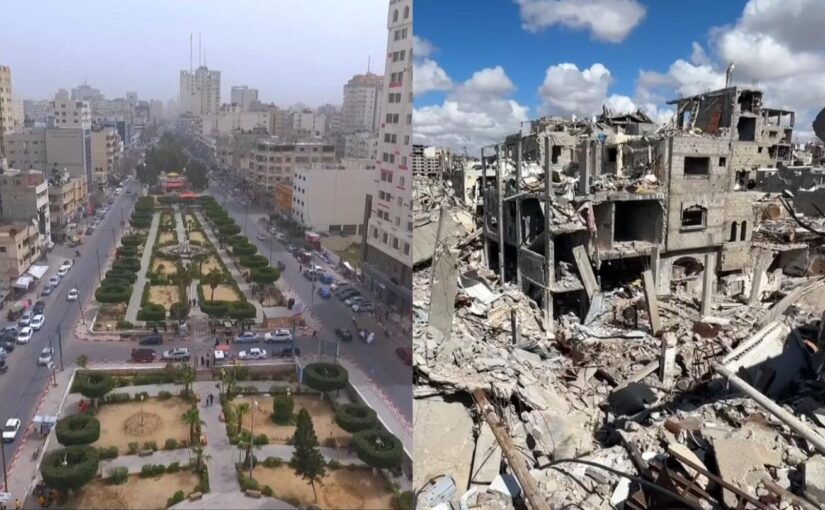
Moderation Note: On Gaza, October 7, and the Limits of Tolerance
Kabir’s Muslim nationalism cosplaying as liberalism is vexatious (it would be excellent if he just disclosed his priors), but I give the admin full authority to handle that directly.
My immediate concern is with BB-HS. I have barred him from becoming an author and have removed his last twenty comments. Despite his earlier misrepresentation about being “half-Muslim,” I allowed him to return under a new handle, tabula rasa. His output, however, is increasingly defined by “fantasies” about what a model minority should be; deracinated and devoid of meaningful character.
BB’s Response (after I had deleted his past 20 comments)
“Why though? The only animus I have is with Kabir because he represents a demographic I loathe – The soft Islamist | The ‘liberal’ English-speaking version who whitewashes his more hardcore cousins’ atrocities. Actual people have died due to Islamists which Kabir downplays (Pahalgam, October 7th). Some ribbing online is nothing in comparison. And I haven’t even said anything insulting.”
My Response
-
- Kabir is not an Islamist. He is a Muslim nationalist—since Pakistan itself is sine qua non Muslim nationalism (the idea that Indian Muslims were entitled to their own nation). Just as every Israeli is, by definition, a Zionist/Jewish nationalist, even if individuals disagree with its implications, Kabir represents that current.
- What stands out is that BB mentions only Pahalgam and October 7—both undeniably tragic events, and I say this as someone who is not Muslim—while omitting the ongoing genocide in Gaza.It is akin to referencing 9/11, a devastating moment in history, without also acknowledging the destruction of Afghanistan and Iraq and the millions of lives lost in their aftermath.
- Unlike Kabir, vexatious, but rarely personal, BB makes his attacks direct. He is not Kabir’s friend indulging in ribbing; he is simply “Honey” under another guise.
- What sets him apart is an openly hierarchical stance: non-Muslim lives ranked above Muslim ones, echoing the very post-colonial divide-and-rule strategies we are meant to reject.
- Kabir manipulates through weaponised victimhood; BB chooses blunt hostility, lacing personal abuse into his commentary. I have permanently removed Honey’s comments for that reason, vulgarity leaves no space for debate and I treat BB and Honey as a single entity.
- Beneath the very different styles of BB-HS & Kabir lies the same contempt: the belief that the only acceptable minority is one hollowed out, compliant, and dead on the inside.
Moderation Philosophy
As a Founder, my job is to ensure Brown Pundits does not become an echo chamber. I have repeatedly critiqued Kabir’s contradictions, but once I accepted him as a Muslim nationalist cosplaying liberalism, I could also accept his place in the debate. We have multiple Hindu nationalists here, and when Kabir is challenged\moderated, the balance tends to restore itself. The ecosystem can correct for his presence.
Finally, let me stress: the comment boards are not the only heart of this site. Too often they descend into noise. If regular commentators want to influence debate constructively, they should apply to become Authors; where they can speak directly to our 2,000+ daily readers, not just the dozen or so regular commentariat.
Brown Pundits is rapidly emerging as the most interesting Indo-Pak cross-channel precisely because it is not an echo chamber. We literally upset everyone and that is a great thing because it means we are covering new difficult terrain. My moderation began with strict principles, but like everyone else, I have a life, job, and family. That means I must also be pragmatic.
Call for Authors
Brown Pundits has always thrived on debate, commentary, and detail. Our compact team—three co-founders, two editors (Nivedita & Indosaurus), and three authors (sbarrkum, Gaurav Lele, Saiarav and Manav); keeps the conversation alive.
We’d like to expand. If you’ve been a regular voice in the comments or simply feel you have something to add, please apply to write for BP. Sharp observations, whether about Modi Ji’s birthday celebrations or broader cricketing analogies, are exactly what we value.
The word Pundit comes from Sanskrit, meaning “learned man” or Brahmin. It reminds us that Brown intellectual life is rooted in centuries of plural, complex traditions of debate. This is our inheritance, and BP stands on those terms; not reducible to any ideology.
I’d especially encourage regulars like brown, Daves, Hoju, Pandit Brown, and BB to consider joining the author list.
Links on My Browser Right Now – Open Thread
A few pieces I’ve been reading this week:
-
The Lies America Tells Itself About the Middle East: (Foreign Affairs) – On how U.S. narratives obscure its own role in the region.
-
Don’t Overestimate the Autocratic Alliance: (Foreign Affairs) – A counterpoint: authoritarian states may not be as cohesive as advertised.
-
The Four Humours: Our 2,500-Year-Old Mania for Personality Types: (BBC Future) – Why these frameworks endure and what that says about how societies interpret character.
-
Can We Hear God? (Bahá’í Teachings) – A reflection on divine communication and perception.
- The Dawn of the Post-Literate Society: (James Marriott, Substack) – On how screens and AI are reshaping reading and writing itself. Thanks Kabir for the suggestion.
Reflections
On the Ummah: Muslims have often failed to concede ground in internal debates, which has left them politically boxed in. One reform across all denominations would be to return directly to the Quran as the primary authority. That alone would dissolve many cultural accretions, halal (animals should be stunned before slaughter), hijab (a Sassanian trait), and other practices, into something more adaptive.
And here’s a more speculative question: if the “Satanic Verses” were reconsidered if Al-Lat, Al-Uzzah, and Al-Manat were understood as sacred divinities at the threshold of the Lote Tree, would that make Islam more fluid, especially for minority-majority dynamics?
On Kabir: I’m not moderating him out, but readers should be aware that he frames everything through Muslim-rights activism. Engage, but don’t get gaslit into endless provocations. Everyone is entitled to their nationalisms — but they can’t claim liberalism at the same time. That tension makes it worth examining how plurality is treated within the Hindu fold itself. Dharma, unlike the Abrahamic Faiths, tends to all for multiple truths co-existing with each other (Buddhism and indigenous East Asian religions).
👉 Over to you. I’m retreating from heavy moderation — I see BP’s strength in letting the commentariat lead. Biases are fine. Gratuitous abuse is not.

“In March 1998 the Indian PM Gujral, told … “Pakistan was not capable of making atomic bombs.” he had been convinced by Indian Intelligence and Dr Raja Raman, the head of Indian Atomic Energy Commission, who had publicly claimed that nuclear weapon were beyond Pakistan’s reach.”