Traffic
We published 76 posts and 1 podcast (Bangladesh) this month.
Traffic fell from ~55–65k (Sept–Oct) to ~33k in November.
However, comment activity remained strong at 819 comments (~27/day).
We published 76 posts and 1 podcast (Bangladesh) this month.
Traffic fell from ~55–65k (Sept–Oct) to ~33k in November.
However, comment activity remained strong at 819 comments (~27/day).
I was speaking recently with a cousin who grew up in India. Their family has been Bahá’í for generations, but their older relatives once lived as Sunni merchants in Old Delhi. When they visited their grandparents as a child, they noticed something striking: in many lanes of Old Delhi, long after Independence, the sentiment was not Indian nationalism but Pakistan-leaning nostalgia. This was not hidden. It was ambient.
That single observation exposes something almost no one in Indian liberal discourse wants to say aloud: post-Partition India inherited a large Muslim population whose political loyalties were, at best, ambivalent. That is not a moral judgement. It is a historical one.
And once you notice this, a second truth becomes obvious: Kabir’s secularist vision of an emotionally unified India makes sense only in a world where 1947 never happened.
Continue reading The Partition of Elites: India, Pakistan, and the Unfinished Trauma of 1947
As Dave mentioned, there is a lively WhatsApp group of BP authors and editors, and it inevitably shapes the comment ecosystem. But one comment on the blog stood out:
“The very foundation of Pakistan is an anti-position. What is not India is Pakistan. So isn’t it obvious?”
It’s an extraordinarily crisp description of Pakistani identity-building. What is not India is Pakistan. That is not a slur; it is, in many ways, a psychologically accurate frame for how the state narrates itself.
What I increasingly find misplaced on this blog is the recurring assumption that Pakistanis are somehow “Indians-in-waiting,” or that Punjab is “West Punjab,” Pakistan “Northwest India,” or Bangladesh “East Bengal.” These are irredentist projections that simply do not match lived identities. This is not “North Korea” or “East Germany,” where both sides continue to imagine themselves as fragments of one common nation.
Yes, Pakistan consumes Bollywood and Hindi music, which themselves derive from Mughal and Indo-Persian syncretic traditions. Yes, Pakistan is culturally embedded in the greater Indo-Islamic civilizational sphere. But emotionally, Pakistan has severed itself from the Indian Subcontinent as a cohesive landscape. It has constructed a hybrid identity; part Turko-Persian, part Islamic internationalist, part anti-India.
I don’t personally agree with this move, and my own trajectory has been toward a strong Hinducised, Dharmic identification. But my view is irrelevant here. What matters is that Pakistani identity is defined negatively; as the commentator put it, “What is not India is Pakistan.”
Whether that is healthy or sustainable is another matter. But identities can persist in unhealthy configurations for a very long time; the stock market can be irrational longer than your liquidity can survive.
Every few months (years?), Brown Pundits goes through its own small earthquake. A post lands wrong, a comment thread ignites, and the whole Commentariat erupts.
The latest rupture began with a mild jibe on caste. I pointed out, in passing, that caste shapes political instincts far more than many admit. The backlash was instant. A section of the readers declared a quiet boycott. The threads went cold. No one wanted to break ranks. The more one claims to have transcended caste, the clearer its caste blind-spots become. Silence itself becomes a shibboleth.
And when the silence hit, the blog froze. Continue reading Why we must talk about caste
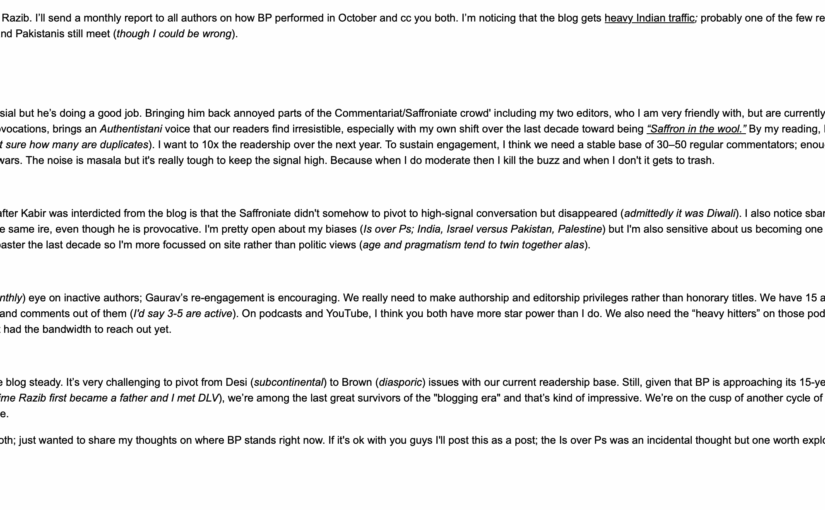
I sent this email to the CoFounders of the Blog (Omar | Razib) and tomorrow I will send through the Monthly Author Report.
The silence on BP these past few days feels deliberate; a kind of Saffron Strike. If so, let it be known: this space was never meant to cater to ideological comfort.
It seems uncommonly quiet; I think I have been misunderstood. I do not care about the traffic and commentary of BP as much as I care about the integrity of the space.
For instance when I felt that Kabir had done wrong; interdiction was the answer. When I realised the narrative was being twisted so that I became his moderator (Kabir generally knows my red lines) then I realised I was wrong. Kabir’s recent postings and commentary have been very high-signal. Continue reading Saffron Strike
We had a quiet Diwali dinner with some South Asian literati here in Cambridge, Mass. No fireworks, but some useful clarity especially about the need for a unified South Asian voice, and where Brown Pundits fits in.
Threads, Fire, and a New Warrior Class
Kabir remains catnip for the Commentariat or as I’ll now call them, the Saffroniate (Brahmins or Brahminised). They pretend otherwise, but the numbers don’t lie. The threads light up when he’s around and yes, I’m aware of the layered joke: threads mean something else too, especially to our youngest Pundits-in-training. Continue reading Fire and the Saffroniate
A week ago, I imposed an interdiction on Kabir ; a move I felt was necessary at the time, not because of his views, but because of the manner in which they were expressed. His tone, his dismissal of this platform, and his tendency to escalate rather than de-escalate all contributed to that decision. But now, I find myself wondering: was Kabir right about Brown Pundits?
Since his departure, the commentariat has gone unusually quiet. Threads that once sparked with disagreement, energy, and engagement have gone still. There is a strange calm but it feels like the calm of a museum, not a marketplace of ideas. And what’s become increasingly clear is that the “peace” has come at a cost. That cost is vibrancy. That cost is friction. That cost is participation. Kabir, for all his faults, drew fire, and fire draws people.
This raises a more fundamental question: am I overestimating the commentariat’s interest in the core mission of Brown Pundits? Were people here for civilizational dialogue, or were they here for the masala of Indo-Pak antagonism? It’s disheartening to admit, but the numbers speak for themselves. Kabir had been blocked years before (not by me), and when I released Loki from his cage, well on his return, so did the attention. Continue reading Was Kabir Right?
Most of our active Commentariat are Authors as well, and that overlap is exactly what makes this space work.
Please don’t worry about the length of your posts or whether you’re mainly sharing links. All I ask is that you include a line or two of context or commentary, however brief, when you do. It helps the discussion move forward and gives readers an entry point. I’ve been seeing some excellent conversations in the Open Threads, but many of you still seem hesitant to post directly. Don’t be!
It genuinely helps me when Authors share what they can, when they can. I’ll edit or follow up if something needs adjusting, but as you all know, I’m very much in favour of a broad church; no pun intended, considering my last piece was on the Church.
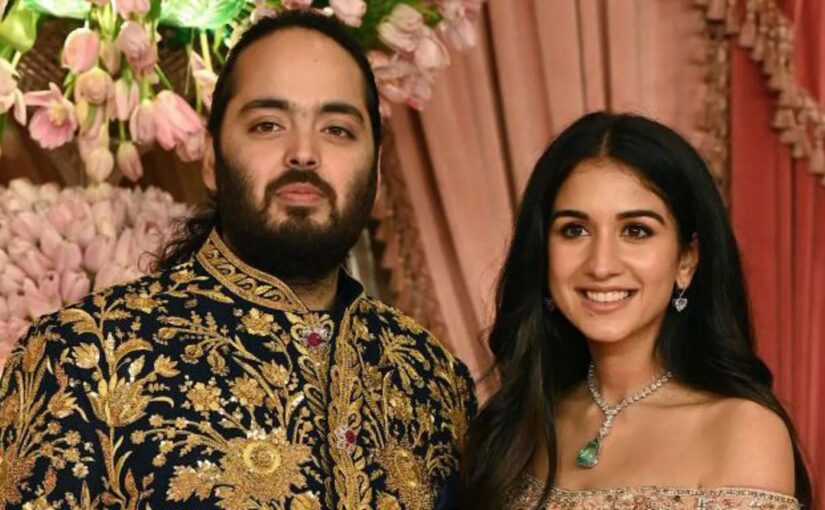
I was speaking with Dr. Lalchand about a number of things, from Anant Ambani’s wildlife project to the recent caste discourse on Brown Pundits. Both, strangely enough, converge around the theme of scrutiny; of who gets to build, who gets to critique, and who sets the rules of engagement.
Let’s start with Vantara. Anant Ambani’s wildlife refuge is coming under sustained criticism. But I ask: why shouldn’t Bharat, arguably the only major civilisation that views animals as divinely inspired, have a world-class zoo or rescue center? If done with sensitivity and vision, this could be a profound expression of India’s Hindu civilisational ethos.
Vantara houses over 200 elephants, 50 bears, 160 tigers, 200 lions, 250 leopards, and 900 crocodiles; albeit imported from across the world into the baking flatlands beside an oil refinery. The scale is staggering. Yes, there are questions: about captive animal welfare, about the case of Pratima the elephant, about transparency. But we should also be able to think of Indian megafauna conservation at global scale especially in a nation where sacred animals are part of dharmic memory.
America had its Gilded Age. The robber barons left behind libraries, parks, and museums. Can’t India do the same? Or do we reflexively dismiss anything built by wealth as vanity? Can there not be a deeper Dharma behind patronage?
And that brings me yet again to caste, controversy, and the structure of Brown Pundits. Continue reading Vantara, Caste, and the Fragile Commons