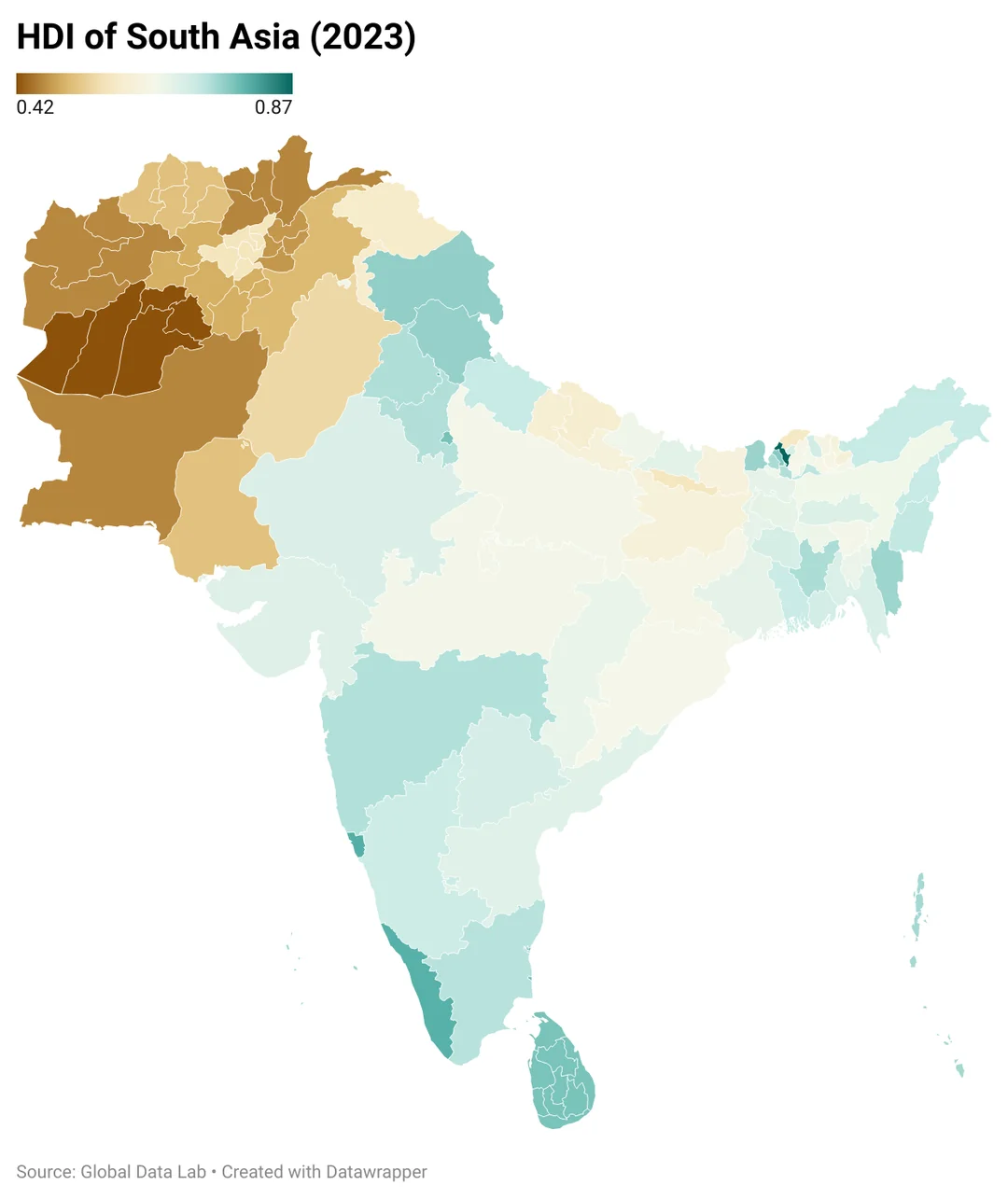
Global Data Lab is an organization that uses this data (amongst other data) to create “sub-national” HDI.
https://globaldatalab.org/
One thing you can see from the map is that the only border which is so distinct is the India-Pakistan one. If one does not know they will not be able to make the borders of India-Nepal, India-Bangladesh, India-Bhutan or Pakistan-Afghanistan.
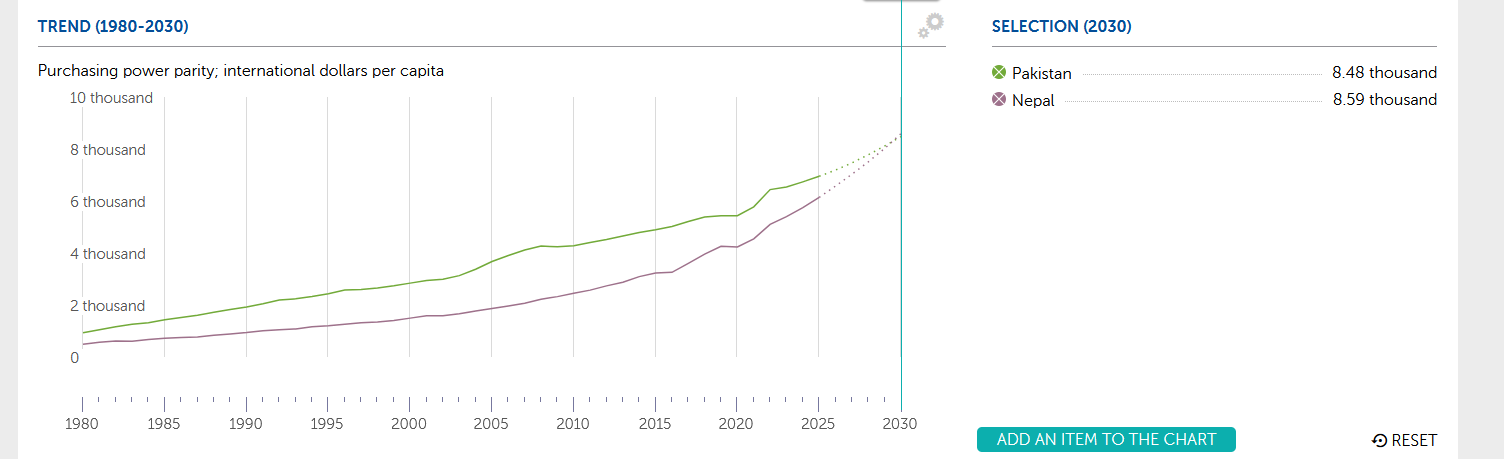
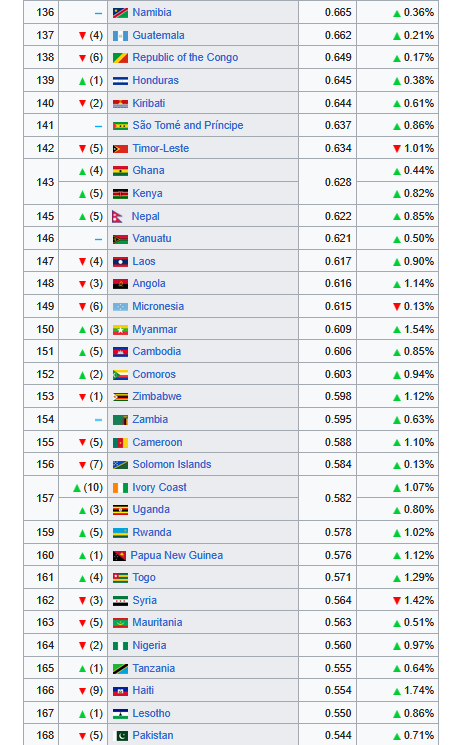
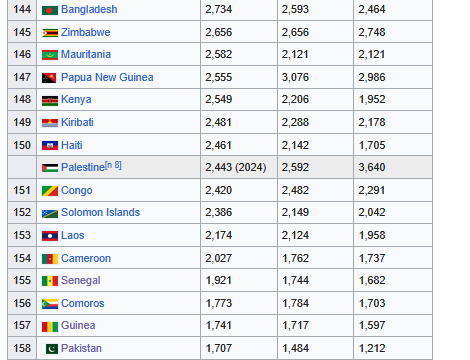
Thing is not only does Pakistan have the lowest HDI in the Indian subcontinent (only one in UN’s “low” HDI below 0.55. Everyone else is above 0.6), it will also have the lowest per capita income in 5 years, going below Nepal.
In fact, the World Bank has removed Pakistan from “South Asia” and classifies them as part of MENAP because their growth data is so different from the rising economies of the subcontinent.
https://www.worldbank.org/ext/en/region/mena
https://www.worldbank.org/ext/en/region/sar
And not only are the other desi countries leaving Pakistan behind, many sub-saharan African countries are as well.
So a new edition of the T20 WC is coming up and it is already embroiled in some controversy. Bangladesh refused to play in India and ICC had them replaced with Scotland.
Cue the usual voices from Pakistan – “BCCICC”, “India’s money is ruining cricket” blah blah.
But it led me to ponder something – Pakistan itself has a huge population of 250 million + and it isn’t that “much” poorer than India. India’s GDP pci is $3050 while Pakistan’s is $1710 (around 1.8x) . Similarly India’s GDP is $4.51 trillion while Pak is $410.5 billion (around 11x).
So the other numbers should be in the same ratio right?
Here is where the difference comes
Revenue of cricket boards
BCCI – INR 20686 crore
PCB – INR 458 crore
That is around 45x
T20 leagues media rights
IPL – $6.2 billion for four years
PSL – $24 million for two years
That is around 130x (normalized on a per year basis)
And if you look at other stuff these huge ratios persist
Cars sold annually
India – 4.1 million
Pakistan – 200,000
Forex reserves
India – $710 billion
Pakistan – $21 billion
Stock exchange market caps
BSE – $5 trillion
PSE – $65 billion
Why do you think that is?
My theory is because the Pakistan military is stronger than the 1/10 ratio, it kind of effects everything else which leads to these lop sided ratios.
As one does, we were discussing societal rise and collapse on twitter and I said at some point:
“I have no clue about EU etc but I think stories of the demise of France, the Vikings and the Poles all look unlikely to me.. And given the evidence of the last 500 years of Russian asabiya, I wouldn’t write them off either.. They will all survive wud be my guess.. Meanwhile, the gods have arranged a once in a millennium opportunity for Indians and it will be an unforgivable tragedy to miss it.. Go big, or go home”
User @whatwasthataga4 on X.com (an Indian American) asked: “I don’t understand this once in a millennium opportunity. What exactly is it and how is it supposed to work in the best case?”
I posted an off the cuff reply and wished I could sit down and do a proper post on this. But knowing that I may not get to it, I am just quickly updating my tweet and hoping that commentators will add value.. So here is my “off the top of my head” explanation of this “once in a millenium opportunity” claim.
We will come back to why “once in a millenium” (i.e., did this opportunity not exist before? will it not exist in the future?), but I think you have to begin with belief in certain things, some of which seem obvious, but others are hotly contested by HBD types (and I think the HBD types are wrong here). So here are some things I believe are true and which constitute a “once in a millennium opportunity to become a developed and powerful nation” (we will dismiss the fantasists who think humans have moved beyond nations, yadda yadda yadda).
1. Indian human resources are potentially world class; the wetware is actually OK (though disease and malnutrition do lower IQ in some significant subsets, but cultural strengths compensate as well, so even that is not a lost cause)
2. So, wetware can work. What about software? I think even the software is not entirely corrupted. The bios is still intact for most people (though under threat) and the culture has many elements that make it potentially successful. For example, there is a significant commercial class and tradition, of the South Chinese type, if not equally developed right now. There is also significant respect for teachers and learning (again, not at Confucian levels, but it is very much there) and respect for legal authority (sometimes, maybe a lot of times, too much respect for authority, but there is also a romantic anti-authoritarian assault from Wokish Leftist ideologies that now threatens to over-correct).
You may be getting a hint of why i say its a chance, not a done deal. These are also strengths that are under sustained assault from Postleftist wokish ideologies and in India there is such significant domination of western leftish narratives in the educated classes that there is the possibility they could actually destroy these cultural strengths in another generation. That would be one way to miss the bus. Another would be to start a religious civil war. The second is very high on the list of fears for leftists and liberals, but I suggest we should be equally fearful of too much leftism 🙂
3. The administrative and military machinery of the Raj is intact, vast and relatively modern, and can be redirected to new purposes. I listed this at 3, but this is probably what many people think of when they say “India has a chance, thanks to the Raj”. I think the downsides of colonization exceed any benefits they brought, but no doubt the existence of this apparatus gives India (and even the other successor states of the Raj) an edge over, say, Afghanistan, for better and for worse. Its a mixed blessing but its there, and it CAN potentially be directed to new ends.
4. A vast and successful diaspora (a source of ideas, ideals, money and skills)
5. Relatively good asabiya for such a large country (I dont buy this notion that Indian people in general are not patriotic. If anything, they are excessively and over-sentimentally patriotic . Patriotism matters. (Pakistan has even better asabiya, so this is necessary, but not sufficient 🙂 )
6. The biggest population in the world Demographic dividend. Another obvious point where the opportunity is there now, but wont be there forever.
And so on.. There is a lot more
Add your comments. (I have left the meaning of development vague, but what I personally mean is very conventional success as the first layer (the thought is that this layer itself implies others), so things like being a giant middle income or more economy, with no serious invasion fears and a clearly functional political and economic system that is a very big source of innovation and ideas for the whole planet; I dont mean people will be more virtuous, or a “new man” will be born after the glorious revolution).
BTW, here is a conventional western view of why a chance for very serious development exists in India (at least this was the view last year, relations are more tense now and the strategic directives behind such programs may have shifted)
Postscript: My conspiracy theory is that a thousand conspiracies are launched and some turn out to be workable, but nobody knows in advance that A or B is a sure shot.. It’s a leap into the dark 🙂 (hence, work for the ones you want, when the time is right, it will happen)
In the rankings of major Indian states based on per capita income, UP and Bihar have been occupying the last two places for quite a while. Their per capita incomes are approximately half and one third of the national average, which has sparked considerable discussion lately. While most people focus on usual suspects like overpopulation and corruption, some argue that the absence of coastlines also plays a significant role. This idea has appeared in this blog several times, and I will offer my two cents.
On the surface, the argument seems reasonable, given that both Bihar and UP are non-coastal states and many coastal states are doing extremely well. However, a closer look reveals a lack of empirical evidence to support this claim. To begin with, the correlation between higher per capita income and having a coastline is relatively new. Back in 1990, of the eight major coastal states, only Maharashtra was performing exceptionally well. Gujarat was above average, while Karnataka, Kerala, Tamil Nadu, Andhra Pradesh, and Bengal were either average or slightly below. Orissa, on the other hand, was quite poor. This suggests that it was economic liberalization, rather than the mere presence of coastlines, that primarily fueled the growth in South India.
The correlation between coastal status and economic performance appears even more spurious when we examine other non-coastal states. There are eight large non-coastal states with populations exceeding 20 million, excluding UP and Bihar. Their combined per capita income is almost same as the national average. In fact, two of these states, Telangana and Haryana, rank among the top three. If being landlocked is indeed such a significant disadvantage, why doesn’t it similarly impact these other non-coastal states?
Let’s explore the coastline related industries further. India’s blue economy, which includes sectors like coastal tourism, fisheries, shipping, and offshore energy, constitutes only about 4 percent of the country’s GDP. Given that coastal states account for 55 percent of India’s GDP, it’s evident that coastlines aren’t as impactful economically as one might assume. The transport sector in India represents roughly 5 percent of the GDP, but a significant part of this involves passenger and local freight transport. The part consisting of transport between port and non-coastal states is relatively small, and the extra burden is equivalent to a tax of less than 5 percent on all imported or exported goods.
So one could probably argue that if UP and Bihar were coastal, their per capita incomes might be 5-10 percent higher. However, this doesn’t change the big picture.
There is much historical work on the Indian economy under British rule. The top line summary is indicated in the graph above, while the world grew quickly from 1800 to 1950 (per capita gdp more than tripling), India stayed exactly where it was. Plenty of reasons have been offered, but India’s troubles in this time come down to two reasons:
A lack of natural resources necessary for industrial growth.
British racial attitudes that deemed Indians unworthy of human investment.
The period I am more interested is the time between 1965 and 1982. The world experienced a surge in output in this time. South Korea went from around the same GDP per capita as India, to 7 times India’s output.