First, a brief acknowledgment: Kabir remains one of the pillars of this blog. His consistency, depth, and willingness to engage with the hardest questions are invaluable. I don’t always agree with him—but the conversation would be much poorer without his voice. The post is a series of reflections—stitched together from the comment threads.
I. Gaza: Beyond the Pale of Language
The death of a 19-year-old TikToker, Medo Halimy, in South Gaza this week caught my eye—not because it was the most horrific (foetuses are sliced in two in Gaza as Dr. Feroze Sidwa* attests). But because having seen his video, it just made the death so immediate (yes that is a cognitive bias).
At this point, to debate whether what is happening is a genocide feels grotesque. It clearly is. The scale, the intent, the targeting of civilians and children—it’s all there. The legal frame collapses under the moral weight. We are witnessing something darker than war: ethnocultural suffocation & demographic extinction, broadcast live and met with diplomatic shrugs. But the world is watching inspired by the very brave Bob Vylan duo (UK punk-rap duo opposing imperialism, recently denied US visas):
Another Browncast is up. You can listen on Libsyn, Apple, Spotify, and Stitcher (and a variety of other platforms). Probably the easiest way to keep up the podcast since we don’t have a regular schedule is to subscribe to one of the links above!
In this episode Amey hosts myself (omar) and Poulasta (our resident Bengali expert) to talk about the recent India-Pakistan kerfuffle. Amey was ready for war, but we found common ground 😉 (as usual with India and Pakistan, a lot of the discussion is about partition and related misunderstandings)
S. Qureshi: “Muslims are today a majority of the population >50% of North British India. If peninsular south was made into its own country in 1947, India would be a Muslim majority country today. Many Muslims actually wanted South India to be a separate country and North India (including Pakistan/Bengal) to be one unit. To say that Indian Muslims who lived in the historical centre of Muslim power for centuries would just get up and leave for Pakistan is just farcical and delusional. These types of ideas were only proposed by extreme right-wing Hindu organizations after partition, and these ideas seem to become mainstream today with BJP. Historical reality, like always, is very different.”
The demographic map of the subcontinent tells a startling story. If South India had formed a separate state in 1947, the rest of British India — encompassing Pakistan, Bangladesh, and the northern Hindi belt — would today constitute a Muslim-majority civilizational bloc. This isn’t conjecture. It’s arithmetic.
Pervez Hoodbhoy needs no introduction. As one of Pakistan’s leading physicists and public intellectuals, he has long stood at the uneasy crossroads of science, nationalism, and conscience. He spoke this week at MIT’s Graduate Tower — the final stop on a grueling five-city U.S. tour, a new city every two days — in support of The Black Hole Initiative, a cultural and intellectual space he’s building in Pakistan. Despite its ominous name, the initiative is a wormhole, not a void: a cross-disciplinary bridge connecting physics, literature, art, and civic life.
What followed was less a lecture, more an exposition — sober, lucid, and grounded in decades of hard-won clarity.
The Logic of Annihilation
Dr. Hoodbhoy walked us through Pakistan’s nuclear doctrine: under long-standing military assumptions, if the north–south arterial route is severed, a tactical nuclear strike becomes viable. But the calculus is disturbingly abstract. Hiroshima’s 20-kiloton bomb killed 200,000. India and Pakistan each possess an estimated 200 warheads. One general once told him that, by crude arithmetic — obscene as it sounds — “only” 80 million would die in the event of a full exchange. Continue reading Southasia Is One Word
Another Browncast is up. You can listen on Libsyn, Apple, Spotify, and Stitcher (and a variety of other platforms). Probably the easiest way to keep up the podcast since we don’t have a regular schedule is to subscribe to one of the links above!
Sunny Narang, a Punjabi born and brought up in Delhi with ancestral roots in Pakistan, speaks with Dr. Ali on post partition Punjabis in Delhi; they also talk about culture and people who have and continue to shape the history of the sub-continent, from Jain bankers in Mughal India to the business clans of modern India.
Some of the books talked about on the episode.
Indiraji Through my Eyes: Usha Bhagat
The City of Hope The Faridabad Story L.C. Jain
The South Asian Papers” , a collection of 16 papers by Stephen Philip Cohen
All These Years: A Memoir by Raj Thapar
Civilization and Capitalism: 15th-18th Century by Fernand Braudel
@FrankBullit67 is a well-read Rajput from India, and an active presence on Twitter. He composed a thread on partition and his view of why India and Pakistan have diverged in many ways since independence. I tweeted it with the comment that it was interesting, but I may not agree with all of it. Which led to several people asking me “what do you disagree with?”. I had not really thought it through, but here is what I came up with; Frank’s tweets are combined into paragraphs and any comment I may have is under the tweet in red. (1. that India and Pakistan have not diverged as advertised here is another possible argument, I skipped that for now, and 2. everybody forgets Bangladesh, which fact was nicely summarized by @shivamsethi01 and i have attached a screenshot at the end of this post).
Frank: I was going to do a thread on Partition in the form of a historical chronology – I think that can wait. I’ve decided to do a thread which is more “philosophical” and on “principles” about Partition. So here goes. As we know, “partition” carved two countries out of one in 1947. One with a Hindu majority (~85% Hindu in 1947 but now 79%). The other with a Muslim majority (over 90% Muslim in 1947 – even more skewed now).
The process was extremely bloody resulting in over a million deaths (some think the figure could be two million).
For those who are unfamiliar with the scale of the carnage, it is worth Googling Margaret Burke-White’s pictures of partition for LIFE Magazine (see here).
Indians, Pakistanis and Brits can keep arguing for centuries about who was responsible for what but that’s another subject. The purpose of this thread is to concentrate on what I think is the key philosophical divergence between Hinduism and Islam which made violent conflict or a “partition” unavoidable. Although one can write an encyclopaedia on the theological differences between the two Faiths, the key difference to me is on the question of “Blasphemy”. Broadly, Hinduism has had atheists in the mix for millennia (or those with a weak adherence to faith or those who have created new sects). This was never punished. As a result, Hinduism, Jainism, Buddhism and later Sikhism lived next to each other for millennia or centuries despite enormous theological differences. Continue reading Pakistan and India: Why Did They Diverge?
My father, Nadir Ali, writes short stories and poetry in Punjabi. He is in his mid-eighties now and has been writing his autobiography in Punjabi and my sister translated a segment that deals with his memories of partition. He was a little over 11 years old at that time. My grandfather was a lawyer in Gujrat city. There are more stories from that time that I hope we can translate at some point. For example, my grandfather rescued some Hindu/Sikh women who had been kidnapped by the rioters and my father was the go-between who was young enough to go into the women’s quarters during those negotiations; I hope to get that story written down someday.
Anyway, my grandfather never really reconciled with partition. He wrote to his Hindu friend Hari Singh regularly until 1965 and I remember hearing that he once lamented in a letter to his friend (they both wrote in Urdu) “what a tragedy and a travesty that you, who are more Muslim than me, are in India, and I, who am more Hindu than you, am in Pakistan”. He would also use Indian time (30 minutes ahead of Pakistan standard time) as his own “standard time” for decades after partition.
Another BP Podcast is up. You can listen on Libsyn, iTunes, Spotify, and Stitcher. Probably the easiest way to keep up the podcast since we don’t have a regular schedule is to subscribe at one of the links above.
You can also support the podcast as a patron. The primary benefit now is that you get the podcasts considerably earlier than everyone else.
Would appreciate more positive reviews! It’s been a really really long time that we’ve been on 30 iTunes positive reviews. I notice that Alton Brown’s Browncast has 30 reviews on Stitcher alone! Help make us the biggest browncast there is!
In this episode we talk to Salman Rashid. Salman is an ex-army man who left the army to become a travel writer. He has written 10 books and countless articles, most of which can be found at his blog odysseuslahori. We talk about partition, Pakistan, history, Alexander the Great and whatever else comes up..
A recent comment revived this excellent older post by The Emissary, so we’re bringing it back to the front page. Our archives are strong, and worth revisiting.
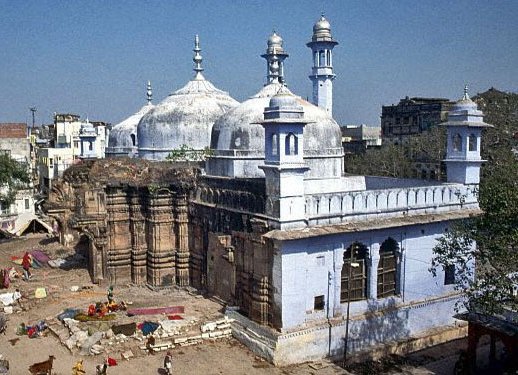
There are various images I could have chosen to represent Islam in India. One could use the Taj Mahal, the ruins of a temple, a mural of a bloody battlefield, Muhammed Ali Jinnah, the beauty of Indo-Islamic art, and so many more images. Islam in India has had a long and complicated history. People have argued till tongues became swords over the impact of Islam on India and its relation to the people. Indeed, one could argue the most lasting impact of Islam on the subcontinent is its partitioning by Jinnah and his cohorts on that fateful day in 1947; when Mahatma Gandhi’s dream was ripped apart in a bloody separation of an ancient people.
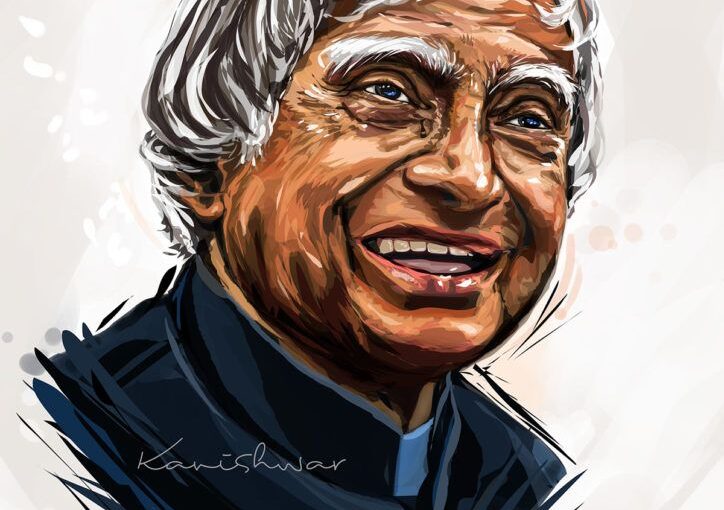
But while this post will examine the past, I want to focus on the now and future of Islam in India. That is why I chose to have possibly the most beloved Indian in history, Dr. APJ Abdul Kalam, as the heading photo for this post. But we will talk more about him and what he encapsulates later; let’s take a look back at the sands of time.
(No) Remorse
Gyanvapi Mosque in Varanasi; Built From Ruins of a Hindu Temple (See Left Side)
I’ll be upfront and say I have an overall negative view on Islam’s past impact on India.
One of the most eminent historians ever, Will Durant, wrote this of the Islamic invasion of India:
“The Islamic conquest of India is probably the bloodiest story in history. It is a discouraging tale, for its evident moral is that civilization is a precious good, whose delicate complex of order and freedom, culture and peace, can at any moment be overthrown by barbarians invading from without or multiplying within.” – The Story of Civilization: Our Oriental Heritage page 459.
History has witnessed monsters that have killed millions – Genghis Khan, Alexander the Great, the Spanish conquistadors of America, etc… – but Durant singles out the hundreds of years long siege of Islam on India as the bloodiest of them all. Millions dead, raped, or forcibly converted. Temples, universities, and entire cities lay in ruin. An indigenous culture repressed and humiliated all because they believed in a different god.
While this image is grave, it’s not what I want you to leave with in regards to India’s Islam. Amongst the carnage and deep darkness that swept the subcontinent, there was light.
Din-I-Ilahi
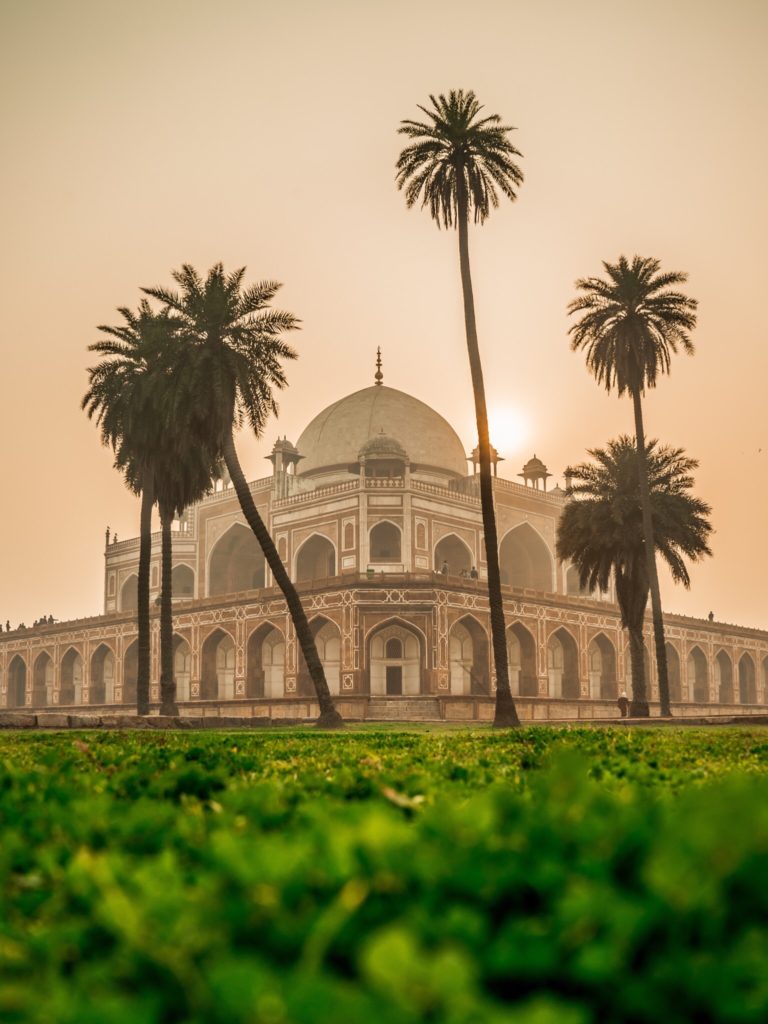
A fusion of Indian, Arabian, and Persian art styles would give birth to they beauty of Indo-Islamic architecture
Islamic rule in India produced great art, literature, opulence, but most beautiful of all – syncretism, the trademark of India. Akbar was one of the first rulers who recognized the underlying similarities between Islam and Hinduism; so much so, that he integrated both religions into his own system – Din-I-Ilahi – or the Religion of God (original…I know).
The Varanasi poet and weaver, Kabir, won the hearts of both Hindus and Muslims. His poetry would be recited till this day as an epitaph to his spirit of spiritual harmony. His musings would change how religion was practiced across North India, including influencing a newly born religion – Sikhism. Guru Nanak would continue Kabir’s compare and contrasting of Hinduism and Islam, while providing his own unique philosophy.