The Price of India’s Soul?

On Great Nicobar, and what integration would actually require

  1. Is the port separable from the township in practice, or only on paper?
  2. Can 229 people hold a veto over a national project? If they cannot, who can?
  3. Does Indian elite capital reinvest at home, and what would it look like if it did?

The Strategic Case

In August 2024 the Public Investment Board, the Finance Ministry body that vets projects with a financial fallout, examined the Great Nicobar proposal brought to it by the Ministry of Shipping. It recorded that the project did not have strategic objectives, and that strategic objectives should be added to it.

They were added. In March 2026 the Ministry of Defence notified the project as strategic. The Hindu has reviewed both the 2024 board documents and the March 2026 records of the Public-Private Partnership Appraisal Committee, the Finance Ministry branch that must clear anything above five hundred crore.

In between, the shipping ministry asked for ₹12,300 crore of viability gap funding. The appraisal committee asked why a commercially viable project required a subsidy, and why the ministry wanted to depart from the funding norms in this case. It also asked how the port would compete with Colombo, Port Klang and Singapore. The funding was refused and the Ports Ministry was told to find the money internally.

Congress Intervenes

Continue reading The Price of India’s Soul?

The Cockroach Takes a Bow

On the CJP, the NEET leak, and the weapon that failed to detonate

1. How much of the patriotic framing was strategy and how much was simply the sincere register of the people who happened to be there?

2. Does the Shaheen Bagh comparison hold? The counter-case is that 2020 and 2026 are not comparable because the CAA was a policy the government wanted and the NEET leak was an embarrassment it did not.

3. Can a satirical formation convert?

Sorting out the Cockroaches?

Every major Indian protest movement of the last twelve years has faced the same attempted execution. Not by baton, though the batons come, and came again on 20 July. The execution is attempted when the state tries to answer the question who are these people? before the movement can answer it. Shaheen Bagh was minorities. JNU was tukde-tukde. The farmers held out longest and won their repeal, and were still, in the telling, Khalistanis with tractors.

It is a sorting mechanism. Once a crowd has been sorted out of the nation, its demands become negotiable in the way that a hostile faction’s demands are negotiable, which is to say not at all.

The Cockroach Janta Party won in large part because Abhijeet Dipke understood this and moved first.

The insult

Continue reading The Cockroach Takes a Bow

The Hindufication of the Indian Bahá’í Community

The Bahá’í community of India hosted this performance in Mumbai roughly around about nine years ago, because 2017 was the sacred bicentenary of the birthday of Bahá’u’lláh.

What’s also interesting is that the prayer is translated into Shudd Hindi, whereas the two languages in the world that get the direct translation from the original Persian and Arabic language of the Writings are Persian, Arabic, and Urdu.

It’s interesting that I don’t know where the Shudd Hindi gets translated from: Urdu, Perso-Arabic or English.

I also got this invite today for this very interesting talk below; K might have some interesting views on the below.

Open Thread – Iran & CJP

I went on Twitter for a bit (I stopped using it) and I was surprised by what’s happening.

The war in Iran seems to be raging and the CJP protests don’t seem to be piping down (yet).

  • What do people think of Sonam Wangchuk?
  • Why doesn’t the Education Minister just resign?
  • The BJP (and especially Modi) have cultivated an aura of invincibility?

I have thoughts but I’ll write on them later on tonight. I commend the Commentariat on VERY high quality exchanges; we don’t all have to agree but when we do so in a calm and measured manner, it yields a lot of fruit.

Also Calvin as captain of the “opposition” is doing after fine job, it’s fairly obviously now that BP is an India-first blog. Pakistan and Diaspora are interesting inasmuch as they impact India’s future, which is bright.

Otherwise, the boundaries of the Sikh Empire essentially map the upper reaches of the Indus watershed. The Sutlej apparently was the Eastern boundary of the Empire.

The Sikh Empire c. 1843 at its greatest territorial extent.

Thoughts on the 5 Point Plan?

I strongly disagree with point 5 since the idea of MP switching is key to political fluidity. Also point 1 feels very iffy; I do like point 3. The Brit in me loves the idea of titles, Upper Houses and MPs having autonomy from their party..

I have no strong views on either 2 or 4.

Eliminator, Not Meritocracy

Calvin has argued that NEET’s meritocracy is a fiction: the exam is cleared through coaching that costs lakhs, tests discipline rather than aptitude, and predicts nothing about the doctor a candidate becomes. 0M-3 answered that a single centralised exam is the one gate a poor student can afford to prepare for, and that the state-run alternatives leak worse (Punjab’s teachers exam, Rajasthan’s SI recruitment).

Continue reading Eliminator, Not Meritocracy

Open Thread: Raga the Martyr?

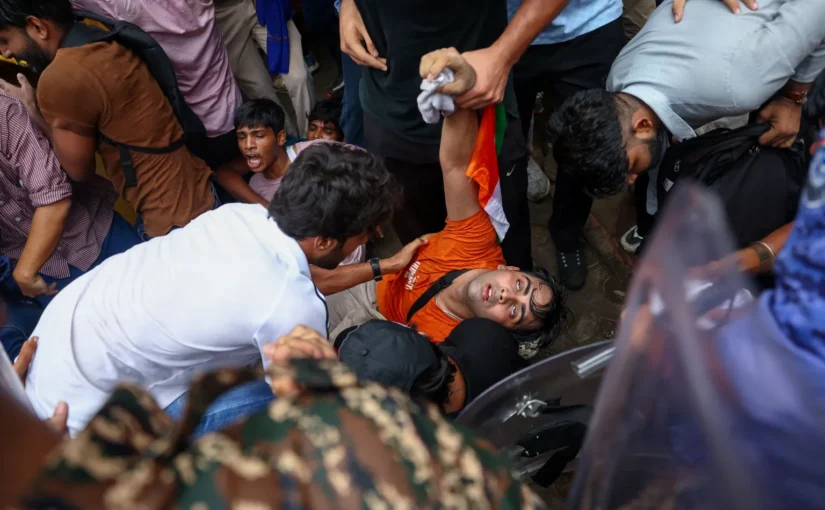
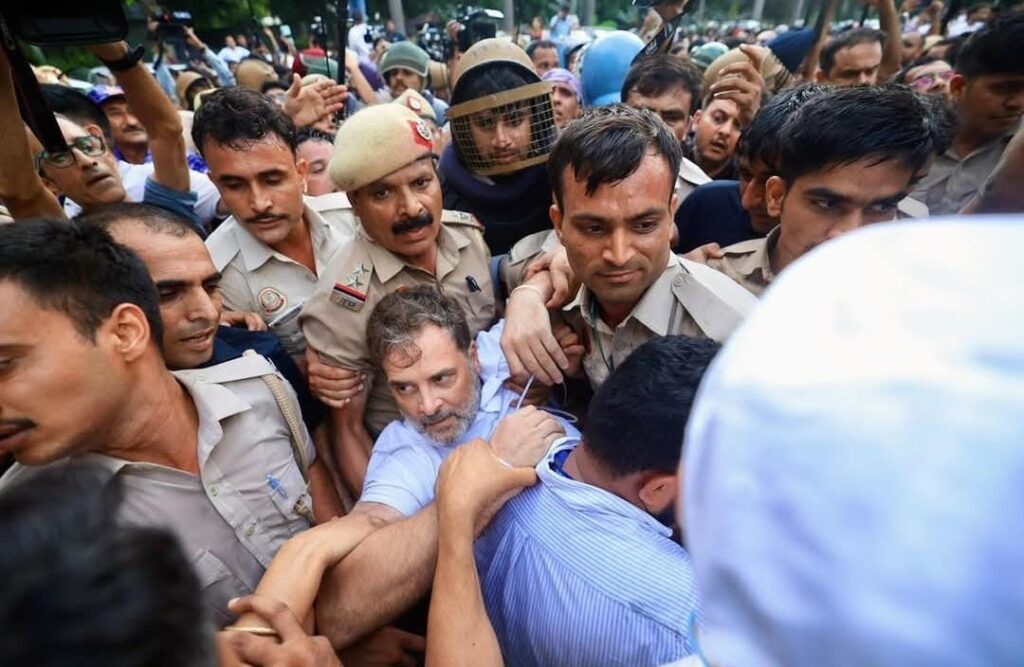
Today July 21 in Delhi. Rahul Gandhi forcefully carried out of the massive student and youth demonstration against the Modi government.

Credit: PB of Sapan News

Best of Bharat

My final event at Delhi was attending the Para Athletes and off.

Team India

It’s quite interesting all the flags of the Commonwealth were there including the Star & Crescent.

Everything about this trip has shown to me what an Indian Superpower looks like.

A soft, but strong, Superpower.

As I walked into the room; the Minister was chant Bharat Mata ki Jha and encourage the room to chant it with him.

And why not; if Divine Blessing can help India, that is Bharat, win as many Gold Medals as possible, then best to holler out Bharat Mata ki Jha.

I’ll end with yesterday’s trip to the Lotus Temple.

Yá Bahá’u’l Abhá

Bharat Mata ki Jha

The Self-Confident Hindu

The Question the Thread Threw Up

Yesterday I asked whether Modi made India great again. The thread beneath it, the liveliest we have had in a while since the discussion on Gender, promptly asked a harder question: is Modi good for the Muslims? It is a fair question and it deserves to be held properly, so let me put two commitments on the table before anything else. Every minority and every people has its rights. And hatred is to be avoided at any cost. Nothing below moves either commitment an inch.

With that said, there is a question beneath the question, and it is the one this post is about. Is a self-confident Hindu a bad thing? Because that, stripped of the slogans, is what this era is actually contesting: whether the majority population of India, indigenous to the land, which did not opt for Partition, and which wrote its minorities in as full citizens, may consolidate its dharma, its mythos, its ideology into a confident and unified global identity.

Britain swears in her seventh prime minister of the decade today; India, one tenure deep since 2014, argues instead about what its majority is allowed to become. I know which argument I would rather be having.

Who Appropriated Whom

“Indians have been appropriating/adopting foreign culture for at least the past 4,000 years.” Q

Adopting, certainly. But appropriating runs the arrow backwards. Did India appropriate the zero (inventor:  Brahmagupta), or give it like it did the “Arabic” numerals? Nalanda drew students from across Asia for centuries; Buddhism, born on Indian soil, remade China, Korea, Japan, Tibet, and Southeast Asia. One of China’s four great classical novels is Journey to the West, and the west in question is India. Columbus was hunting a route to India when he blundered into the Americas.

Continue reading The Self-Confident Hindu

Brown Pundits