How can it be a fair election if the Awami League were banned?
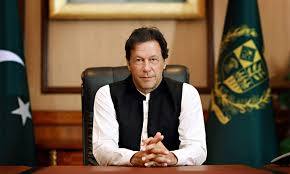
It’s like saying Pakistan is a democracy with Imran Khan still in jail?
The only true democracy in undivided India remains Bharat that is India.
How can it be a fair election if the Awami League were banned?
It’s like saying Pakistan is a democracy with Imran Khan still in jail?
The only true democracy in undivided India remains Bharat that is India.
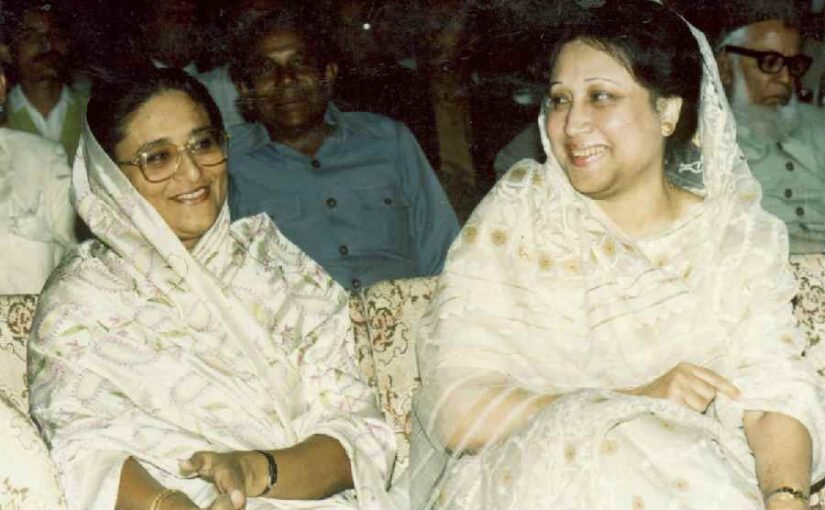
In the tea stalls of Bangladesh, where politics is consumed with the same sugary intensity as the cha, the mood is one of jittery anticipation. For 18 months the country has been a state in parenthesis.
On 12 February that parenthesis would close. Voters will go to the polls in a unique double act: casting one ballot for a new parliament and another in a referendum on the “July Charter,” a package of constitutional reforms designed to prevent the rise of another autocrat.
The election is framed as the culmination of a “Second Liberation,” born of the student-led uprising that ousted Awami League in August 2024 after 15 consecutive years in power.
Observers from the Commonwealth, the EU and other nations are in place; the ballot boxes are ready.
Continue reading After the Begums: Bangladesh searches for a new order
There is something faintly ridiculous about how often educated people insist on using the term South Asia as if it were a neutral, hygienic improvement on an older and supposedly “problematic” word. It is neither neutral nor an improvement. It is a bureaucratic euphemism invented to manage post-Partition discomfort, and it collapses the civilizational reality of the region rather than clarifying it.
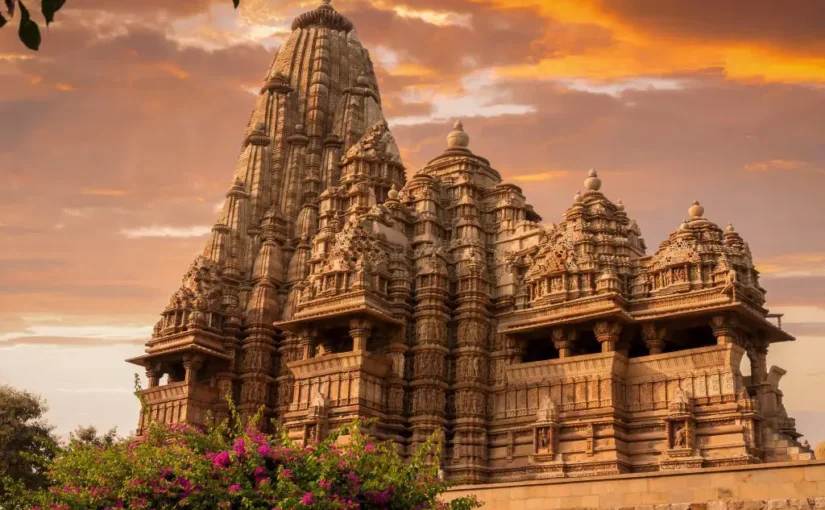
The Indian subcontinent has had a name for millennia. It was called India because it lay beyond the Indus. Greeks used it. Persians used it. Arabs used it. Medieval Muslims, early modern Europeans, and the British all used it. The word survived because it described a geographic and civilizational unit, not because it flattered any modern state. The fact that the Republic of India later adopted the name does not retroactively invalidate its older meaning. Belgium did not abolish the word “Europe,” and Serbia’s existence does not make “European” offensive.
South Asia, by contrast, is not an ancient term misused by a nation-state. It is a late–Cold War academic construction, popularised by American area studies departments that were uncomfortable saying “India” once India no longer meant a single polity. It is a word designed to avoid an argument, not to resolve one. Like “Middle East,” it describes nothing from within the region itself. No one historically lived in “South Asia.” No one spoke “South Asian.” No one cooked “South Asian food.” Continue reading South Asia Is an Ugly Postcolonial Euphemism
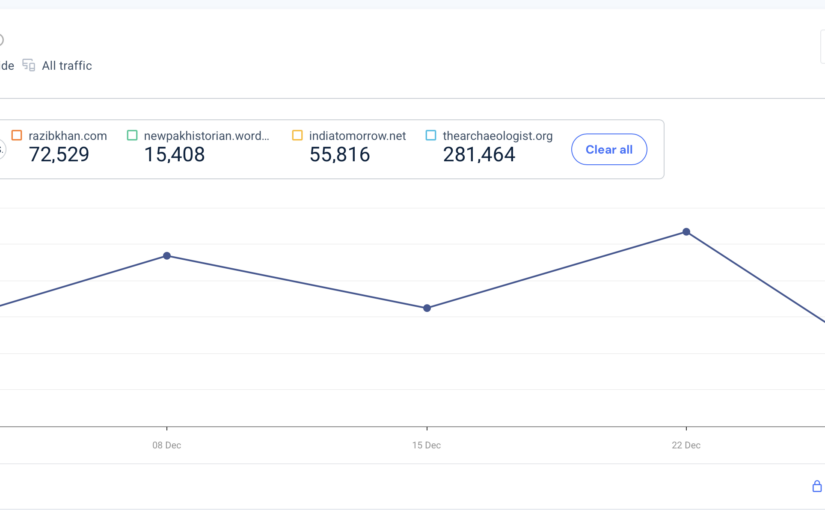
Every few months someone asks whether Brown Pundits is “dying.” I understand the instinct. The internet is littered with abandoned blogs. Attention is fickle. Writers drift. The centre does not hold. And yet, when I actually look at the numbers, the mood often turns out to be wrong.
We had a real dip. In September and October we were running at roughly 55–65k monthly readers. Then we fell hard, to around 33k. This month, we have bounced back to roughly 53k. That is a 60% jump on the trough. A lot of it is mobile. A lot of it is casual readership rather than the old-school desktop cohort. But it is still real people arriving, reading, and sharing.
The geographical pattern is also telling. India and the United States remain the main pillars, as you would expect. But Bangladesh has surged in a way we did not anticipate. That matters because it suggests we are not only a niche diaspora salon. We are also being read inside the region, by people who do not need South Asia explained to them. Continue reading The Demise of Brown Pundits Is Much Exaggerated
We published 76 posts and 1 podcast (Bangladesh) this month.
Traffic fell from ~55–65k (Sept–Oct) to ~33k in November.
However, comment activity remained strong at 819 comments (~27/day).
Another Browncast is up. You can listen on Libsyn, Apple, Spotify, and Stitcher (and a variety of other platforms). Probably the easiest way to keep up the podcast since we don’t have a regular schedule is to subscribe to one of the links above!
In this episode Maneesh Taneja and myself talk to Shaifq ur Rahman and Jyoti Rahman, Bangladeshi academics and scholars with an interest in the current political churn.
I was speaking recently with a cousin who grew up in India. Their family has been Bahá’í for generations, but their older relatives once lived as Sunni merchants in Old Delhi. When they visited their grandparents as a child, they noticed something striking: in many lanes of Old Delhi, long after Independence, the sentiment was not Indian nationalism but Pakistan-leaning nostalgia. This was not hidden. It was ambient.
That single observation exposes something almost no one in Indian liberal discourse wants to say aloud: post-Partition India inherited a large Muslim population whose political loyalties were, at best, ambivalent. That is not a moral judgement. It is a historical one.
And once you notice this, a second truth becomes obvious: Kabir’s secularist vision of an emotionally unified India makes sense only in a world where 1947 never happened.
Continue reading The Partition of Elites: India, Pakistan, and the Unfinished Trauma of 1947
On Nivedita & Archer’s joint request (Mamnoon/Tashakor/Merci for the kind words); I’m going to expand on my comment:
“Kabir is definitely right. Ethnicity in Pakistan is complex; there are three tiers of society. The English speaking elite (Imran is part of that so is Kabir), who are “Pakistanis” and ethnicity isn’t really reflected on…”
This comment, which the BP archives have tons of similar posts on (BP was venerable even in 2014), sketches the bones of Pakistan’s sociological map. But what lies beneath the skin?
Pakistan is feudal; India is not.
That one statement alone explains much. Landholding elites dominate politics, rural economies still function on patronage, and class mobility is rare. Caste, though “denied,” is real and sharper, in some ways, than it could ever be in India (the reservation system does not really exist in Pakistan except for religious minorities but not for socio-economic castes). Pakistanis can sniff out class in one another with a dexterity that’s probably only matched in the United Kingdom, which is the home of class stratification (I remember reading Dorian Gray in Karachi in the early millennium and shocked how similar late Victorian early Edwardian England was).
The postcolonial state froze itself in amber. There has never been a serious leftist rupture, excepting 1971’s successful Bengali revolution. Even Imran Khan, who styled himself a reformist, is a product of elite schools, Aitchison College, Oxford, and aristocratic lineage. His “Islamic socialism” was only ever viable because Pakistanis still believe in myths of the benevolent landlord.
And yet, Pakistanis sometimes seem happier than their Indian counterparts, even if not remotely successful. Why? Continue reading Pakistan’s Inner Logic
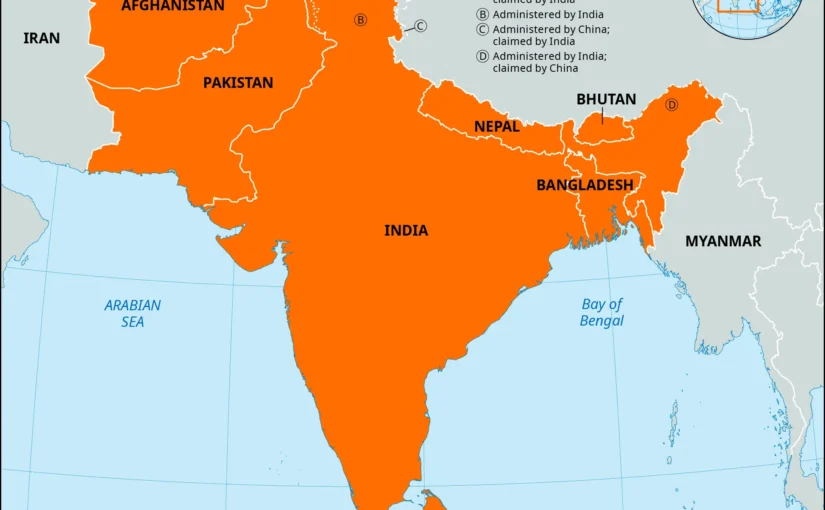
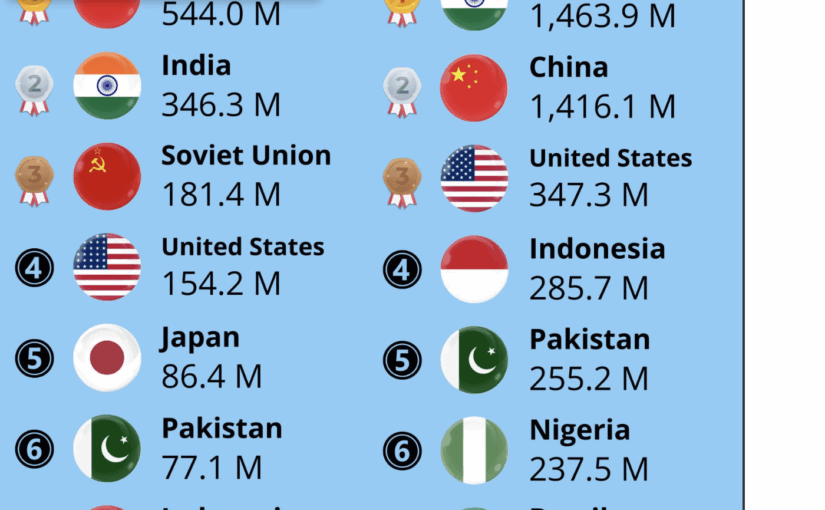
South Asia’s demography is one of the great untold stories of the modern world. Too often we look at the subcontinent through today’s partitions — India, Pakistan, Bangladesh — but the real insight comes when we view the region as a single whole. Across 125 years, the balance of populations has shifted dramatically.
📊 1900: A Baseline
At the turn of the twentieth century, Muslims made up about 20% of undivided India’s population. The rest were overwhelmingly Hindu, with significant Sikh, Christian, Jain, and other minorities.
📊 1950: Partition and Realignment Continue reading The Changing Demographics of Undivided India (1900–2025)
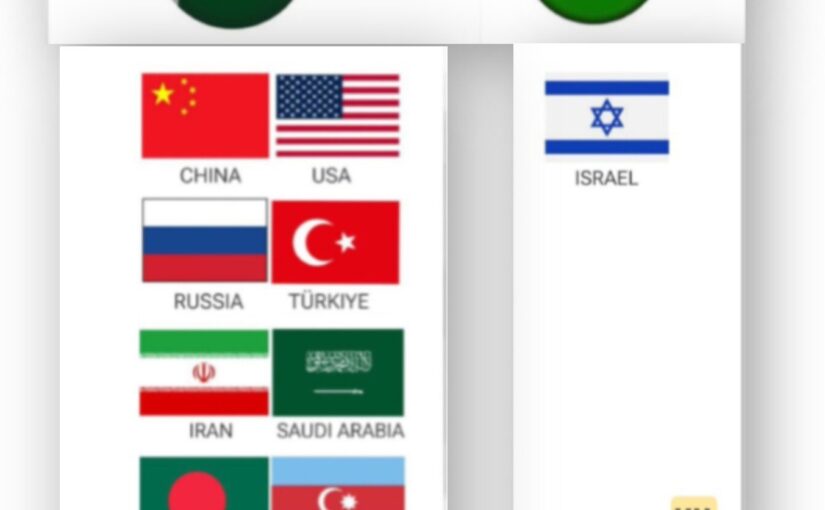
The chart above lays out “strategic partners” for 2025. Pakistan lists China, Türkiye, Iran, Saudi Arabia, and assorted others. India, by contrast, shows Israel. But the real issue isn’t who collects more flags; it’s whether any of Pakistan’s patrons will ever raise its HDI, improve infrastructure, or embed long-term stability.
I’m interested to hear what the commentariat thinks of this moment. India’s foreign policy is already locking it into superpower status. Pakistan remains reactive, borrowing survival from whoever will lend it.
The analogy that strikes me: India–Pakistan resembles Russia–Ukraine, except if Ukraine had kept nuclear weapons. The parallels are strong:
Ukraine, like Pakistan, is a breakaway sibling — the “other half” of a civilizational whole.
Ukraine, like Pakistan, survives by appealing to larger patrons.
And interestingly, the GDP ratio gap between Russia and Ukraine is almost exactly the same as between India and Pakistan (please fact check me).
Just as Ukraine is considered the homeland of the Russian Empire (Kievan Rus’), Pakistan carries the legacy of Partition as the “Indus homeland.” That symmetry makes the analogy more than superficial.
On Kabir: I understand his consistent emphasis on Muslim rights and Muslim nationalism. Readers should be aware of that lens. I’m not moderating him out, but I would caution the commentariat against being gaslit into endless provocations by Kabir. The question here is not identity politics, but the direction of Indian and Pakistani foreign policy in a critical moment in global history (decades are happening in weeks).