đŸȘ™ What’s in a Name? Mukesh, Not Mukash.

While reading Brad DeLong’s fascinating newsletter on centi-billionaires and political power (I’m going to ignore Elon’s self-imploding stunt), I noticed something that jarred me more than it should have: Mukesh Ambani’s name was misspelled as “Mukash.” A minor slip, perhaps. But it was the only error in a list that included Bernard Arnault, Warren Buffett, and Michael Bloomberg—men whose names command a certain global familiarity.

What does it say that even after spending nearly half a billion dollars on a wedding for his son, India’s wealthiest man doesn’t merit a spellcheck? It says a lot.

🧠 The Chimera of Respect via Capital Continue reading đŸȘ™ What’s in a Name? Mukesh, Not Mukash.

💔Sana Yusuf Did Not Have to Die

The Pakistani Crisis Is Not Just Legal—It’s Civilizational

By X.T.M

As I write this, the news of Sana Yusuf’s murder is barely 48 hours old. A 17-year-old TikTok creator with over a million followers, she was gunned down in Karachi by a 22-year-old stalker. She was a rising star—funny, expressive, beloved. And now, she is dead.

We’ve been here before. Qandeel Baloch. Noor Mukadam. Khadija Siddiqui. Now Sana.

Every few years, Pakistan reels in collective shock at the killing of yet another woman by a man convinced of his right to possess, control, or erase her. And every time, some voices insist “this is not our culture.” But what if it is?

📍Not an Anomaly—But an Outcome

Sana’s murder is not an aberration. It is the predictable consequence of a society structured around honor, control, and male entitlement. Patriarchy in Pakistan isn’t just cultural—it’s systemic, generational, and fiercely defended. Continue reading 💔Sana Yusuf Did Not Have to Die

The Elder Race and the English-Speaking Heat

As I write this from Dublin, waiting to board my connecting flight—I’d nearly missed it in Newark, too absorbed in writing to hear the gate call—I’m struck by how a Euro sign or EU flag can alter one’s sense of place. Technically, I’m still in the British Isles. But culturally—unmistakably—I’m on the Continent. A sensation I never quite feel in England.

It’s a strange feeling, this flicker of European belonging. In the early millennium, I was a passionate Brexiteer—young, angry, seeking change. By the time of the referendum, a decade later, I found myself morally conflicted. I knew the EU was not a good fit but as a Bahá’í, I knew I could never advocate for disunity, of any sort. I abstained. Ironically, Commonwealth citizens could vote, but EU nationals couldn’t—a bit of imperial gatekeeping that deeply irritated my liberal British-Irish friend. (“Why can Indians vote, but not the French?” he asked.)

Today, standing in Europe, I feel the contrast sharply. The Continent is genteel, even decadent, locked into postwar consensus. Meanwhile, the English-speaking world feels like it’s on fire—politically, culturally, psychologically. It’s not just the UK or the US. India, too, belongs to this hot zone of rhetoric and reinvention. Pakistan, by contrast, while elite-driven in English, remains emotionally and socially an Urdu republic. Continue reading The Elder Race and the English-Speaking Heat

Merit, Class, and the Ossified Dream

Dispatch from Newark Airport

By X.T.M | Acting Editor, Brown Pundits

I lost my train of thought earlier, but I’m back now, writing this from Newark Airport, awaiting a flight back to the United Kingdom—then onward, as they say, to the old, old world.

What I’d begun to reflect on was social mobility—and how drastically it’s shifted over the past few decades. In much of the Global South, the idea of a working-class avant-garde—those who rose through grit, communal aspiration, and sacrifice—still retains cultural force. But in the Global North, that current has largely dissipated. Class structures have ossified. The ladder still exists, but the rungs are brittle.

I’ve been mapping that reality onto the commentariat, especially the highly educated, striving upper-middle-class Hindus who have, for the most part, embraced the system—IITs, IIMs, Oxbridge, the Ivies. These are not just institutions; they’re rites of passage. For many, the peak came at the point of entry. Twenty years on, what remains is not expansion, but a formula—one track, one ceiling. Continue reading Merit, Class, and the Ossified Dream

Denial Isn’t Just a River in Egypt—It’s a Dammed Indus Too

By X.T.M | Acting Editor, Brown Pundits

“Qureshi” has glibly informed me that caste doesn’t exist in Pakistan, and that had I not deleted his comment, I would have seen his thoughtful explanation on why his ancestors would (or wouldn’t- tough to follow) have “embraced caste.”

Let’s address both claims.

I. Denial, and the Geography of Amnesia

First: the deletion. The reason I removed Qureshi’s comment was simple—it referred to “when the Hindus left Pakistan in 1947.” As if they left. As if it were a long vacation. That turn of phrase is emblematic of a deep, disturbing historical erasure—a civilizational amnesia that’s not just inaccurate, but actively offensive.

To phrase the violent dislocation of millions as “leaving” is a textbook case of internalized Hinduphobia—a posture so normalized in Pakistani elite discourse that it barely registers as cruelty.

This is not about word policing. It’s about confronting the inherited violence buried in euphemism. Continue reading Denial Isn’t Just a River in Egypt—It’s a Dammed Indus Too

Is It Indian Culture or Hindu (Brahmin) Culture that creates excellence?

On Faizan Zaki, Spelling Bees, and Civilizational Osmosis

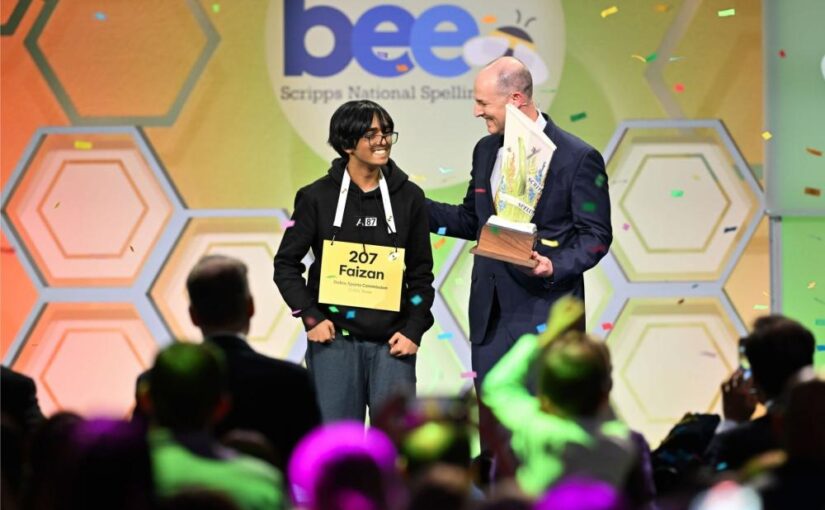
Another year, another Spelling Bee crown for an Indian American. But this one, the 100th Scripps tournament,  is different.

Faizan Zaki—young, brilliant, and by name Muslim—just became the latest in a long line of Indian-origin champions of America’s most idiosyncratic intellectual ritual. Faizan is the 32nd Indian American to win—meaning they’ve claimed 32 out of the last 40 Spelling Bees. But he is very likely the first Muslim American to do so.

Which raises an old but essential question: Continue reading Is It Indian Culture or Hindu (Brahmin) Culture that creates excellence?

Flame Thread Protocols: Honey Kabir

A Note from the Editor

Flame thread warning: Honey vs. Kabir.

Last night’s open thread surged past 50 comments—most of it orbiting the now-familiar friction between the two.

Let me be clear: I’m inclined toward Kabir. He’s often overwrought, sometimes hyperbolic, but he’s a known quantity. He’s been part of this space for nearly a decade. He is a “real person.” We know how he argues, where he lands, and the limits of his provocations.

Honey is harder to read. Multiple handles. No clear background. No track record. And a rhetorical posture that feels less like engagement, more like carpet bombing—especially when it comes to Pakistan. There’s a difference between critique and hatred, and it’s usually in the tone. “Pakistanis under-endowed”—LOL, happy to disprove that.

Moderation is evolving. I no longer think of it as refereeing an online debate. I think of it like hosting a discussion in my living room. That means: Continue reading Flame Thread Protocols: Honey Kabir

Jet Lag: India, Pakistan, and the Theatre of the Air

Since the commentariat can’t resist a good Indo-Pak exchange—especially when it involves fighter jets—here’s a fresh contribution to the theatre. Personally, I’m much more interested in Concord cafĂ©s and JD Vance’s selective memory, but one must feed the algorithmic gods. So here’s what S. Qureishi gleefully shared:

A day after Subramanian Swamy accepted 5 jets were down in a Hindi interview, Indian CDS Gen Chauhan accepts jet losses in the recent encounter to Bloomberg. What’s more he accepted that the Indian planes did not fly after May 6-7 and were grounded,

Take that as you will. Fog of war, political spin, or just belated candor—either way, the skies are louder than the silence.

As an aside, I’ve always found Pakistani commentary on India—the civilizational motherland, however estranged—to be oddly fixated. It’s like staring into a mirror with the lights off.

Anyway—comment away, and please play nice. After all, xperia2015 has author privileges and can selectively void what he likes.

“A Foreign Class of Servants” — JD Vance and the Great American Amnesia

Vice President JD Vance recently declared that America doesn’t need to “import a foreign class of servants” to remain competitive. “We did it in the ’50s and ’60s,” he said. “We put a man on the moon with American talent. Some German and Jewish scientists who had come over during World War two, but mostly by American citizens.”

The line is memorable—not for its nationalism, but for its breathtaking amnesia.

The moon landing was not the product of some closed, white-bread meritocracy. It was powered by German engineers, Jewish refugees, and immigrant scientists—many quite literally “imported.” Wernher von Braun, the face of NASA’s rocket program, was a former Nazi, repurposed by America for its Cold War dreams.

Today, the immigrant pipeline Vance sneers at includes his own in-laws—his wife’s parents, Indian-born academics. I’ve highlighted this problematic tendency before. They weren’t servants. They were scholars. Like hundreds of thousands who have powered this country’s universities, tech firms, hospitals, and labs. America doesn’t run on pedigree. It runs on brains. And yes, those brains often have accents.

America First doesn’t mean America stays first Continue reading “A Foreign Class of Servants” — JD Vance and the Great American Amnesia

Brown Pundits