The Crescent has a sharp edge

Context in BP is cumulative, mes amis.

As we know, certain members of the Crescentiate remain emotionally invested in Pakistan, and certain members of the Saffroniate respond by undermining Pakistan. Neither tendency is a criticism in itself, we try to keep as few Shibboleths as possible in BP.

As an aside the Crescentiate are “Zionesque” (or perhaps more appropriate Jinnahesque) in the sense of preferring Pakistan to Islam.

What is a criticism is repeatedly reaching across that line, eliciting the predictable reaction, and then presenting oneself as the neutral party once it arrives. This is a small community with a very long memory. The personality maps build over time, and we remember who did what first.

The Crescentiate, with whom Sbarrkum is aligned, correctly called Iran the victor in this year’s confrontation with the United States and Israel, a reading the Saffroniate has refused to grant. We deeply dislike the regime but acknowledge that its valiant defence of the homeland may augur new glimmerings for the Ummah (we are who we imagine ourselves to be hence why psych warfare is so dangerous).

Getting Indian Classical Music Wrong

For instance, to tell our resident ethnomusicologist, an academic at Pakistan’s top university (Ivy+ crawls with LUMS researchers), that his field is entirely Hindu is ahistorical. Lest we be accused of green-washing, we prefer the Indian Continent be called Jambudvīpa.
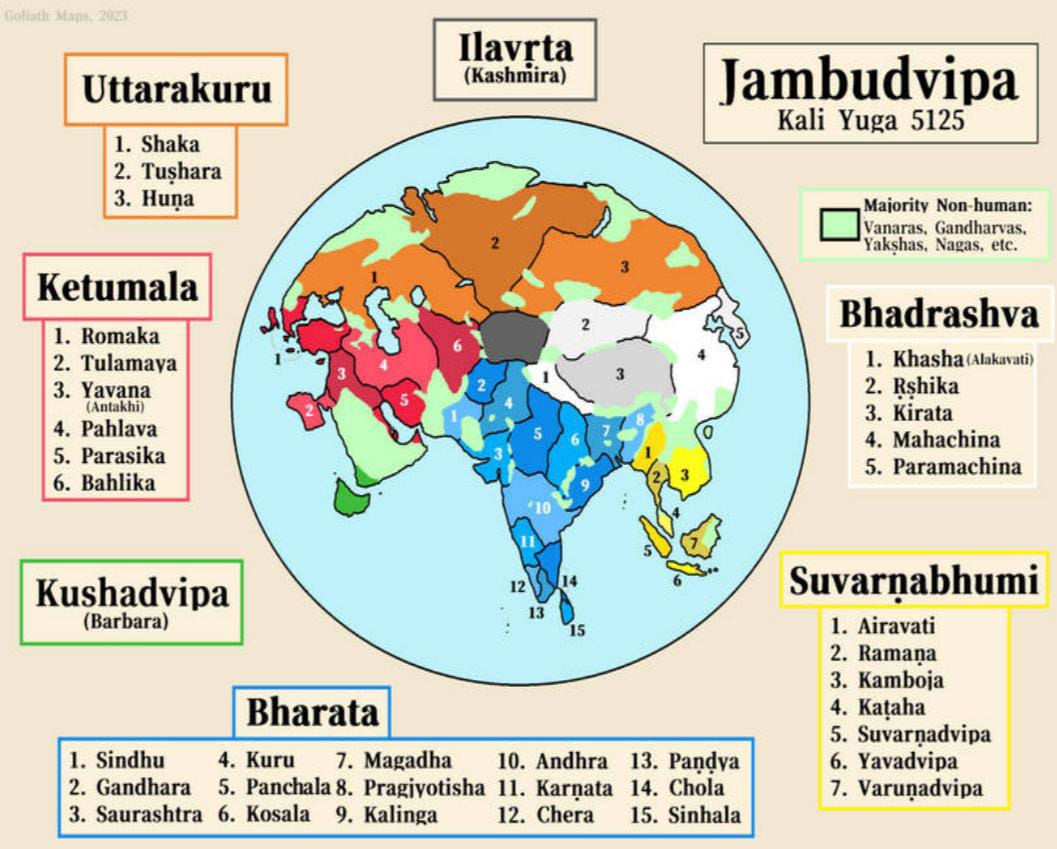
Let's dive into the forgotten map of the ancients - Jambudvipa as described in our Puranas & Itihasas. This isn't just geography, it's cosmic cartography: mapping realms of humans, Devas, Nagas, Gandharvas

But we are also appreciative of historical truth: all major khayal gharanas have Muslim founders, converts or otherwise. Islam has long since moved past the mawali stage.

Imam Bukhari, compiler of Sahih al-Bukhari and the most authoritative hadith scholar in Sunni Islam, had a great-grandfather who was a Zoroastrian convert and mawla of the Banu Ju’fa.

So when someone is triggered, we will look to understand whether the trigger is justified, and what “triggered” the trigger, before acting.

Parliament at her Best:

Remember this is Parliament. And in Parliament, the curious thing is that members of opposing benches are often more cordial with one another than they are with members of their own party. The hostility you see across the aisle is theatre. The knife-work happens at home.

We moderate by nunchi, not by formula, encouraging congeniality both within and across the benches.
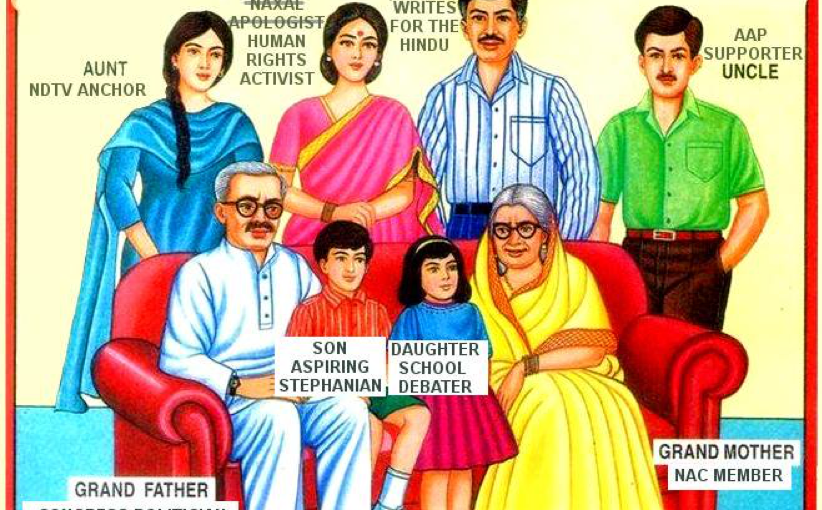
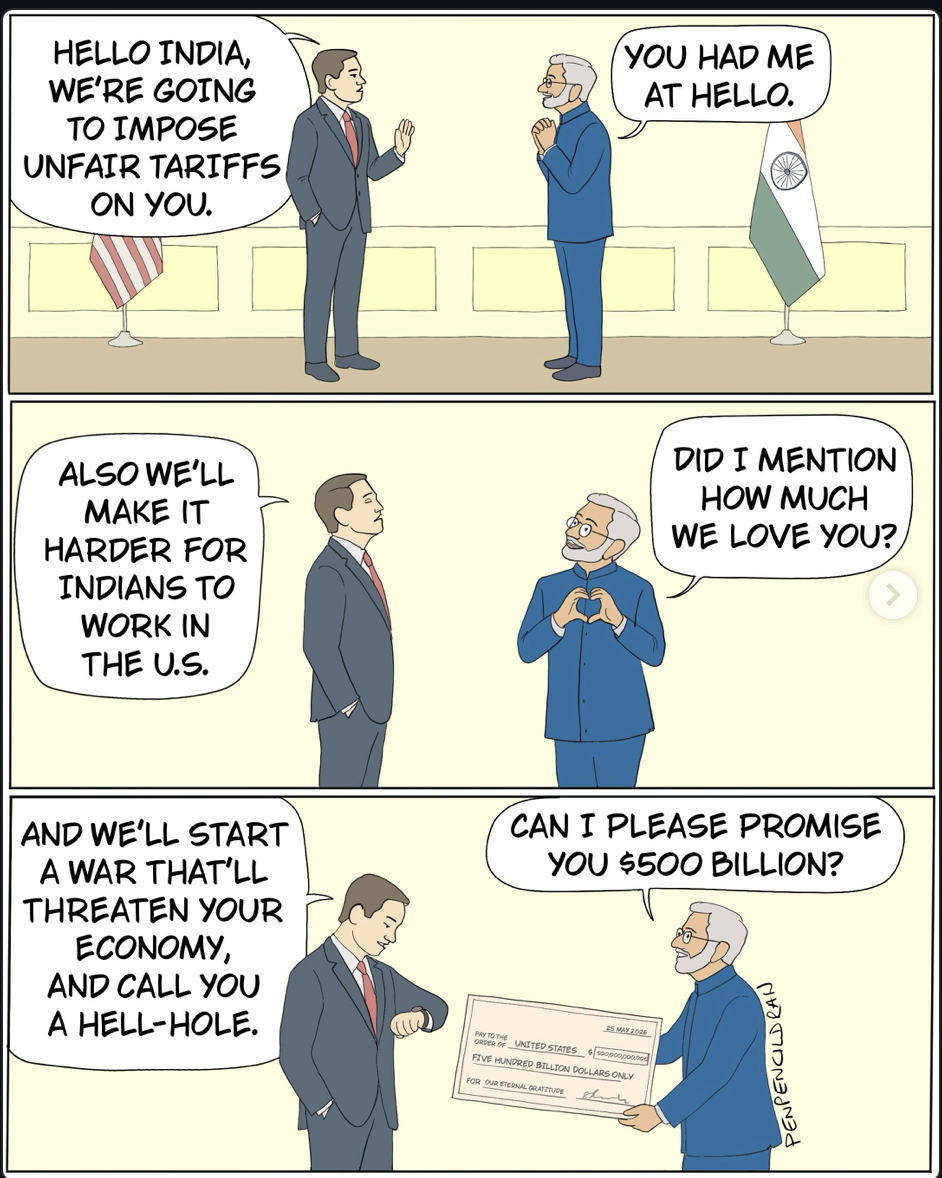
Mocking Modi Is the Only Nationalism Left-Liberals Know

A Trump-coded American (a mix of JD & Rubio) imposes tariffs, restricts H-1B work, threatens war, calls India a “hell-hole.” Modi, eyes lowered, hands folded, writes a cheque for five hundred billion dollars. The signature reads penpencildraw, a left-liberal account. The Instagram account is run by urban anti-Modi liberals who, on most other days, want a poorer, slower, more Nehruvian India.

Continue reading Mocking Modi Is the Only Nationalism Left-Liberals Know

Mardana’s Children: The Rababis of Lahore (Short Film)–Kabir’s Open Thread

I don’t want to post too much in one day but this short film is worth sharing. On BP, there is a lot of focus on the negative side of Pakistan (understandably since this blog’s commentariat is mostly Indian nationalists and of a “Saffron” persuasion). Often, I feel that this commentariat finds the very existence of Pakistan personally offensive.  

This film serves as a counter to that discourse. 

A short film on the Rababis of Lahore, a community of Pakistani Muslim musicians with deep-rooted ties to the Sikhs by way of a centuries-old music tradition. Mardana’s Children traces the current descendants of Bhai Mardana (the 15th century musician and disciple of Guru Nanak), piecing together a story of shared devotion across India and Pakistan, traversing the modern boundaries of religious and nation, and highlighting the unifying power of music in the face of the divisive legacy of identity politics and the partition of 1947.

Disclosure: I know one of the producers (Kirit J Singh) from SOAS where he was doing a Phd on Sikh Music.  My father facilitated one of Kirit’s research visits to Lahore.

A useful piece to accompany this documentary is Arieb Azhar’s essay “Soundscape: When Punjab Sang as One” published in yesterday’s DAWN.

Finally, I would like to share a clip of myself performing the Shabad “Suraj Kiran Milay”. This shabad was composed in Raga Darbari by Ustad Hamid Hossain.


Nehru Lost India, Not Jinnah

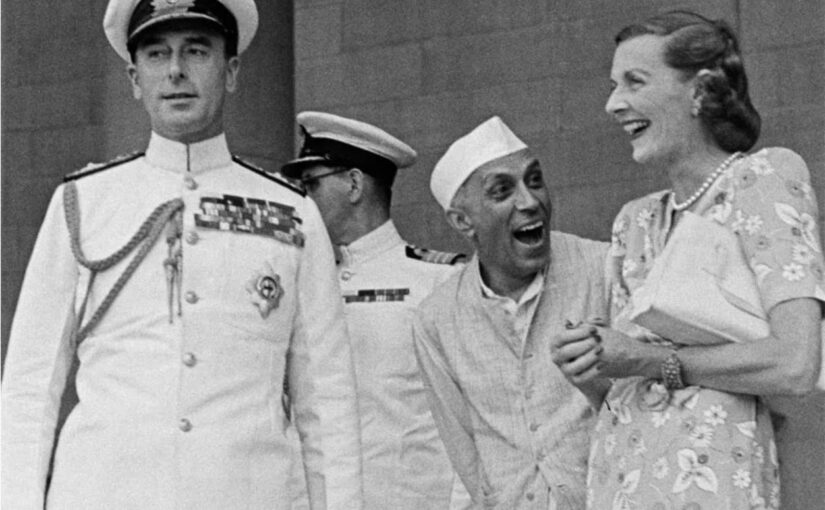
We write this from the chair of those who have just declined, again, to partition their own blog. The exercise concentrates the mind. Brown Pundits has a Saffroniate. It has a Crescentiate. It has an awkward intermediate seat between Viceroy and Prime Minister. We have chosen, repeatedly, to hold the centre.

We have observed that Nehru did not.

1. The Men.

Jinnah was self-made. He was technically brilliant. He was legalistic to the point of pedantry, which is the only kind of legalism that ever wins a constitutional argument. Nehru rode on his father’s coattails, on Gandhi’s affection, on the Mountbattens’ hospitality.

The asymmetry was decisive. One man knew the document. The other man trusted the room.

2. The Cabinet Mission Plan.

The Cabinet Mission Plan of 1946 already confederated India. Grouping A, Grouping B, Grouping C. The Centre held defence, foreign affairs, communications. Everything else devolved. This was workable. The League accepted it provisionally as the best available route to parity. Nehru wobbled, then in his July Bombay press conference reserved the Congress right to revise the groupings once seated in power. The League withdrew within weeks. The edifice collapsed.

The question the Saffroniate refuses to ask is the simple one. Why was it harder to confederate on linguistic lines than on religious lines? The States Reorganisation that the Republic executed in 1956 was already latent in 1946. Madras Presidency was a Tamil, Telugu, Malayalam, Kannada tinderbox. Bengal was Bengal. The Indus was the Indus. The Hindi belt was the Hindi belt.

Four groupings could have been negotiated. Continue reading Nehru Lost India, Not Jinnah

The Ministry of Utmost Happiness: A Look into the Underbelly of Modern India

Since we are being encouraged to look at the seamy side of each other’s societies (see BB’s post on child sex abuse among British Pakistanis), I am sharing this review of Arundhati Roy’s novel The Ministry of Utmost Happiness.  Ms. Roy is one of India’s greatest public intellectuals.  

Also see my review of her memoir Mother Mary Comes to Me

Ever since The God of Small Things was published to great acclaim in 1997, Arundhati Roy’s fans have been eagerly awaiting her next novel. It was a long wait—two decades—as Roy transitioned from being a novelist to being an activist and a non-fiction writer. Now, the wait has finally ended with the publication of The Ministry of Utmost Happiness.

The novel focuses on several characters, most of whom are outcasts from the new rising India. They include a hijra named Anjum, a Kashmiri separatist (or freedom fighter) named Musa and Tilottama, the Malayali woman who loves him. Over the course of the novel, these disparate characters encounter one another and their stories intersect, sometimes in surprising ways. Continue reading The Ministry of Utmost Happiness: A Look into the Underbelly of Modern India

Caste & British Pakistani Grooming Gangs

Admin Note: this thread was permitted and indeed encouraged. We hold that every community benefits from examining its own shibboleths. Members of the Saffroniate are accordingly asked to state their caste identity, and the privilege attendant on it, before participating in discussions about their Achilles heel. Intellectual honesty requires such disclosure to precede the argument.

Pakistan and North India

Pakistan is more “North Indian” than India. India has a much greater chunk of North India, both by area and population but it has a much bigger non North Indian population which changes the overall nature of India. Pakistan doesn’t so it remains steadfastly North Indian – in culture, language, food etc.

One of the side-effects of this is that Pakistan views India through the North Indian lens.

And while Pakistan is diverse in its own right, Indian diversity is orders of magnitude higher – in terms of race, language, culture, religion etc. India is a continent as a country. You could call it a “subcontinent”. Continue reading Caste & British Pakistani Grooming Gangs

Aasiya (Translation from the Urdu)

I’m sharing another translation of an Urdu short story from Bilal Hasan Minto’s Model Town.  There has been a lot of discussion on BP recently about gender dynamics in Pakistan and this is relevant in that context. 

There are people who might have felt the neighborhood was against Apa Sughra just like that, without a reason. They could have wondered how anyone could be against a woman so devout that she had fired her cleaning lady Alice on a matter of principle when she found her drinking water from glasses reserved for Apa Sughra’s Muslim household. A woman so righteous that she had summarily dismissed Susan because her husband supplied alcohol to a Muslim. But such people who question our hatred of Apa Sughra are ignorant of the facts.

We had not always been against her. When she rented the house next door, Ammi sent her both meals that first day because her kitchen wouldn’t be ready. So obviously, we hadn’t hated her from the very beginning. Quite apart from all the terrible things we found out later, what she did to her own daughter Pari, soon after moving to our neighborhood, was enough for us to condemn her, vilify her, and treat her with hostility. Pari was not at all to blame for the incident. Whoever heard of it said “What did the poor girl do wrong?” Naveed Bhai had been really angry and said Apa Sughra needed to be taught a lesson but Ammi strictly forbade him, saying there was no need to mess with that witch. It’s a different matter that I suspected Naveed Bhai didn’t have any way to do anything to Apa Sughra even if Ammi hadn’t said so. I thought he was just boasting.

Ever since Apa Sughra began living in our neighborhood we had noticed she didn’t allow her twin daughters, Fari and Pari, out of the house at all. Meeting us was out of the question; they weren’t even allowed to play with the neighborhood girls. We always thought the poor things were locked in the house after school. What did they do all day? Did they play with each other or was that not allowed either? And if they were so constrained, why did Apa Sughra even send them to school? Why was she educating them? Continue reading Aasiya (Translation from the Urdu)

Open Thread: Mother Indus is on Fire

The Commentariat on the “Long Night” has been busy. The Saffroniate counts Hindu babies, the Crescentiate counts Muslim babies, both sides argue with conviction over a future neither seems to have read the Weather Report for.

A heatwave advisory graphic maps much of Pakistan’s plains into extreme-risk zones for the final week of May 2026. Jacobabad, Multan, Bahawalpur, Sukkur, D.G. Khan and Sargodha sit in an extreme zone marked 47 to 50°C. Lahore, Faisalabad, Rawalpindi, Peshawar and Islamabad sit in a high zone at 42 to 45°C. Karachi, sea-cooled, stays at a relatively merciful 35 to 38.

The Indus does not read Radcliffe. The Punjab that cooks at 45°C on the Lahore side is the same alluvial plain that sears the Amritsar side. The Thar runs through both Sindh and Rajasthan. The Gangetic plain inherits the same dome of heat a fortnight later. The cradle of Desidom that the Commentariat are fighting over, will soon turn into a Heat Dome. Conversations on who fills it faster, who outbreeds whom, ultimately elide that Radcliffe drew a paper line. The thermometer does not pause at Wagah.

What It's Like Living in One of the Hottest Cities on Earth—Where It May Soon Be Uninhabitable

Continue reading Open Thread: Mother Indus is on Fire

Deepa Mehta as Auteur

Continuing on from my essay on Indiana Jones and Bride and Prejudice,  I am sharing another essay related to film. This piece was originally written for an Intro to Film Studies course at George Washington University.  I am sharing it here since it is related to South Asia and makes the case that Deepa Mehta is an auteur. 

In his 1954 essay “A Certain Tendency in French cinema”, the founder of auteur theory, French filmmaker Francois Truffaut, argued passionately against the “Tradition of Quality” which privileged the work of the screenwriter who created adaptations of literary works. Truffaut believed that films should reflect the creative vision of the director, as if he or she were the primary author, or auteur. In his view, all good directors have such a distinctive style or consistent theme that their influence is unmistakable in the body of their work.

Traffaut’s theory was popularized in the United States by Andrew Sarris. In his article “Notes on the Auteur Theory in 1962”, Sarris proposed a sort of scientific definition of the auteur. He compared his three criteria to a set of three concentric circles. The outermost circle corresponds to technical capability, the middle circle to personality and the innermost circle to interior meaning or “elan of the soul”.  In Sarris’s view, it is only when a director’s work satisfies all three criteria that he or she can be considered an auteur.  This theory was critiqued by film critic Pauline Kael in her essay “Circles and Squares.” Kael disputed the notion that the great director must be technically competent. She also criticized the concept of “elan of the soul” arguing that it was mere mystical mumbo jumbo.

In this essay, I will discuss the work of the Indian-Canadian director Deepa Mehta in the context of Sarris’s definition of the auteur and its criticism by Kael. I will draw my examples from Mehta’s “Elements Trilogy”, which consists of the films Fire (1996), Earth (1998) and Water (2005). All three of these films were both written and directed by Mehta and reveal her substantial influence on the work. They also deal with similar themes, depicting various moments in Indian history and focusing on oppressed groups and on women’s issues. In all three films, one can sense that Mehta is clearly aligned with the oppressed. Continue reading Deepa Mehta as Auteur

The Diaspora Saved The Mullahs. Pahlavi Helped.

Farhad’s thesis, delivered without prompting:

during the Woman Life Freedom protests, the Islamic Republic appeared more vulnerable than at any point in a generation. Women had started it, men had joined, opposition-minded Iranians inside the country felt the floor shifting. Then Pahlavi stepped forward, declared himself the advocate of Iranians, launched his petition, and pulled the diaspora’s attention outward at the exact moment Iranians on the ground needed it inward. He picked the wrong time. He saved the IRGC.

The Royal positioned as the alternative to the regime is the man Farhad blames for keeping the regime alive.

We are not endorsing this view. We are reporting that an Iranian who follows the country obsessively, who rallies behind Pahlavi today as the best of bad options, still holds him responsible for a historic missed moment. That is a serious accusation from a sympathetic source.

The Court In Exile

Continue reading The Diaspora Saved The Mullahs. Pahlavi Helped.

Brown Pundits