Carolina Almeida, a philosopher, internationalist, and political scientist, shared that as children, they are raised with the understanding that the farther they are away from Blackness, the greater the person they are going to be.
She says, âSo, identifying as a Black woman or as a Black man in Brazil is a great step, actually a great social and, also, emotional step to be achieved, because we are constantly being persuaded by everything around us that being Black is bad, itâs ugly, itâs not interesting.â
Earlier tonight, Dr. V and I decided to go out spontaneously for dinner in Boston. At the first restaurant, the hostess, polite but prim, told us the wait would be about an hour. Fair enough, it was busy. At the second restaurant, something felt off. The hostess, looking somewhat wary, directed us to the bar, insisting there were no available tablesâeven though several were clearly open. We werenât the customers they wanted. Rather than argue, we left.
At the third restaurant, we were seated immediatelyâno questions, no hesitationâby a cheerful, welcoming hostess. It was only later that I realized the difference. The hostesses at the first two restaurants had both been white, while the one who seated us without issue was Asian American. The contrast was undeniable, and the pattern became clear: access was subtly controlled based on how we were perceived. It reflected how colorism worksâquietly but unmistakably shaping who is welcomed and who is turned away.
Iâve written before about experiencing subtle discrimination in Boston. And while Iâm usually one to complain when things are off, I didnât make a fuss this time (I understand how these situations can escalate, and confronting the second hostess wouldnât have ended well, she would have brooked no dissent over her dictactes). Plus, honestly, I canât get too worked up about food in the U.S. These days, something just feels wrong about the ingredients, and the value-for-money equation is off, especially in New Englandâs food scene, which Iâve covered before.
This whole experience feels like a meditation on the evolving concept of whitenessâa category that has become increasingly easy to join. But while whiteness might be flexible, there remains a rigid, impenetrable spectrum of colorism within it, not unlike traditional caste systems.
Earlier, while I was trying to buy sunglasses, I noticed two Persian girls nearby, also browsing and chatting in Farsi. Even though they had likely only been in the U.S. for a few years, I could see they were already fitting into the “ethnic white” category. Despite sharing the same cultural heritage (I’m fluent in Farsi), it felt like we were on different sides of the ethno-cultural divide.
As the U.S. shifts from a binary racial nationstate to a more complex, multi-national Imperiumâsimilar to South Asia or Latin Americaâthese subtler forms of exclusion become more visible, yet harder to challenge.
Vimal Yoganathan, South Asian Representation, and Footballâs Unspoken Racial Hierarchies
Vimal Yoganathan’s debut for Barnsley, highlighted by his two-goal performance, represents more than just a personal victory. His success shines a light on the severe underrepresentation of *South Asians* in English football, where they make up 7% of the UK population but only 0.3% of professional footballers.
There are two important nuances to consider regarding the South Asian population in football. Firstly, a significant portion of this population consists of adult immigrants, who typically do not enter professional sports due to their age upon arrival. Secondly, there has been some positive progress, with a 29% growth in the number of South Asian players in recent years, although this remains a small fraction relative to their overall representation in the UK.
For South Asian players, Yoganathanâs story is an outlier, illustrating the deeply embedded systemic and cultural barriers that continue to block progress in a sport dominated by white coaches and management.
Even with a close examination of Vimal’s story, there are notable parallels to a more subtle and complex issue unfolding in the Premier League, involving themes of racism, nationalism, and financial power. While these connections are striking, I prefer not to delve into speculative discussions on public platforms.
Finally, there is a fourth garden, the Garden of the One. A seeker went to that door and a voice asked, âWho is there?â The seeker answered, âI am here, Beloved.â The voice replied, âThen go away.â The seeker went away, and continued his search and meditation for many years, until finally he returned and once again the voice met him with the same question as before. This time, the seeker answered, âYou are here.â Then the seeker entered and there was no seeker and no sought, there was no lover or beloved, there was only the âOneâ forever and ever.
as an aside I found it rather bemusing to see the “Ghorbeh” (the Cat, which is a shorthand for the map of Iran) displayed on the screen
One of the commentators on this blog responded to my commentadvocating for 55% female representation and leadership on the Waqf board controversy with the following:
“When you want to destroy a company from the top, you put women in the C-suite. The same logic applies here, itâs a sinister ploy.”
Presumably (and hopefully), this is simply bad banterâmy British sensibilities are primed towards the funny kind. However, given the complex issues around patriarchy in Pakistan, as Omarâs recent post on blasphemy suggests, itâs important to examine this claim and set the record straight.
Blasphemy Laws in Pakistan: A Legacy of Tragedy and Controversy
Rather than engaging in such cynical takes on women in leadership, let’s look at the tangible results produced by women who have ascended to leadership positionsâspecifically the career of Indra Nooyi, the former Indian (Tam-Bram from Chennai) CEO of PepsiCo, and how her achievements compare to those of her competitors.
Indra Nooyi | IIM Calcutta
Revenue Growth: Under Nooyiâs leadership, PepsiCo’s revenue grew by 80%, while Coca-Cola’s revenue fell by approximately 9% during the same period.
Stock Performance: PepsiCoâs stock price surged by 109% under Nooyi, far outpacing Coca-Colaâs 67% growth from 2006 to 2018.
Healthier Product Shift: Nooyi spearheaded PepsiCo’s pivot from sugary snacks to healthier options, increasing its âguilt-freeâ product revenue to 45%. Meanwhile, Coca-Cola struggled to make comparable gains in the health-conscious market.
Waqf properties, governed under Islamic law, make up the third-largest landholdings in India. Spanning nearly 900k properties & 2.3mn acresâroughly the size of Delaware or Luxembourgâthey include iconic sites like the Taj Mahal, Jama Masjid, and Charminar. Despite their cultural significance and prime urban locations, these properties have faced scrutiny for mismanagement, with their total value estimated at âč1.2 lakh crore ($14.5 billion).
Taj Mahal
Waqf refers to properties dedicated to religious or charitable purposes under Islamic law. Once designated as waqf, ownership is transferred irrevocably to Allah. There are 32 waqf boards in India, including two Shia boards, with about 200 individuals managing them. Once a property is declared waqf, it remains so indefinitely, leading to disputes such as claims on islands in Bet Dwarka, the Bengaluru Eidgah ground, and Kolkata’s Tollygunge Club. Some of these properties, like the Royal Calcutta Golf Club and ITC Windsor Hotel, have historical significance dating back to the Mughal era.
Jama Masjid
The Waqf (Amendment) Bill 2024
The Waqf (Amendment) Bill 2024, currently under review, proposes around 40 amendments to the existing Waqf Act of 1995. It seeks to overhaul how these properties are governed, introducing non-Muslims and Muslim women into Waqf board governance, updating the registration process, and shifting property dispute resolutions from Waqf tribunals to civil courts. The aim is to improve transparency and accountability across the nearly 1 million properties controlled by 32 Waqf boards.
Charminar
Historical Context
Waqf properties trace back to the Delhi Sultanate and were formally regulated during the British era under the Mussalman Waqf Act of 1923. This act aimed to curb the misuse of Waqf properties, but even today, mismanagement, corruption, and encroachments plague these lands, prompting calls for reform. The 1995 Waqf Act, later amended in 2013, did little to prevent the ongoing inefficiencies, leading to the introduction of the Waqf (Amendment) Bill 2024.
“Repeated gut detoxes and probiotics wonât help if you continue holding onto the “tigerâs tail”âthe stress. Thatâs the missing link in your detox protocol” Dr. Ashmita
With 100 days left until I turn 40, Iâve become laser-focused on preemptive careâa philosophy inspired by Bryan Johnsonâs Blueprint. My genetic predispositions, including non-alcoholic cirrhosis and cardiac arrest, means that health is more than just importantâitâs personal & spiritual*.
In the 15th century, Venetian explorer NiccolĂČ de’ Conti coined the phrase “The Italian of the East” for Telugu, captivated by its melody and rhythm. He famously asked, âIs this language or music?â
Telugu boasts around 96 million speakers and ranks 16th globally, while Italian, with approximately 60-70 million speakers, falls outside the top 20, usually around 21st or 22nd.
Despite its cultural prominence, Italian’s global reach may be possibly smaller than Teluguâs owing to this upcoming election between the beautiful & elegant Dravidians of the United States.
 Telugu Usha Vancereprising the historic Telugu-Tamil rivalry; Veep Kamala Harris
Maybe in light of the emerging 21st century power dynamics, it’s more appropriate to consider Italian as the “Telugu of the Mediterranean?” đ
But less on geopolitics and back to linguists; much like Italian, Teluguâs frequent use of vowel-ending words creates a natural rhythm, blurring the lines between speech and melody. Many thanks to the excellent video below for so much of the source content of the post.
Tl;dr Four Reasons Why Telugu is So Poetic:
Vowel-Endings: Nearly every word in Telugu ends with a vowel, making it rhythmically pleasing and easy to rhyme.
Vowel Harmony: Teluguâs phonetic structure ensures that vowels are adjusted for a more aesthetically pleasing flow, creating a melodic cadence.
Verb Flexibility: Telugu verbs can take on thousands of forms from a single root (e.g., choodu becomes choosaanu, choosthunnanu, choosindi), allowing for nuanced expression and sound variation.
Sanskrit, Prakrit, and Dravidian Influence: The layering of these linguistic traditions adds depth and variety to Telugu, enriching its poetic and musical capabilities.
Indiaâs influence on world history is undeniable, yet the narratives that emerge often come from unexpected directions. William Dalrympleâs latest, The Golden Road, shines a light on the central role India played in ancient global exchangesâspreading ideas, art, religion, and science across vast geographies. From the Atlantic Ocean to the Pacific, the legacy of Indian civilization is visible everywhere.
Consider Mamallapuram (Mahabalipuram), a bustling port city under the Pallava dynasty (275-897 AD), whose ships once connected India to Southeast Asia. These traders didnât just carry textiles and spices; they brought with them Sanskrit, Buddhism, and Indian architecture. The awe-inspiring Angkor Wat in Cambodia, the largest religious monument in the world, and Borobudur in Java, the largest Buddhist temple on the planet, are prime examples of how Indian ideas were adopted and adapted by local cultures. In Angkor Wat, Hinduismâs cosmology of Mount Meru shaped the templeâs design, while Borobudurâs mandala-like structure reflects Indian Mahayana Buddhismâs spiritual journey to enlightenment. Continue reading The Power of the ancient Indian Story
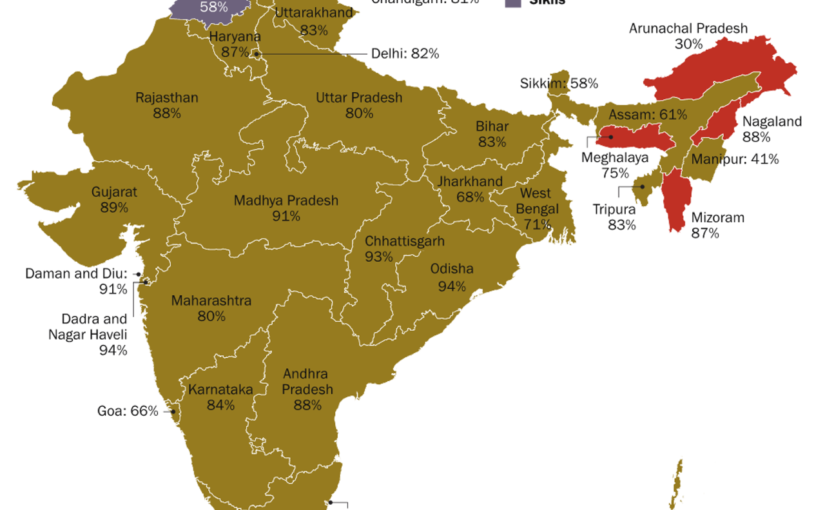
Across India, discussions about demographics are charged with questions of destiny and identity. In the Hindi belt, particularly in UP and Bihar, the focus often turns to birth rates between Hindus and Muslims, a dynamic sometimes referred to as a “cradle race.” This term reflects deeper concerns about societal balance, yet paradoxically, it also influences high birth rates among upper castes. I know a (Hindu) woman from Bihar who recently had her third son, a personal example of how this dialectic pervades everyday life.
Globally, the Hindu population has grown modestly from 11% to 15% over the past five centuries. In contrast, the share of the Abrahamic faiths has surged from 37% to 54%, moving from a plurality to a Scottish majority.
In the same period, within what is the modern boundaries of India, the Hindu population has seen a subtle declineâfrom 85% to 79%âreflecting a complex history of migration, cultural shifts, and geopolitical changes. The most pronounced demographic shifts occurred in areas now known as Pakistan and Bangladesh, which made the Hindu population of the Greater Indian Subcontinent dropped from 78% to 66%. Despite this decline, these two countries still rank as the 2nd and 5th largest Hindu populations globally, underscoring their profound & immovable Indic substrate.
Imperialism in India over a long millennia
Mughal imperialism significantly reshaped Bengal’s religious landscape with taxation settlements, British colonialism introduced Christianity with further irrigation works also impacting demographics in Western Punjab, and Partition irrevocably redrawing demographic lines.
The narrative of global demographic displacementâoften framed as the decline of a lighter-skinned, prosperous population in a democracyâoversimplifies and distorts the real dynamics. The Parsis of Mumbai, for example, despite their dwindling numbers, continue to wield significant economic and cultural influence. Their enduring presence in South Bombay, marked by landmarks and institutions, underscores a critical point: demographic numbers don’t necessarily dictate power or presence.
Dishoom is a homage to the Bombay-Irani cafe culture; one of London’s most prominent restaurant groups
Historically, the emergence of elites often resulted from historical accidents rather than pure meritocracy. The upper castes in India, consistently representing 15-25% of the Hindu population over centuries, exemplify this. Their enduring influence, despite societal changes and efforts toward social equity, highlights the deep-rooted structures that shape contemporary realities.
the new French cabinet
In France, the overrepresentation of white individuals in parliamentâestimated at 90-95% despite whites comprising 70-85% of the population (but these numbers are notoriously hard to get by as France doesn’t do official racial & ethnic counts so as to not undermine the indivisibility of the French people & nation)âreflects a global issue: power doesn’t always proportionally reflect demographic makeup. This discrepancy invites a broader reflection on how historical advantages and institutional control determine who holds power.
This discussion is crucial, not just academically, but for understanding how identity, power, and demographics intersect in complex ways. By critically examining these narratives, we can better understand the realities of demographic changes without succumbing to deterministic thinking.
The myth of democratic liberal capitalism is the presumption that voters determine the true shift of power. The growing inertia of the deep stateâcivil services and military administrationsâmakes genuine reform difficult, echoing George Orwell’s observation: “but England will still be England, an everlasting animal stretching into the future and the past, and, like all living things, having the power to change out of recognition and yet remain the same.”
It’s nigh on impossible to imagine India that is not Bharat, to envision a future where Hinduism isn’t deeply & inextricably intertwined with its land of origin. It is much more likely that one day, Vedic traditions will once again flow across the banks of the Indus, reclaiming the lost civilization of the past.