Denial Isn’t Just a River in Egypt—It’s a Dammed Indus Too

By X.T.M | Acting Editor, Brown Pundits

“Qureshi” has glibly informed me that caste doesn’t exist in Pakistan, and that had I not deleted his comment, I would have seen his thoughtful explanation on why his ancestors would (or wouldn’t- tough to follow) have “embraced caste.”

Let’s address both claims.

I. Denial, and the Geography of Amnesia

First: the deletion. The reason I removed Qureshi’s comment was simple—it referred to “when the Hindus left Pakistan in 1947.” As if they left. As if it were a long vacation. That turn of phrase is emblematic of a deep, disturbing historical erasure—a civilizational amnesia that’s not just inaccurate, but actively offensive.

To phrase the violent dislocation of millions as “leaving” is a textbook case of internalized Hinduphobia—a posture so normalized in Pakistani elite discourse that it barely registers as cruelty.

This is not about word policing. It’s about confronting the inherited violence buried in euphemism. Continue reading Denial Isn’t Just a River in Egypt—It’s a Dammed Indus Too
Is It Indian Culture or Hindu (Brahmin) Culture that creates excellence?

On Faizan Zaki, Spelling Bees, and Civilizational Osmosis

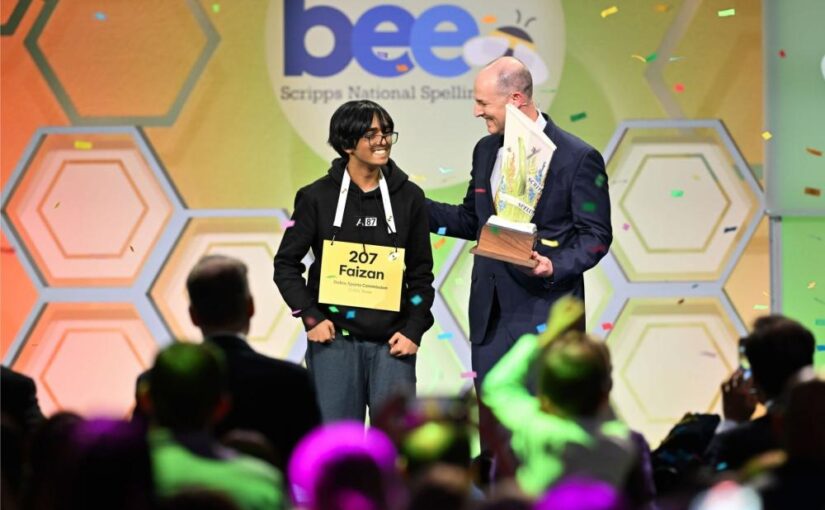
Another year, another Spelling Bee crown for an Indian American. But this one, the 100th Scripps tournament,  is different.

Faizan Zaki—young, brilliant, and by name Muslim—just became the latest in a long line of Indian-origin champions of America’s most idiosyncratic intellectual ritual. Faizan is the 32nd Indian American to win—meaning they’ve claimed 32 out of the last 40 Spelling Bees. But he is very likely the first Muslim American to do so.

Which raises an old but essential question: Continue reading Is It Indian Culture or Hindu (Brahmin) Culture that creates excellence?

Flame Thread Protocols: Honey Kabir

A Note from the Editor

Flame thread warning: Honey vs. Kabir.

Last night’s open thread surged past 50 comments—most of it orbiting the now-familiar friction between the two.

Let me be clear: I’m inclined toward Kabir. He’s often overwrought, sometimes hyperbolic, but he’s a known quantity. He’s been part of this space for nearly a decade. He is a “real person.” We know how he argues, where he lands, and the limits of his provocations.

Honey is harder to read. Multiple handles. No clear background. No track record. And a rhetorical posture that feels less like engagement, more like carpet bombing—especially when it comes to Pakistan. There’s a difference between critique and hatred, and it’s usually in the tone. “Pakistanis under-endowed”—LOL, happy to disprove that.

Moderation is evolving. I no longer think of it as refereeing an online debate. I think of it like hosting a discussion in my living room. That means: Continue reading Flame Thread Protocols: Honey Kabir

Jet Lag: India, Pakistan, and the Theatre of the Air

Since the commentariat can’t resist a good Indo-Pak exchange—especially when it involves fighter jets—here’s a fresh contribution to the theatre. Personally, I’m much more interested in Concord cafĂ©s and JD Vance’s selective memory, but one must feed the algorithmic gods. So here’s what S. Qureishi gleefully shared:

A day after Subramanian Swamy accepted 5 jets were down in a Hindi interview, Indian CDS Gen Chauhan accepts jet losses in the recent encounter to Bloomberg. What’s more he accepted that the Indian planes did not fly after May 6-7 and were grounded,

Take that as you will. Fog of war, political spin, or just belated candor—either way, the skies are louder than the silence.

As an aside, I’ve always found Pakistani commentary on India—the civilizational motherland, however estranged—to be oddly fixated. It’s like staring into a mirror with the lights off.

Anyway—comment away, and please play nice. After all, xperia2015 has author privileges and can selectively void what he likes.

“A Foreign Class of Servants” — JD Vance and the Great American Amnesia

Vice President JD Vance recently declared that America doesn’t need to “import a foreign class of servants” to remain competitive. “We did it in the ’50s and ’60s,” he said. “We put a man on the moon with American talent. Some German and Jewish scientists who had come over during World War two, but mostly by American citizens.”

The line is memorable—not for its nationalism, but for its breathtaking amnesia.

The moon landing was not the product of some closed, white-bread meritocracy. It was powered by German engineers, Jewish refugees, and immigrant scientists—many quite literally “imported.” Wernher von Braun, the face of NASA’s rocket program, was a former Nazi, repurposed by America for its Cold War dreams.

Today, the immigrant pipeline Vance sneers at includes his own in-laws—his wife’s parents, Indian-born academics. I’ve highlighted this problematic tendency before. They weren’t servants. They were scholars. Like hundreds of thousands who have powered this country’s universities, tech firms, hospitals, and labs. America doesn’t run on pedigree. It runs on brains. And yes, those brains often have accents.

America First doesn’t mean America stays first Continue reading “A Foreign Class of Servants” — JD Vance and the Great American Amnesia

Café Concord: A View from the Counter

I’m writing this from a bakery-cafĂ© in Concord, Massachusetts—the cradle of the American Revolution, where ideals like liberty and equality were born anew in the New World. The croissants are fresh, the espresso is bespoke (lavender), and the staff layout is eerily familiar.

At the front: white staff—stylish, aesthetic, articulate—handling (bossing sometimes but in general everyone is exceptionally lovely & calm) model minority clientele with curated ease. In the kitchen: Mexican workers—efficient, invisible, foundational. It’s the same setup across most of America’s cool, clean consumer spaces: the aesthetic and the labor silently segregated by race and language.

No one talks about it. You’re not supposed to notice the subtle “Americanisation” at play (the American dream and its attendant complexities). But once you do, as a twice-immigrant (East to Britain, old England to New England), it’s hard to unsee. The roles aren’t assigned by policy, but by a deeper algorithm—one that sorts people into place based on centuries of sedimented power: race, class, culture, even aesthetics. Continue reading CafĂ© Concord: A View from the Counter

Open Thread: From Murder to Mercy — The Midwives of Bihar

In the 1990s, rural midwives in Bihar were quietly killing baby girls under pressure from families. Some confessed to dozens of infanticides. Dowry, caste, poverty — all conspired to make daughters disposable.

Thirty years later, one of those girls has returned — adopted, loved, and thriving — to meet the women who chose to save rather than kill.

This story, told through BBC Eye’s The Midwife’s Confession, is brutal, human, and profoundly moving.

What does it say about India’s gender imbalance, social reform, and the moral grey zones of survival?

This thread is open for reflection. Please engage with care.

đŸŽ„ Watch on YouTube

📖 Read the full story

“I Will Never Speak Kannada”

SBI Manager Sparks Language Flashpoint in Karnataka

A now-viral video captures a moment that feels both petty and profound: an SBI bank manager, posted in Karnataka, flatly refuses to speak Kannada to a customer. When reminded that Karnataka has its own official language — and that RBI guidelines encourage local language use — the manager responds curtly:

“I will never speak Kannada.”

She then walks off.

She has since been transferred, but not before the clip set off a digital firestorm.

This incident may seem minor — another viral tiff between state pride and bureaucratic indifference — but it exposes a deeper tension in India’s federal fabric. At its heart is a language question that never died: who accommodates whom in a multilingual republic? Full clip after the jump.

Continue reading “I Will Never Speak Kannada”

India’s Demographic Nervous System: Partition, Federalism, and the Fear of Muslim Majority Provinces

King Khan — I don’t think it’s irrelevant that Muslim-majority regions would have been liminal. Literally.

The previous post got me thinking about demographic engineering, and how it has quietly shaped post-Partition India — not just at the borders, but deep inside the Union itself. When Qureishi redefined the demographic weightage of the Indo-Gangetic, I was reminded of how states like Madhya Pradesh (I’ve had a post waiting on this for months), Maharashtra, Uttar Pradesh, and Bihar — the so-called “giants” of India’s federal structure — were similarly calibrated. Even the historical Andhra Pradesh (before Telangana split), Kerala, and distant territories like the Lakshadweep Islands show signs of internal rebalancing. The logic? To prevent the consolidation of another Muslim-majority province — something the Indian state has remained deeply wary of since Kashmir’s accession crisis in 1947–48.

The anxiety over Muslim-majority units lies at the core of why Kashmir remains “special” — not spiritually, but politically. Its sovereign ambiguity and constitutional exceptionalism stem directly from the post-Partition plebiscite logic, which India initially welcomed. At the time, Nehru and the Congress were confident of winning that vote. Quaid-e-Azam had thoroughly alienated Sheikh Abdullah, by backing the non-consequential “Muslim Conference” and the National Conference had significantly diverged from the Muslim League. The shift didn’t come until later — particularly after the rigged 1987 elections and the spillover from the Afghan jihad, which together detonated the insurgency.

This raises an unsettling but important question: Continue reading India’s Demographic Nervous System: Partition, Federalism, and the Fear of Muslim Majority Provinces

South India Makes British India Hindu?

TNT Saved Hinduism; Dravidia preserved Aryavarta?

S. Qureshi: “Muslims are today a majority of the population >50% of North British India. If peninsular south was made into its own country in 1947, India would be a Muslim majority country today. Many Muslims actually wanted South India to be a separate country and North India (including Pakistan/Bengal) to be one unit. To say that Indian Muslims who lived in the historical centre of Muslim power for centuries would just get up and leave for Pakistan is just farcical and delusional. These types of ideas were only proposed by extreme right-wing Hindu organizations after partition, and these ideas seem to become mainstream today with BJP. Historical reality, like always, is very different.”

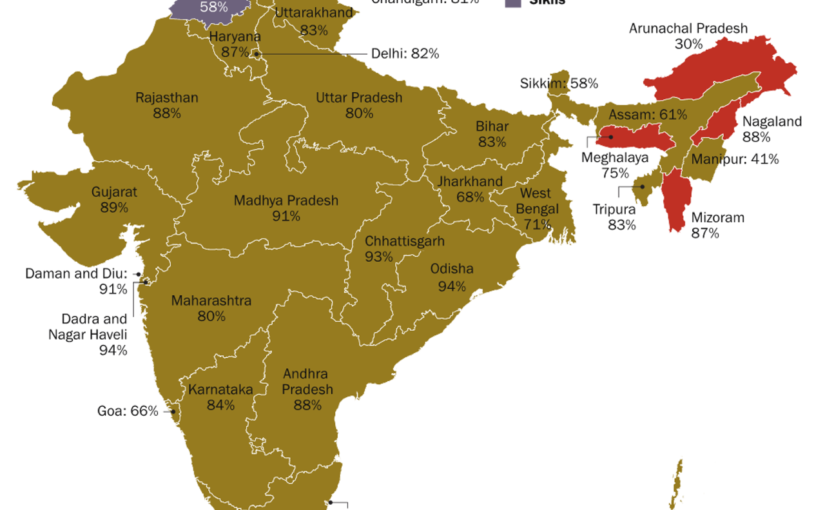
The demographic map of the subcontinent tells a startling story. If South India had formed a separate state in 1947, the rest of British India — encompassing Pakistan, Bangladesh, and the northern Hindi belt — would today constitute a Muslim-majority civilizational bloc. This isn’t conjecture. It’s arithmetic.


The Numbers That Reorder the Narrative

Here’s what the Indo-Gangetic arc looks like today (please fact check me): Continue reading South India Makes British India Hindu?

Brown Pundits