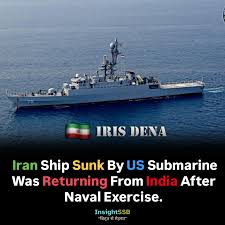
India’s Guest. America’s Kill.

On the 4th of March 2026, a US submarine torpedoed the Iranian frigate IRIS Dena in the Indian Ocean, 40 nautical miles off the coast of Galle, Sri Lanka. At least 87 sailors were killed. Over a hundred remain missing. Pete Hegseth called it “quiet death” from the Pentagon podium; bragging it was the first torpedo kill since World War II.

MILAN at Vyzag

The IRIS Dena had just left Visakhapatnam. It had been India’s guest. Formally invited to MILAN 2026, the International Fleet Review hosted by the Indian Navy, attended by 86 ships from 74 nations. The Eastern Naval Command had tweeted a welcome photograph two weeks earlier: “reflecting long-standing cultural links between the two nations.”

42 warships, submarines and 29 aircraft: How Navy's mega exercise MILAN unfolded - The Times of India

Two weeks later, that ship is on the ocean floor. And from New Delhi, silence. Iran’s Foreign Minister Araghchi said it plainly: Frigate Dena, a guest of India’s Navy, was struck in international waters without warning. That line will not be forgotten in Tehran. It should not be forgotten in New Delhi either; because it is the most precise summary available of what Modi’s diplomatic positioning has actually cost India.

When guests are murdered

Image

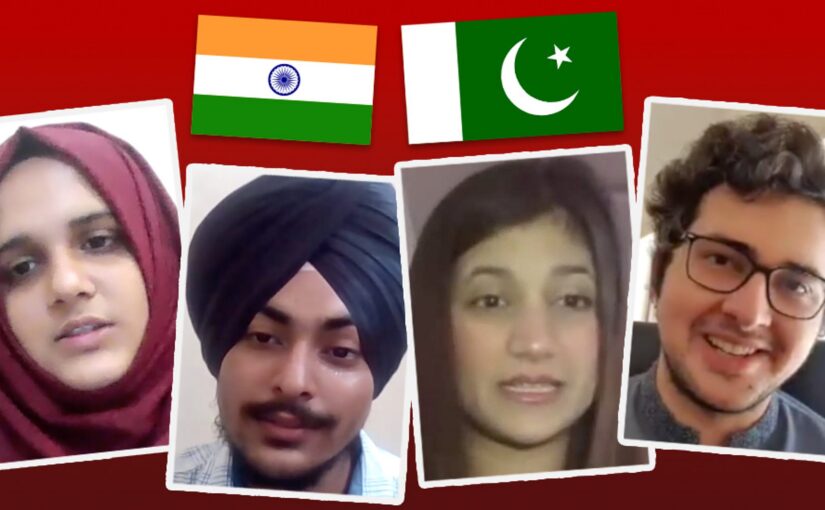
Say what you want about Pakistan’s post-colonial elite; and there is plenty to say. But since Pahalgam they have been reading the room better than New Delhi has. Not because Islamabad became richer or more competent. Neither of those things happened. What happened is simpler: when the bombs fell on Iran, Pakistan said nothing loud, and that silence was itself a signal. Across the Muslim world that signal was heard. Loyalty travels farther than power. Whether that loyalty is strategic or genuine is a separate question. The effect is the same.
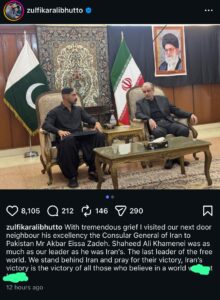
Pakistan Post-Pahalgam Continue reading India’s Guest. America’s Kill.
When Even Jainism Becomes a Hack

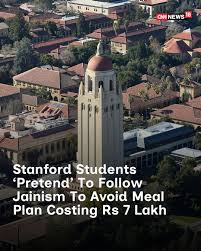
And so, some students I know claim to be devout members of the Jain faith, which rejects any food that may cause harm to all living creatures — including small insects and root vegetables. The students I know who claim to be Jain (but aren’t) spend their meal money at Whole Foods instead and enjoy freshly made salads and other yummy dishes, while the rest of us are stuck with college meals, like burgers made partly from “mushroom mix”.

I was reading about Stanford’s accommodation culture when one detail stopped me cold. Some students, the article noted, claim to be devout Jains in order to escape the mandatory meal plan. Jainism, one of India’s oldest religions, forbids harm to living beings. That includes insects. In many traditions it excludes root vegetables, because uprooting a plant kills it. It is an ethic of extreme restraint, discipline, and care. The students claiming it, by the author’s own admission, are not Jain. They are optimisers. This is not a small lie. It is a revealing one. Continue reading When Even Jainism Becomes a Hack

Pakistan’s Civilisational Orphanhood

The argument over Balochistan exposed something deeper than maps or borders. It revealed a confusion about what Pakistan is supposed to belong to.

Formally, Pakistan is one of the most nationalistic states on earth. Its red lines are absolute. Its territorial language is uncompromising. Its founding trauma has hardened into doctrine. And yet, beneath this rigidity sits a quieter truth: Pakistan’s elite does not actually live inside a closed nation-state imagination. They live in English.

They think in Western legal categories, read Western literature, speak the language of international institutions, and send their children into global circuits of education and finance. At the same time, their social world remains unmistakably South Asian; family-centred, hierarchical, ritualised, and deeply embedded in subcontinental habit. They are neither fully Western nor comfortably Indic. This produces a tension that Pakistan has never resolved.

The Nation-State After 1945: A Container That No Longer Holds

Continue reading Pakistan’s Civilisational Orphanhood

Iran and Pakistan Are Not the Same Kind of State

Iran cannot be analysed using the same political categories as Pakistan or most modern states. The difference is not whether a regime is monarchical, clerical, or military. It is the age of the civilisation being governed. Pakistan is a young state. Its borders, institutions, and political language were assembled in the twentieth century. In such states, power fills a vacuum directly.

Power in Young States, Authority in Old Ones

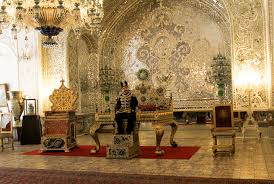
A military dictatorship governs by force, hierarchy, and command. Its legitimacy is procedural and immediate: order, security, survival. This form works where political memory is thin and inherited meaning is limited. Pakistan’s army did not overthrow an old order. It stepped into an empty one. Iran is structured differently. It is a civilisational state that has existed in recognisable form for roughly three thousand years. Power there has never been exercised through force alone. Authority has always been tied to ideas that predate any single regime.

Monarchy as Civilisation, Not Administration Continue reading Iran and Pakistan Are Not the Same Kind of State

Mid-Nov Circular

Dear all,

With everything going on in the last 48 hours, we wanted to send a short note to everyone directly. BP has sputtered back to life in the past year, and with that revival comes all the familiar subcontinental pathologies: everyone believes they’re right, everyone believes moderation is biased, and everyone believes someone else is being unfair. In that sense, BP is working exactly as it always has.

We want to restate something very clearly: we’re not going to run a hyper-moderated blog. It takes too much time, too much energy, and, crucially, it’s an unfunded mandate. Nothing is more dispiriting than a dead space. Our approach has been simple and consistent:

1. Authors control their own threads.

If things escalate on your post, you shut it down when and where you see fit. That’s the cleanest system and the only one we can realistically sustain.

2. No bans, shadow bans, or entrapment games.

Once we go down the path of micro-policing, BP loses its character. That’s not the direction we want to take.

3. We do not manufacture controversy.

If anything, the only thing we are biased toward is what the audience reads and engages with. That’s it. Everything else is noise.

Reflections:

Some of you will have seen the recent exchanges where accusations were thrown in both directions, and where intentions were questioned. Without going into details: this is exactly how online political communities melt down; by assuming the worst in each other and by escalating minor provocations into existential battles. It’s the same pattern we saw a couple of years ago at a public talk by Rahul Gandhi in Cambridge: someone asked a loaded, “gotcha” question, the out of context reply went viral, people got outraged, and the whole thing became a cycle of reaction and overreaction. We’re drifting into the same dynamic.

Let’s not.

BP works only when people post, comment, disagree, and move on. If that stops, the blog dies. And as Omar’s recent post highlighted, we want authors to write more, not less.

So our simple request is this: Calm down, carry on, manage your own threads, and do not fall prey to the outrage factory.

If you feel strongly about a situation, reach out; if you want more balance, we’re happy to add an additional admin to offset the load (BP’s editorial board already functions with more factions than the Lebanese Parliament); if something crosses a line, handle it on your post. But let’s not turn BP into a miniature Whitehall where everything becomes bureaucratised. We’ve done extremely well this past year. Let’s keep the energy without burning down the house.

Warmly.

What Is Not India Is Pakistan

As Dave mentioned, there is a lively WhatsApp group of BP authors and editors, and it inevitably shapes the comment ecosystem. But one comment on the blog stood out:

“The very foundation of Pakistan is an anti-position. What is not India is Pakistan. So isn’t it obvious?”

It’s an extraordinarily crisp description of Pakistani identity-building. What is not India is Pakistan. That is not a slur; it is, in many ways, a psychologically accurate frame for how the state narrates itself.

What I increasingly find misplaced on this blog is the recurring assumption that Pakistanis are somehow “Indians-in-waiting,” or that Punjab is “West Punjab,” Pakistan “Northwest India,” or Bangladesh “East Bengal.” These are irredentist projections that simply do not match lived identities. This is not “North Korea” or “East Germany,” where both sides continue to imagine themselves as fragments of one common nation.

Yes, Pakistan consumes Bollywood and Hindi music, which themselves derive from Mughal and Indo-Persian syncretic traditions. Yes, Pakistan is culturally embedded in the greater Indo-Islamic civilizational sphere. But emotionally, Pakistan has severed itself from the Indian Subcontinent as a cohesive landscape. It has constructed a hybrid identity; part Turko-Persian, part Islamic internationalist, part anti-India.

I don’t personally agree with this move, and my own trajectory has been toward a strong Hinducised, Dharmic identification. But my view is irrelevant here. What matters is that Pakistani identity is defined negatively; as the commentator put it, “What is not India is Pakistan.”

Whether that is healthy or sustainable is another matter. But identities can persist in unhealthy configurations for a very long time; the stock market can be irrational longer than your liquidity can survive.

Caste, Civilisation, and the Courage to Own It

Kabir suggested that I apologise but for what, exactly? Why should Saffroniate be considered offensive? Own it. I don’t see anything inherently wrong with the idea of Akhand Bharat; the concept of a broader Dharmic civilisation makes eminent sense to me.

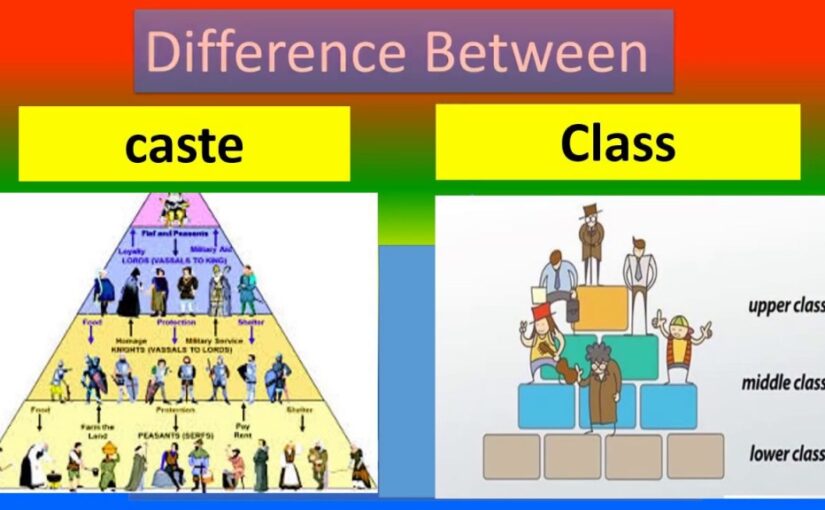
Likewise, I don’t understand why questioning caste identities provokes such sensitivity. Again, own it because the more caste is repressed, the more likely it is to resurface.

At heart, I’m a reformist, not a revolutionary. I believe in improving and refining what exists, not erasing it. Cultural features should only be abolished when they are truly harmful or deleterious, not simply because they make us uncomfortable.

Everyone Western Becomes White Eventually


brown: if the fresh inputs from india is reduced ( because of immigration laws and raising prosperity back home), how long can ‘indians in u s a’ remain an effective group? i feel that they will dissolve in next 20 years.

Nivedita: That is such an interesting take! I agree actually. Indians are pretty much white adjacent and are intermarrying with whites, so in all probability what you predict might actually happen.

That’s a sharp observation, and worth expanding. The truth is, in the West, all immigrants eventually become “white”—not in phenotype, but in assimilation, in aesthetic, in aspiration. Continue reading Everyone Western Becomes White Eventually

Brown Pundits