What’s in a name? That which we call a Swastika, isn’t exactly a symbol of hate

Disclaimer: As this post deals with an academic discussion on the Swastika symbol, I have included various images containing Swastika below. If you are repulsed by the symbol or do not like to look at it, please consider yourself warned. Also, for the same reason, this post is NSFW.

Growing up in India, I had developed this habit of drawing symbols of auspiciousness and good luck on my exam answer sheets. I have no recollection of who taught me to do that or when I started doing it but I can clearly remember even during my bachelor studies, I would collect the answer sheet from the invigilator and immediately proceed to draw an ‘ॐ’ (Om), a ‘श्री’ (Shree) and a ‘卐’ (Swastika, albeit with 4 dots in the middle as one would draw in India) at the top of the first sheet of the answer paper. This rather innocent practice wasn’t unique to me. Apparently many other students used to do this until the universities started cracking down on this ‘malpractice’ for ‘displaying symbols of faith on answer sheets’ and ’emotionally appealing to the evaluators’. In a religiously polarized India of the 2010’s, I don’t expect any less ham-handed response from our University VCs. But, personally, what prompted me to stop this practice was my move to Germany for my master’s.

In the first few weeks of the semester, all international students took part in an orientation program at the university. One of the most shocking things I learnt  that day was that any public display of Swastika was BANNED in Germany. I was not ignorant of Germany’s sordid past. Watching ‘Schindler’s list’ beamed onto the wall of a dark classroom with my fellow drama club members in high school is one of the most vivid memories I have. I was just 15 then and the movie shocked me to my core. It was one of those instances of loss of innocence in my life when cruelty, inhumanity, Germany, Hitler, Jews and hate took on a whole other meaning in my psyche. In spite of that, discovering Swastika, an omnipresent sign in India that I had grown up seeing everywhere and that which is considered good and auspicious by everyone around me, could be a banned symbol of hate in the country I had just moved to, was another instance of loss of innocence.

Just like me, many Indians who have moved to the west have discovered this in their own way. The subreddit r/AITA (no connection with raitas 😛 ) has quite a few posts from hindus who have been mistaken for a white-supremacist (Oh! The irony!) for displaying Swastikas as a pendant gifted by grandmother, in the form of a rangoli/kolam in their frontyard, a tattoo on the arm they got while in India, having portraits of hindu gods at home, etc. All these instances happened in the US. From my personal experience, I have found the germans to have better awareness about Swastika; it’s use as the Nazi party symbol, a hate symbol of neo-Nazis and also as the auspicious symbol for many asian religions and cultures. This is because of two reasons:

1. The curriculum at schools explore all aspects of Germany’s sordid past with a level of frankness that I can only describe as ‘very German’. The curriculum makes the differentiation between the two symbols very clear as you can see from this children’s website that takes them on a german historical journey of the last 100 years.

2. The germans use two different words for this symbol. The symbol of hate used by Hitler and the neo-Nazis is called ‘Hakenkreuz’ while the auspicious symbol of the orient is called ‘Swastika’. Just the existence of two different words makes it easy to differentiate the meaning of the two symbols.

Funnily enough, even though I lived in Germany for 5+ years, I was not aware of the existence of ‘Hakenkreuz’. I only came to know about it in the past year or so through twitter! It was probably through a thread by True Indology (lost when his account was suspended) that I became aware of the german word ‘Hakenkreuz’ that when translated to english means hooked cross and not Swastika. The problem lies with the current mistranslation of Hakenkreuz in English.
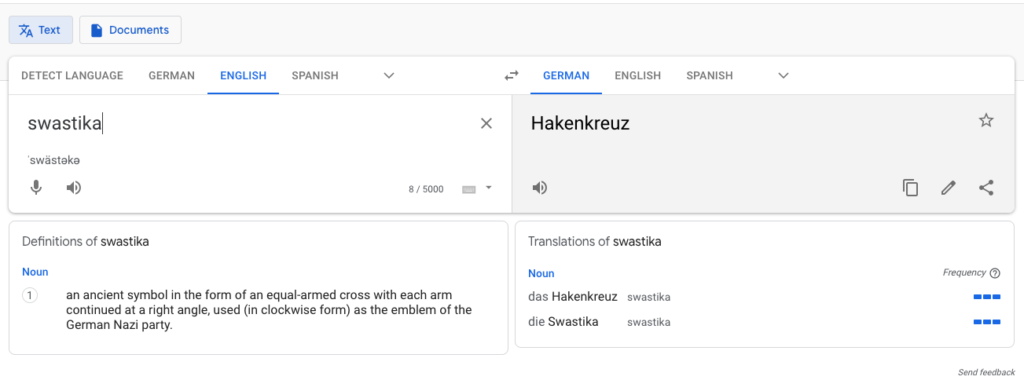
Google translate translates Swastika as Hekenkreuz in German. Notice the possible translations of the word – das Hakenkreuz and die Swastika. Also notice the definition of Swastika in english. It only defines the Hakenkreuz, the symbol used by Hitler.

Instead of translating into hooked cross, it is translated as Swastika, which is clearly wrong. So, why IS it mistranslated to Swastika? Who first translated Hakenkreuz to English as Swastika and how did that translation stick? More importantly, did Hitler adopt the eastern symbol Swastika as the anti-semitic symbol of his political party or did the inspiration come from elsewhere? These were some of the questions that recently led me to write a thread on twitter (you could also read it on the thread reader app here). I will summarize my findings below.

Colonialism and imperialism in the 18th and 19th century CE brought about a great deal of interest in the eastern cultures by the west which gave rise  to the field of oriental studies and orientalism. All things east were considered exotic and the ‘popular’ phenomenon of cultural appropriation led to the adoption of various eastern symbols in the west. One among those was the Swastika. It shot up in popularity among the western academicians in the 1880’s and pretty soon entered the pop culture scene as a symbol of good luck, akin to today’s good luck charms like Maneki-neko (Japanese beckoning cat), Chinese fortune cookies or the Irish shamrock.

A report by Thomas Wilson titled ‘THE SWASTIKA, The earliest known symbol, and its migrations; with observations on the migration of certain industries in prehistoric times” for the US National museums in 1894 wonderfully compiled the then existing knowledge of Swastika. It is meticulous and very clearly written with almost no bias from Mr. Wilson. This also happens to be the first recorded instance where an English speaker tried to compile all the crooked cross like symbols and used the umbrella term of Swastika in English. Until then, the word Swastika did not exist in any english dictionary or encyclopedia. He writes in the preface:

An English gentleman, versed in prehistoric archæology, visited me in the summer of 1894, and during our conversation asked if we had the Swastika in America. I answered, “Yes,” and showed him two or three specimens of it. He demanded if we had any literature on the subject. I cited him De Mortillet, De Morgan, and Zmigrodzki, and he said, “No, I mean English or American.” I began a search which proved almost futile, as even the word Swastika did not appear in such works as Worcester’s or Webster’s dictionaries, the Encyclopædic Dictionary, the Encyclopædia Britannica, Johnson’s Universal Cyclopædia, the People’s Cyclopædia, nor Smith’s Dictionary of Greek and Roman Antiquities, his Greek and Roman Biography and Mythology, or his Classical Dictionary. I also searched, with the same results, Mollett’s Dictionary of Art and Archæology, Fairholt’s Dictionary of Terms in Art, “L’Art Gothique,” by Gonza, Perrot and Chipiez’s extensive histories of Art in Egypt, in Chaldea and Assyria, and in Phenicia; also “The Cross, Ancient and Modern,” by W. W. Blake, “The History of the Cross,” by John Ashton; and a reprint of a Dutch work by Wildener. In the American Encyclopædia the description is erroneous, while all the Century Dictionary says is, “Same as fylfot,” and “Compare Crux Ansata and Gammadion.” I thereupon concluded that this would be a good subject for presentation to the Smithsonian Institution for “diffusion of knowledge among men.”

In this report, Wilson examined different forms of crosses that had been found all around the world and concluded that Swastika is the most ancient one of them all.
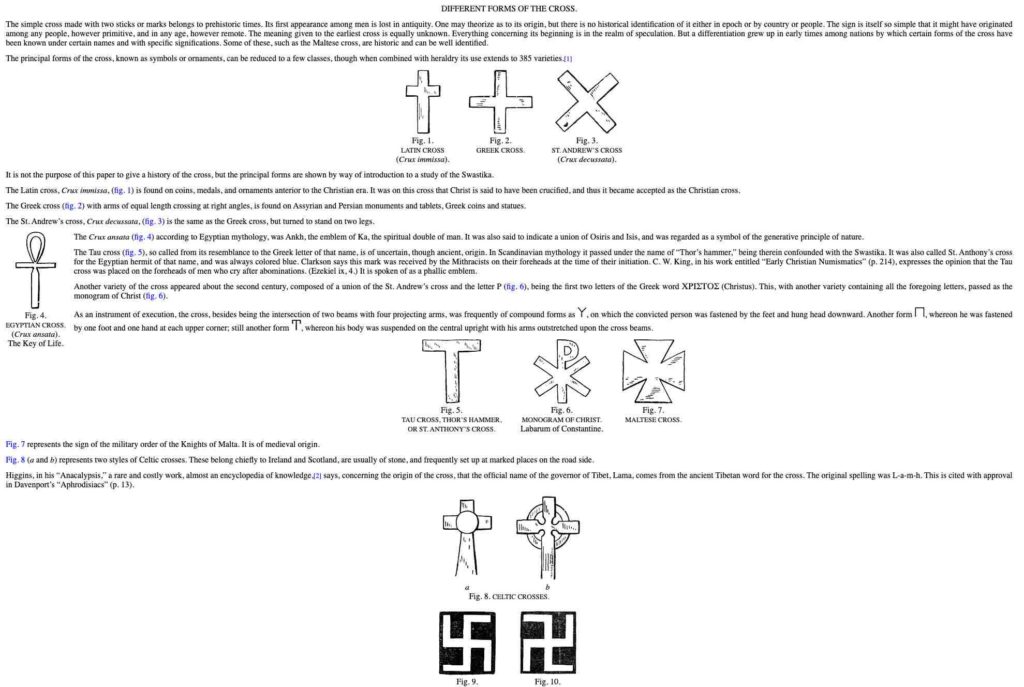
Different cross-like symbols examined by Thomas Wilson in THE SWASTIKA

He complied various definitions of Swastika as recorded by different researchers and it was commonly understood to mean ‘good being’ or ‘good fortune’ in Sanskrit. The symbology was interpreted by different academicians differently. Although mostly everyone agreed that it is an auspicious symbol for the hindus and buddhists, there was no consensus on how to interpret the symbology. He writes,

Many theories have been presented concerning the symbolism of the Swastika, its relation to ancient deities and its representation of certain qualities. In the estimation of certain writers it has been respectively the emblem of Zeus, of Baal, of the sun, of the sun-god, of the sun-chariot of Agni the fire-god, of Indra the rain-god, of the sky, the sky-god, and finally the deity of all deities, the great God, the Maker and Ruler of the Universe. It has also been held to symbolize light or the god of light, of the forked lightning, and of water. It is believed by some to have been the oldest Aryan symbol. In the estimation of others it represents Brahma, Vishnu, and Siva, Creator, Preserver, Destroyer. It appears in the footprints of Buddha, engraved upon the solid rock on the mountains of India. It stood for the Jupiter Tonans and Pluvius of the Latins, and the Thor of the Scandinavians. In the latter case it has been considered—erroneously, however—a variety of the Thor hammer. In the opinion of at least one author it had an intimate relation to the Lotus sign of Egypt and Persia. Some authors have attributed a phallic meaning to it. Others have recognized it as representing the generative principle of mankind, making it the symbol of the female. Its appearance on the person of certain goddesses, Artemis, Hera, Demeter, Astarte, and the Chaldean Nana, the leaden goddess from Hissarlik, has caused it to be claimed as a sign of fecundity.

Until then, Swastika, as a symbol was known by different names in different languages because the symbol existed almost everywhere in the world, in Asia, Europe, northern Africa and the Americas. Also in Great Britain. So, what did the English call the symbol? Fylfot. Wilson writes,

In Great Britain the common name given to the Swastika, from Anglo-Saxon times by those who apparently had no knowledge whence it came, or that it came from any other than their own country, was Fylfot, said to have been derived from the Anglo-Saxon fower fot, meaning four-footed, or many-footed.

So, there existed a word for the 卐(crooked cross) symbol in english but only for the 卐 found in and around great britain. Instead of using this word for all crooked crosses in English, Mr. Wilson instead chose to use the word Swastika since he found it to be the most ancient of them all. This was a ham-fisted move because the Indic name swastika corresponded to the 卐 that symbolized auspiciousness which the other crooked crosses did not. Even Wilson admits that by quoting a letter by the famous Indologist Prof. Max Müller,

I do not like the use of the word svastika outside of India. It is a word of Indian origin and has its history and definite meaning in India. * * * The occurrence of such crosses in different parts of the world may or may not point to a common origin, but if they are once called Svastika the vulgus profanum will at once jump to the conclusion that they all come from India, and it will take some time to weed out such prejudice.

So, in 1894, the word Swastika was proposed by Mr. Wilson to denote all crooked crosses in english language and we see that the practice stuck since the use of the word in english language increased since then. So, is this when the German word ‘Hakenkreuz’ started being called as Swastika? Interestingly, no! In fact, the report mentions finding variants of swastika in Germany but mentions no name in German. ‘Hakenkreuz’ was barely used until then and was relegated to 19th century vocabulary books like the Bailey-Fahrenkrüger’s Wörterbuch der englischen Sprache and the Deutsches Wörterbuch von Jacob Grimm und Wilhelm Grimm (yes, they are the Brothers Grimm of Grimm’s fairy tales). So, to answer one of the questions posed above, ‘Hakenkreuz’ wasn’t actually translated into English. By the time germans started using Hakenkreuz as the word for the infamous anti-semitic symbol, the English speaking world had already picked up on the word Swastika and called any crooked cross symbol as such.

So, when and why did the Nazis adopt the Hakenkreuz as their anti-semitic symbol? The reason goes all the way back to Troy, the location of the fabled trojan war (it’s an interesting story, you can read a detailed article here). When a german businessman and amateur archeologist Heinrich Schliemann found the remains of the mythical city of Troy in modern day Turkey in 1871, along with the ruins, he found the 卐 symbol on everything – pieces of pottery, ruins of buildings, marble carvings, etc. Being an amateur archaeologist he did not understand the significance of his find. So, he consulted his orientalist friends – Max Mueller(yes, the same guy who didn’t want to call ‘Swastika’ found outside India as Swastika) and Émile-Louis Burnouf, a leading expert of Sanskrit. Fun fact: Bernouf was also an anti-semite and a propounder of Aryan master race.

Burnouf made a bunch of dubious claims (debunked by Wilson in his monumental report on Swastika) which was covered in Schliemann’s book ‘Troy and its remains‘ and concluded that Suastika (that was the spelling he went with) is an essential symbol of the Aryan race. The popularization of this flawed idea led to its appropriation as the symbol by the German ‘Völkisch‘ national movement gaining steam at the juncture of 19th and 20th century. It was a nationalistic movement which propounded that Germans belong to the Aryan ‘master race’ and hence need to dominate the world. Poetically, the year Burnouf breathed his last, 1907, was also the year when the Swastika was first used as a symbol of Aryan dominance by a secret society called ‘Order of the New Templars’ (Ordo Novi Templi, or ONT) in Austria by Lanz von Liebenfels, an Austrian racialist. So, in early 20th century, as most of the west started embracing Swastika as a ‘cool’ motif, it was also being appropriated secretly by an anti-semitic and racist underground movement becoming a symbol of racial supremacy for various organizations until it was mainstreamed by Hitler in the Nazi flag in 1920.
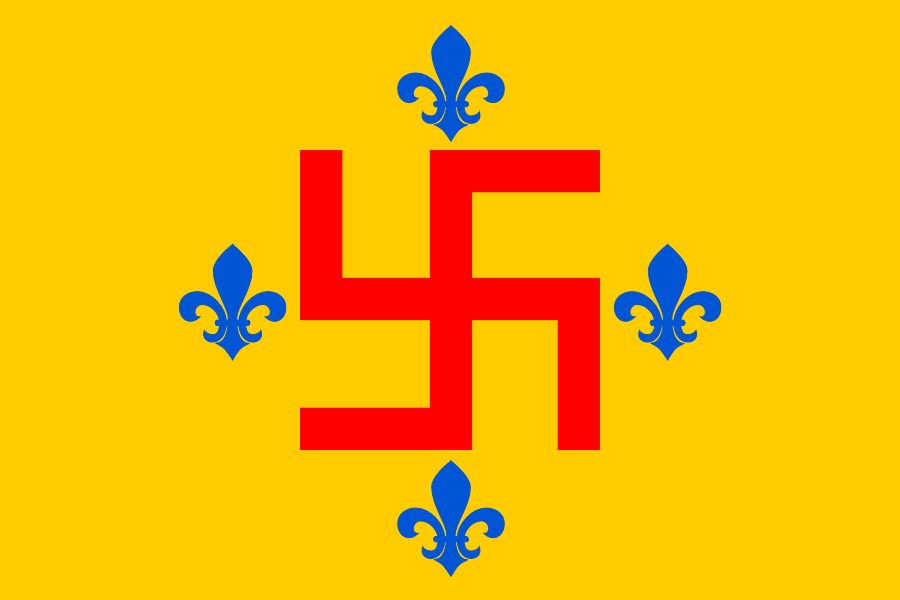
Flag of the ‘Order of the new Templars’. This was the first instance of Swastika used as a symbol of Aryan dominance in 1907.


What inspired Hitler to choose this symbol for his political party? Was it just the connection to Aryan race or did the inspiration come from elsewhere? The anti-semitism displayed by the Nazis did not arise from a vacuum. Anti-semitism or anti-Judaism has existed in Europe since pre-Christian times but morphed into ‘religious anti-semitism’ due to the early christian belief that jews were collectively responsible for the death of Jesus Christ. This sentiment and the associated conflict intensified after Christianity spread as a state religion in Europe. However, the pseudo-scientific racial theories that became widespread in 19th century Europe threw up an additional strain of ‘racial anti-semitism’ where the basis of discrimination and persecution was the ‘scientific evidence’ that jews belongs to a separate lower ‘non-Aryan’ race. The combination of these two strains of anti-semitism, one historic and one modern, manifested politically in the form of Hitler’s Nazi party.
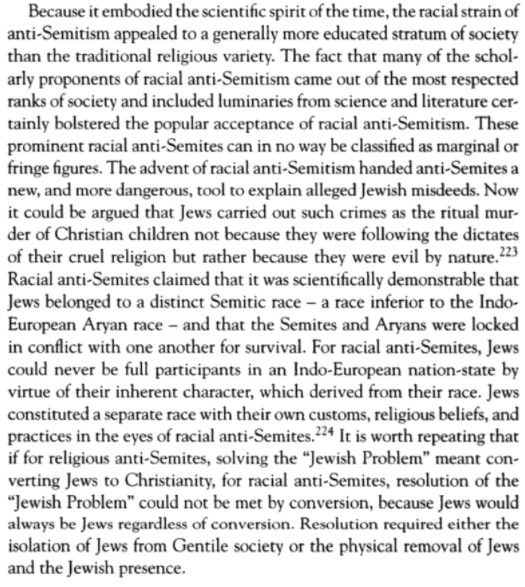
Professor William Brustein’s book, Roots of hate delves deep into pre-Holocaust anti-semitism in Europe

Adolf Hitler was a complicated man to understand. Forests have been felled to publish books speculating his inspirations and motives. Most scholars however agree that although Hitler distanced himself away from Christianity in his later years, he leaned heavily towards christianity in his early years. His catholic upbringing, his admiration for
Why did so many BAME (Black, Asian and Minority Ethnic) voted Tory? (a)

This is a follow up to:

Why did so many BAME (Black, Asian and Minority Ethnic) voted Tory?

It appears that Jews, Indian and African Britons abandoned Labour in droves and voted for other political parties. Would be curious to learn who they voted for. Suspect many voted for the Liberal Democrats.

As described by Veedu Vidz in the above previous Brown Pundit post, moderate muslims also appear to have abandoned Labour en mass. Who did moderate muslims vote for?

Are there any English exit polls? [Updated with this exit poll hat trip Ali Choudhury.] Do we know how Pakistani Britons, Bangladeshi Britons, Indian musiim Britons, muslim Britons in general voted?

In the above conversation it was implied that minorities and people of color in USA vote Democrat. My response is that in America Asian Americans and Latino Americans are “swing voters” not wedded to either party. Black African Americans vote overwhelmingly Democrat. However, I think President Trump will likely do a lot better with the Black African American vote in 2020 than he did in 2016.

From page 26 of the exit poll provided by Ali Choudhury, we can see the following:

  • Labour lost only nine percentage points of the BAME vote
  • Conservative Tories gained only one percentage point in additional BAME voters
  • Liberal Democrats gained only six percentage point in additional BAME voters
  • Other political parties gained two percentage points of additional BAME voters

Labour–if these exit polls are not contradicted by other exit polls–did FAR better in 2019 among BAME voters than I thought (and that many political commentators thought). To my surprise the Liberal Democrats only gained six percentage points of BAME voters (for 12% total) and the Conservative Tories only gained one percentage point in additional BAME voters.

My new question is why did the overwhelming vast majority of BAME Britons vote for Jeremy Corbyn? Why did so few BAME Britons vote Liberal Democrat?

Did the moderate muslim Britons almost universally vote for Jeremy Corbyn? If so, why? Would love to hear from Veedu Vidz and Rakib Ehsan.

Why did so many BAME (Black, Asian and Minority Ethnic) voted Tory?

https://www.youtube.com/watch?v=hmz97E0z8Sc&t=785s

Another amazing podcast from Veedu Vidz–heartthrob of England. {Sisters, he is already owned by Mimzy and unavailable. Sorry.}

Start watching from 25 minutes in. Some take-aways:

  • Chinese earn the most per hour of any group in Britain.
  • Indians earn the second most of any group in Britain. {Chinese continue to economically outperform Indians globally and in Britain.}
    • Do Chinese and Indians really earn more per hour than English Jews? I am skeptical. What is beyond all doubt is that British caucasians are massively academically and socio-economically under performing Jews, Chinese and Indians.
  • The sample sizes for Chinese and Indian Britons is too small to know how they voted for certain. But it is possible that Chinese, Indian, Sikh Buddhist Hindu and moderate muslim Indians voted against Jeremy Corbyn in part because of Corbyn’s close alliance with conservative Sunni and Islamist groups.
  • Before 2019, Pakistani and Bangladeshi Britons  use to heavily vote for Jeremy Corbyn and Labour.
    • Brown Pundit favorite Sajid Javid has received a lot of abuse for being a muslim Tory.
  • Tory Priti Patel (who I just heard about for the first time) has also received a lot of abuse.
    • (Is part of the English anger at Priti Patel jealousy over the socio-economic success of Indians? Given how many Indian Britons vote Tory, how can it be because of that?)
    • Priti Patel wants a point based (merit based) immigration system. (Why is this controversial among caucasian English people?)
  • There is a great deal of diversity among the British muslim population
  • Veedu Vidz says that Boris Johnson is anti everyone who is not Boris Johnson.
  • 38 minutes in discusses deep anti Jewish bigotry on the part of English caucasians, the Labour party and Jeremy Corbyn.
    • comes from the far left
    • comes from the far right
    • need to focus a lot more on muslim anti Jewish bigotry
  • 43 minutes in, many working class caucasian and BAME voters probably are voting Tory in part because they are so scared of being accused of racism by their representatives for asking questions.
  • 46 minutes in, Labour has lost its moral legitimacy on racism, bigotry and sectarianism. Labour and the BMP are the only two parties in English history to be investigated by the Equality and Human Rights commission for misconduct.
  • 58 minutes in, many poor and working class caucasian britons have suffered from globalization and have no privilege at all. Labour should stop accusing them of having non-existent privilege.
  • 60 minutes, many Labour try to blame the world’s social ills on Britain. (I am stunned that this still happens. England has been falling apart for generations and is in many ways more backwards than many of her former colonies. Talk about delusions of grandeur.)
  • 63 minutes in Veedu asks if Hindus have an advantage over muslims in Britain.

My questions:

  • I get why many Britons felt they could not vote for Corbyn and Labour. Why didn’t more vote Liberal Democrat?
  • Can anyone send me an exit poll with granular detail on 2019 UK voting patterns?

++++++++++++++++++++++++++++++++++++++++++++++++++++++++++++

Update 1:

Maajid Nawaz Gob-smacks Corbyn and says Corbyn beat Corbyn.

https://www.youtube.com/watch?v=eeni-2J_fYs

+++++++++++++++++++

Update 2:

Katie Hopkins is a Member of the Tory party and is trying hard to create an alliance between the UK and India (and presumably the Dharmic world more generally). The alliance would focus on resisting:

  • Globalism (which she mostly defines as post modernist wokeness, perhaps combined with pro business free markets to a lesser degree)
  • Islamism
  • Feminism (by which I think she means third wave woke post modernist intersectional femnism)

To simplify, I think she mostly means post modernism and Islamism. She appears to think the Europe will divide into Islamist hamlets and non Islamist hamlets. And that Europe and the world as a whole needs India’s and America’s help to survive.

Could the UK government pursue an alliance with India focused on post modernism and Islamism? Could this end any remaining Indian sensitivity about being colonized by the UK? Is this being facilitated by Indian Britons and perhaps muslim Indian Britons leaving the Labour party?

Sham Sharma has speculated that Indian Americans could wholesale flip to the Republican Party similar to the flip of Indian Britons between 2017 and 2019? Could this really happen?

+++++++++++++++++++++++++++++++++++++++++++++++++++++++++++++++++

Update 3:

https://www.youtube.com/watch?v=YkpnSU6ceg8

It is possible that British Asian, African, ethnic minority, poor and lower middle class European ancestry voters were scared about anti Jewish bigotry:

https://www.youtube.com/watch?v=ZSmUU7t2zgc

As a side note, the UK has very different issues than the USA. For example UK students perform far better in math than Americans. 13% scored 5 or higher in the 2018 OECD PISA test, compared to 8% of Americans.  Immigrants appear to slightly academically underperform non-immigrant Brits across reading, science and math, although mathematical performance  was not provided. The definition of “disadvantaged students” in the report was unclear.  Between 2009 and 2018 the number of immigrant students has risen from 11% to 20%. One third of immigrant students are “disadvantaged students.” Math results for England have been rising over time and girls sharply outscored boys in mathematics, science and reading.

+++++++++++++++++++

Update 4:

According to Nimco Ali (patriotic Briton who happens to have Somali muslim ancestry) most African Britons vote Tory. She is a leading campaigner against female genetic mutilation and says that Tory leaders, Tory moderate muslims and Tory Indians (Priti Patel ) are backing her. Nimco also fights for muslim woman to have the right not to wear the hijab, and again says that she gets support from many Tory leaders, Tory moderate muslims and Tory Indians (Priti Patel ). She is very aspirational. She says that in Britain the aspirational BAME are African Britons and Indian Britons. Both back the Tories. The less aspirational Britons are Pakistanis and they tend to support Labour and Jeremy Corbyn. I am guessing that Bangladeshis are in the middle.

I wonder why more African Britons don’t vote Liberal Democrat. My main man Maajid Nawaz is Liberal Democrat. I get why African Britons don’t like Jeremy Corbyn.

Nimco Ali says that Briton has recently prosecuted several muslim Britons for female genetic mutilation of children. Until recently no Briton was prosecuted for female genetic mutilation. About a tenth of mothers giving birth to children in many British hospitals have had FGM. Kudos to Boris Johnson, Brown Pundit favorite Sajid Javid, Priti Patel and other Britons for trying to end FGM!

Afghanistan’s History (a)

Special thanks to Mayuresh Madhav Kelkar for sending this. I would start watching this excellent Dari Farsi documentary 1 minute 19 seconds in. There are many excellent ancient maps of central and south Asia.


I just want to watch this again and again, just to listen to the narrator’s voice. Majestic, wise, soft and sweet. For those so sure Afghanistan will fall; any nation with voices like this is perchance stronger than she appears. This may be where the homo sapien sapien modern civilization was born.

+++++++++++++++++++++++++++++++++++++++++

Afghanistan’s History


Avtar Singh Khalsa: Lion of Afghanistan

Is it time for Asian Americans and Latino Americans to ask to be considered “white”? (d)

This is the next article in the series “Is it time for Asian Americans and Latino Americans to ask to be considered “white”, “Is it time for Asian Americans and Latino Americans to ask to be considered “white” (a)”,  Razib’s  “Hasan Minhaj’s Patriot Act on Affirmative Action“, “Is it time for Asian Americans and Latino Americans to ask to be considered “white” (b)” and “Is it time for Asian Americans and Latino Americans to ask to be considered “white” (c)”.


A middle eastern student shares how deeply offensive a condescending pretentious patronizing xenophobic post modernist baizuo caucasian is towards them. The baizuo caucasian tells the middle eastern student that he is a genie for solving a math problem and then apologizes for it afterwards, since after all the word “genie” comes from the middle east. Two phenomenons might be at play. One is baizuo. The other is anti muslim islamaphobia.


If this is coming from baizuo, this is a very old problem. It comes out of European imperialism in the 1700s and 1800s. The European intelligentsia tried to colonize the minds of their imperial colonial subjects with inferiority complex to damage their self confidence. Europeans also tried to deconstruct colonized peoples, causing them to be embarrassed by, hate and reject their ancient history, technology, science, product development, process innovation, civilization, culture, religion, spirituality, art, literature, institutions, ancestors and elders. Post modernism divided colonized peoples into many categories of oppressed and oppressors (mostly manufactured irrational concepts) to turn different groups of people against each other; implying that power oppression rather than meritocratic competence defined local hierarchies. This European colonization of the mind sharply lowered total factor productivity and material living standards in the developing world ceteris paribus. The Latinos, Africans and Asians got sick of it, and kicked the Europeans and their baizuo European intelligentsia out. You can read more about this in a Nuanced understanding of British Colonialism.


Sadly the baizuo caucasian intellegentsia did not seem to learn from this. In the 1960s they tried to undermine America’s heroes Muhammed Ali and Malcolm X. Please watch Muhammed Ali’s and Malcolm X’s videos speaking about the baizuo in American Caste (a). And the baizuo seem to continue to get worse year after year. I don’t understand how this is happening. Perhaps could this be a xenophobic jealous backlash against the accelerating socio-economic rise of the rest–especially darkies?


What can we darkies do about this? Should we ask to be considered white?


To the middle eastern student who wrote Prof Saad, maybe the caucasian overlords should learn that the vast majority of Aryans are Asians. Asians (Iran, Afghanistan, Uzbekistan, Xinjiang, Tibet, Turkmenistan, Tajikistan, SAARC, South East Asia) are very proud to be Aryan or Arya, thank you very much. Arya or Aryan is a cultural rather than genetic marker. Arya means nobility. Maybe ignore the baizuo and become extremely successful in everything you do despite their efforts to sabotage you. Fewer and fewer foreigners are fooled by the hard bigotry of low expectations, by the lie that we cannot manifest our own miracles. Their time is almost up.


I would like to thank Prof Saad for being a glowing light of wisdom and inspiration for our world. Love you Saad!


In the comments, please mention if anyone would like to invite Prof Saad to be a guest for the Brown Caste podcast.

Post Modernism (d)

Five thousand years ago the greater Egyptian, Sumerian, Eastern (defined as pan Arya plus China) civilizations were very mathematically oriented.  Many caucasians appear to believe that these ancient civilizations were racist. Possibly because of this many caucasians believe that math is racist.


Another possible reason many caucasians appear to believe that math is racist is because they fear it might unfairly advantages “brown” people (Asians, Arabs, Latinos) and “brown” cultures (eastern philosophy including Toaism and Confucianism, native american religion) at the expense of caucasians in the new global artificial intelligence, neuroscience, genetics economy.


Could part of the anger against math come from fear that mathematics, science, technology, seeking the truth through thought, seeking the truth without thought might be haram or blasphemous? (Obviously most Abrahamics do not believe this and this is not a critique of Abrahamism.)


I believe that mathematics is part of art; and that it derives from beyond normal gross thought. From what in Sanskrit is called Buddhi, Vijnayamaya Kosha, Ananda Maya Kosha, Sukshma Sharira, Kaarana Sharira, the subtle heavens.


Perhaps the anger against mathematics is part of a deeper anger against the subtle heavens? If so, one possible way to look at this is that to transcend the subtle heavens (including mathematics) it might be helpful to love them and love our way through them. Or to love and respect the racist (subtle heavens–including mathematics) until we transcend the various subtleties of thought and feeling.

What are everyone’s thoughts?

+++++++++++++++++++++++++++++++++++++++++++++++++++

Post Modernism (c)

Post Modernism (b)

Post Modernism (a)

Intellectual Dark Web (a)

Intellectual Dark Web

Kailasha and Soma central to Arya culture?

Please read the following:

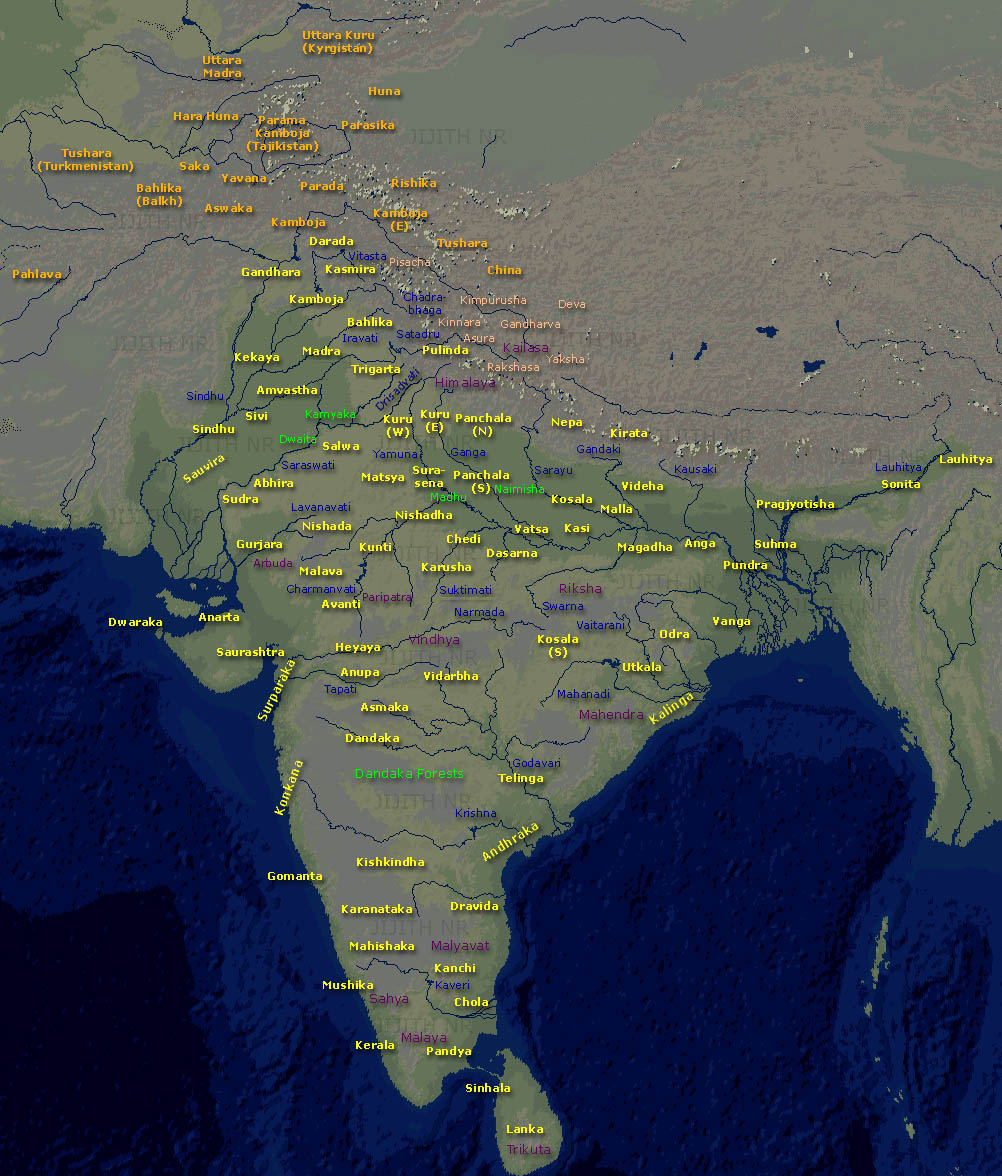
Is the famous Mount Soma another name for Mount Narodnaya? I don’t know. Many have been trying to identify the famous Mountain Soma–which appears in so much of ancient Arya literature and is one of the most important sources of Arya culture. Mount Soma is in Uttara Kuru. Soma, also called Chandra, is synonymous with the moon. Which means that the moon, and Monday (Moon Day or Selene Day or Luna Day), are very closely connected with this mountain. The famous Chandra vamsha or Soma vamsha (or Jati of Moon and Monday) originates from Mount Soma.

Long ago the seventh Manu (Vaivasvata Manu or progenitor of hominids) had a son called Ishvaku, father of the Surya Vamsha (or Jati). For tens of thousands of years hominids came from the Ishvaku dynasty, including during the time of the Ramayana. Then, based on my interpretation of the texts, tens of thousands of years later a new hominid came called Illa. Illa, another daughter of Vaivasvatu Manu, lived for many, many generations of normal humans (which suggests that she is a different species, or alien, or had some type of advanced medical technology to avoid aging, or was born multiple times the way the Dalai Lama is.) She was a great proponent and practitioner of daily gender fluidity, changing gender hundreds of times. At times she was androgynous with no gender or parts of both genders. There are many Ardhanarishvara class beings in the east. In fact the goal of spiritual practice in the eastern philosophy is to transform ourselves into an Ardhanarishvara. To be a perfect man and perfect woman at once. Eventually transcending all philosophies, all genders,  all concepts, all forms and all qualities.

This gender fluid Illa is the progenitor of the Chandra Vamsha. She married Budha (Mercury or Hermes or Woden [Odin]), and had a son called Pururavas. Budha is a personification of the planet Mercury and Wednesday (day of the week). In the eastern system Mercury is the de facto son of the Moon and the de jure son of Jupitor (Zeus or Thor). The legal consort of Jupitor (Brihaspati), mother of Mercury (Budha) and combination Guru/mentor/friend/lover of the Moon is Tara.

Illa had many children, both as a mother, father and androgynous being. Her son Pururavas was also from Mount Soma (associated with the Moon). He married the Apsara (or different branch of hominid or non hominid or alien) Urvaśi. As an aside Illa answered some of the most asked questions of all time:

  1. Is it better to be a man or a woman?
  2. Who enjoys life better?
  3. Who enjoys reproduction more?

For readers slow on the uptick, the obvious answer to these much asked questions is very simple . . . woman. This is yet another reason woman are considered far superior to men in the east. [Krishna said that woman have seven divine qualities versus men having only three divine qualities.]

Let me posit a hypothesis for consideration and testing. Might the Surya Vamsha be an allegorical reference to the south east Asian branch of humans from 50,000 to 75,000? Might Chandra Vamsha be a reference to the the Iranian or Turan farmer from around 9,000 years ago? How can these hypothesis be tested?

What is Mount Soma, which along with Mount Kailash is central to Eastern and Arya philosophy? Other than Mount Narodnaya what other tall mountains west or north of South Asia could it be? Note that Sugreeva says not to go north of Mount Soma. Could this be because of the northern Polar ice cap? Are the areas north of Mount Soma a reference to Aurora Borealis?

“On passing beyond that mountain in Uttara Kuru, there is a treasure trove of waters, namely vast of Northern Ocean, in the mid of which there is gigantic golden mountain named Mt. Soma. Those who have gone to the sphere of Indra, and those who have gone to the sphere of Brahma can clearly see that lordly Mt. Soma, situated in the vast of ocean from the vast of heavens. Even though that place is sunless it is comprehensible as if with sunshine, since it is illuminated with the resplendence of Mt. Soma itself, which will be irradiating that place as if with the resplendence of the Sun. The God and Cosmic-Souled Vishnu and Shambhu or Shiva, an embodiment of eleven selfsame Souls, called ekaadasha rudra-s , and the god of gods Brahma who is surrounded by Brahma-Sages, will be sojourning on that Mt. Soma.”

This suggests that Mount Soma is also a reference to deep personal mystical experience. Note that the eleven Rudras are a reference to Shiva. In the ancient Vedic Samhitas 33 gods are repeatedly referenced [12 Adityas + 8 Vasus + 11 Rudras + two others]. This has many layers of meaning which can only be understood through deep meditation. One layer of meaning is 33 sections of the spine. From a certain perspective the 33 Gods are when someone enters Samyama or Samadhi with respect to 33 different parts of the nervous system. This might also be linked to a common theory among  neuroscientists that the human brain has 33 senses instead of 5 senses. Mount Soma is linked to Monday, the Moon, and the 8 Vasus (one of which is the moon). 

Continue reading Kailasha and Soma central to Arya culture?

Afghanistan’s History

Afghanistan’s History

There are several perspectives on Afghanistan’s name. Afghanistan’s name might come from “Upa-Gana-stan”:

  • “Upa” with a choti “a” at the end or “उप” means near
  • “Gana” or “गण” I believe might be a reference to Shiva’s Ganas (gouls, ghosts, unusual looking beings . . . possibly a reference to non homo sapiens of some kind, some say aliens)
  • “Stan”, I don’t know. Is this “Sthaana” or “स्थान”? If so this might mean position or venue or station or field or throne

An extremely wise fellow contributor from Brown Pundit reminded me of two other ancient names used for Afghanistan:

  • Panini’s Aṣṭādhyāyī refers to Afghanistan as ash-va-kaa-na (अश्वकान​).
    • Please note that the Aṣṭādhyāyī  is much older than Patanjali who is considered millennia older than Krishna. Traditional scholarship of Aṣṭādhyāyī  places it more than 7 thousand BC, which is not to say that the Aṣṭādhyāyī  has not in any way been modified since then.
  • Pakrit name “a-va-gaa-nna” (अवगान्ना).

The oldest part of the Rig Veda samhita refers to:

The top hyperlinked article also alleges:

  • “The Pakthoons are descendants of the Paktha tribe mentioned in Vedic literature.”
  • “Archaeological excavations in this region conducted by Sir Estine (an East India Company official) led to the recovery of uncountable shrines and inscriptions. He has authored four books on that topic featuring photos of icons, icons and inscriptions discovered. The photos show a sun temple and a Ganesha statue too. An Islamabad University professor Abdul Rehman has authored two books on those finds recalling the glory and prosperity of those times.”
  • “Regimes of two Hindu rulers “Kusham” and “Kidara” lasted for fairly long periods. During their rule a number of Shiva temples were not only in Afghanistan but in other West Asian regions too. Uzbekistan and Takzikistan formed part of the Afghan kingdom in those times. Tashkent has one of those ancient Shiva temples standing even today.”
  • “Professor Abdul Rehman states that Bukhara region Was known as “Shah Vihar” in ancient times. It was ruled by an Hindu king. When Arabs invaded that kingdom its queen traveled to Kashmir to seek military help. Arab chronicles mention her as ‘Khatoon’, meaning ’Woman’.”
  • “An Ayurvedic practitioner of Varansi (alias Benares) had treated the Khalifa for some ailment afflicting the latter. In those days it was Hindu Ayurvedic practitioners who were eagerly sought by Arab patients. A number of Arabs had translated Sanskrit Ayurvedic texts into Arabic. A list of those translated Sanskrit texts appears in a Volume known as al “Frisht“.”
  • “Baku (capital of the Azerbaijan region) known for its underground petroleum yields has still an ancient Hindu temple of the Divine Flame generated by the subterranean petrol and gas). During the Czar regimes in Russia a Punjabi priest officiated at that temple. The walls display some religious stanzas written in Punjabi Gurumakhi script. The market there also had Hindu merchants. Nearby was a locality too of Hindu inhabitants. Baku in Azerbaijani language actually signifies a Goddess. Therefore obviously Baku derives its name from a very ancient Vedic Goddess temple there.”


Afghanistan is also central to the ancient Sharada civilization:

The Sharada civilization [Afghanistan, Northern Pakistan, Kashmir] represents many things. One is the convergence of the six major Shaivite schools (not just Trika) within Uttara Mīmāmsā (Vedanta) and the four major Tibetan schools via the shared 84 Siddhas. Later large streams within Sufism joined this convergence [which might be the topic of a future researched article].

Legend of Rama: Antiquity of the Janmabhumi Debate argues that many places of great significance to the Ramayana and Puranic stories are in Afghanistan:

In the opinion of Wilson the renowned Vedic translator Kandahar is similar to the Rig Vedic word Gandhara. Wilson further observes,:

Ibn Haukil mentions that in his time there were remains of a considerable city more to the west, by the people of which, Zaranj was built. He calls this places Ramshhristan, a curious compound of Indian and Persian appellations.

There were ruins ‘at astonishing number’ in Herat, at Farrah, and Peshawarun–all sites near the province of Dranjiana connected with the Vedic dynasty of the Srinjayas [who were prominent during the 18 day Mahabharata war]. It therefore becomes all the more curious to hear the name of the place called Ramshehristan.

Panini, the eminent grammarian of Sanskrit, lived here in about 350 BC. [for the record I think Panini lived far earlier and before Patanjali] In his composition of the a sutra (4.3.93) on the Sindh and Takshasila class (gana-patha), he includes Sindhu, Varnu, Madhumat, Kamboja, Salwa, Kashmir, Gandhara, Kishkindhya, Urasa, Darada and Gandika. These are geographical names and lie in the trans-Indus regions. The place mentioned by Panini as Kishkindhya is today known as Kalat in Baluchistan. A great linguistic puzzle is that the local people call Brahuis speak in a Dravidian dialect.

Afghanistan was not the name of a country before 1747 AD. The lands lying to the est of the River Indus were called by different times as Kamboja, Bahlika, Madra, Aratta etc. in the north; as Sarayu (Horayu) in the north-west; as Sarasvati (Harahvati) in the south-east; as Gandhara in the center; as Zranjiana in the south-west and as Kishkindhya in the south.

. . .

They were of five streams or Pancajanas. Their leader was Visvamitra, who lived in Satudri-Vipasa valley (RV III.22.1). They fought against the Srinjayas under Vasistha in the famous battle of the ten kings.

Several waves of the new people, the Aryan races–Druhyus, Turvasus and Anus went westwards from these places. These groups are variously known in traditional literature as the Persians (Parsu), Medians (Madras), Parthians (Prithus), Hyksos (Yaksus), Mittanians and Helenes (Alinas) etc. They originally settled at a places known as Shortugai in Badakhshan in North Afghanistan. Old Sumerian texts as also the descriptions in the Baudhayana say that Aratta was Badakhshan, Balkh, or Bactria in Central Asia. From here, they exported lapis lazuli to the Sumer. The Sumerian epic, Enmerker and the Lord of Aratta describes this in detail. The epic, found in the clay tablets of Boghaz Keui is dated c. 1700 BC. In the Mahabharata, Karna derides the Madras and Arattans as being lowly people! [in conversation with Salya during the 17th day of the Kurukshetra war]

. . .

The name Srinjaya is similar to Zaranj and Sarangaei of the Iranians, old Persians and the Greeks. These were the names of the Iranian tribes who lived according to Herodotus in Zranjiana or Dranjiana, an area on the River Sarasvati or Horahvaiti in the Arochosia-Helmand region. Divodasa, greatest among the Rig Vedic kings, was a Srinjaya. He was born here.  . . .

Horahvaiti region i.e. the Helmand-Arachosia region of what is today western Afghanistan . . .

Heldebrandt, one of the earliest scholars on the Ramayana in the West, was of the view that Sarasvati was the river Arghandab (Horahvaiti of the Zend Avestaiver, ) in Arachosia of modern Afghanistan (then Iran). Brunhofer, another scholar of the epic, adopted the Iranian link. Zimmer was in favour of placing the Rig Vedic Sarasvati in this area. Recently, Burrow has held that the early Rig Vedic Sarasvati  was the River Horaxvaiti of Iran, and the River Sarayu was the Afghan, Horayu. Among the Indian scholars, Jaichandra Vidyalankar, after a detailed rumination, identifies Sarasvati as the Iranian Haraqvati . . .

The Ishvaku, the family Ram belonged to, and the Vasistha family were linked to a very early time of the Rig Veda, originally from the north and north-west region called Harirud of modern Afghanistan, on the bank of the River Horayu, mentioned in the Avesta. Only in the Rig Veda there is the name Sarayu. In the same way, still earlier, the family of Atris hailed from the banks of the River Rasa in the region of South Russia and North Afghanistan today. In a very early hymn in the Rig Veda (53.9), Sage Syavasva Atreya extols in glory a fleeting dolumn of the Maruts moving southward–the horse-borne storm troopers. In the course of their journey, they cross the rivers Rasa (Ranha or Oxus, in modern South Russia), Krumu (Kurran), Sindhu (Indus-between Pakistan and India today) and Sarayu (Horayu or Harirud)

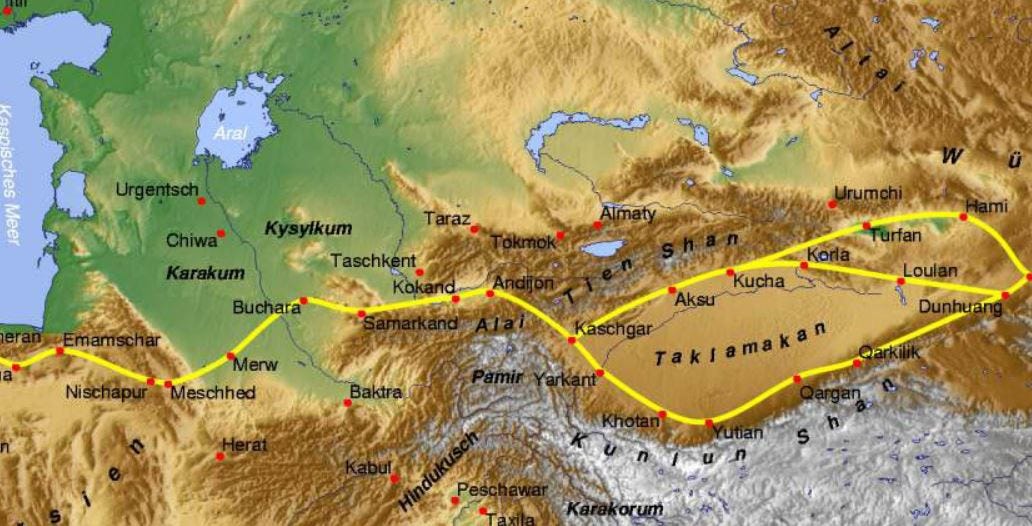
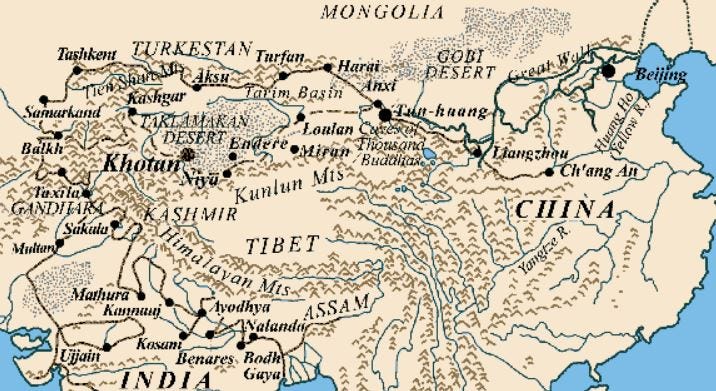
Most people do not know that until about a thousand years ago, the Tarim Basin (northwest of Tibet, which is the part of Xinjiang below the Tian Shin Mountains) was Indic in culture and it was a thriving part of the Sanskritic world; its people spoke the Gāndhārī language which many see as descended from Vedic Sanskrit, and Khotanese Saka, which is also closely related to Sanskrit. Perhaps the region to compare it most is Kashmir, to whose north it lay. There was also much interaction between the two regions with many scholars traveling from Kashmir to Khotan, and silk culture is believed to have passed from Khotan to Kashmir and then into India.

Gāndhārī inscriptions have been found as far east as Luoyang and Anyang in Henan province in Eastern China which attests to the vastness of the influence of Sanskrit. Europeans in recent centuries called the whole region Serindia, indicating the meeting place of China and India.

Khotanese kings were Mahāyāna Buddhist but as we know this sect incorporates Vedic and Tantric systems, with all the devas such as Indra, Śiva, Viṣṇu and Sarasvatī, and just places the Buddha at the head of the system (as in Vidyākara’s Treasury). There was also Krishna worship in Khotan and we find the Rāma story in Khotanese language, of which there is also a Tibetan version.

The above article from Subhash Kak continues:

The traditional date for the   of Khotan, on the southern and the more ancient branch of the Silk Road, is the reign of Aśoka Maurya (3rd century BCE). It was ruled by Buddhist kings until it was conquered by the Muslims in 1006. Some of the kings mentioned in the “Prophecy of the Li Country”, composed in 746 CE, dealing with events of the recent past are Vijaya Kīrti, Vijaya Saṅgrāma, Vijaya Dharma, Vijaya Saṃbhava, and Vijaya Vāhana.

Many Khotanese cities had Sanskrit names. For example, Khotan in Sanskrit was Gaustana गौस्तन and the modern city of Kashi (Kashgar) was called Śrīkrīrāti (in Sanskrit Śrī+krī+rāti, श्रीक्रीराति, ‘Glorious Hospitality’). Kashgar itself appears to be the popular name from Sanskrit Kāśa+giri (काशगिरि, bright mountain). The Khotanese called their language hvatanai ह्वतनै which later became hvaṃnai ह्वंनै; this is equivalent to the name deśī that is used for language in India (vatan, from svatana = deśa).

The liturgical texts in the region were written in Buddhist Hybrid Sanskrit, whereas those in the region of Krorän (Chinese Loulan), an important oasis further east of Khotan, used Prakrit in administration. A third language called Tocharian was also used both to translate Buddhist texts and as an administrative language. Many Sanskrit texts of India remember the general region as Tuṣāra or Tukhāra, and it retains currency as a popular proper name.

Another major language was Khotanese Saka, which is sometimes seen as an eastern Iranian language (that is emerging from the region just west of Kashmir). But since the large number of the Śaka who ended up in India as rulers or soldiers have always spoken the more easterly Indo-Aryan languages, I personally believe that the Saka languages were largely Indo-Aryan, although as one traveled further west, the Iranian elements increased.

That Khotanese Saka was principally a Indo-Aryan Prakrit is reinforced by the fact that the texts are in Indian scripts of Brāhmī and Kharoṣṭhī. Many of these documents were collected in archaeological explorations to Chinese Turkestan by Aurel Stein, who is also known for his translation of Kalhaṇa’s Rājataraṅginī. Stein came across tens of thousands of manuscripts from 5th to 11th centuries in various sites including the Caves of the Thousand Buddhas in the Kansu (Gansu) province. One of the principal scholars who edited and translated many of these texts was H.W. Bailey and this literature remains a popular field of study for scholars.

Aurel Stein says in his celebrated Ancient Khotan: “There was little to prepare us for such overwhelming evidence .. on the large place which Indian language and culture must have occupied in the administration and daily life of this region during the early centuries of our era. That Sanskrit Buddhist literature was studied in Khotan down to the end of the eighth century A.D. has been proved beyond all doubt by the texts in Brāhmī script which I excavated.”

The mummies of Tarim Basin

The discovery of the Tarim mummies that go back to 1800 BCE strengthen the view that the region was Sanskritic. The earliest mummies in the Basin are exclusively Caucasoid, and the American Sinologist Victor H. Mair has said: “Because the Tarim Basin Caucasoid corpses are almost certainly the most easterly representatives of the Indo-European family and because they date from a time period that is early enough to have a bearing on the expansion of the Indo-European people from their homeland, it is thought they will play a crucial role in determining just where that might have been.”

Some have suggested Europoid identification to explain the blonds and red-heads among the mummies, but there is no need to travel thousands of miles to Western Europe to explain this; Kashmir, just south of the Basin has plenty of red-heads and blonds.

One of the DNA studies notes that the population had “relatively close relationships with the modern populations of South Central Asia and Indus Valley, as well as with the ancient population of Chawuhu.” This is perfectly reasonable if the original inhabitants of the region were from Indus Valley [code for India] and they left a genetic trace in the region.


My own interpretation is that the Vedas, Purana Itihasas, Ramayana and Mahabharata  refer to some places north of Afghanistan in Turan (perhaps Sudakshina‘s army in the Mahabharata came from Turan) and west of Afghanistan in Iran (some believe that Pahlava refers to Arjuna‘s, Abhimanyu‘s, Parakshit‘s and Janamajeya‘s and Ashwamedatta’s ancestral line). Some even claim that the temple of Baalbek in Lebanon

https://www.youtube.com/watch?v=0_p5yU4YGWI

and temple of Delphi in Greece are very closely connected to Arya culture and temples in the east:

Hopefully future articles will be written about Turan, Iran and further west. Again, please read the top hyperlink in full.

Article updated.

India Still Rising

The Honorable former U.S. ambassador to India David C. Mulford’s summary of why India is rapidly becoming a great global superpower and why PM Modi might become the best PM in Indian history. My estimate is that India will have more billionaires than America in less than a generation. When this happens what is to stop post modernists from decrying “Asian supremacy”, Asian hegemony, Asian exploitation, Asian empire, Asian imperialism, Asian oppression, Asian racism/bigotry/ sectariansim? How to reduce jealousy of Asia? Or is this dark future inevitable?

Brown Pundits