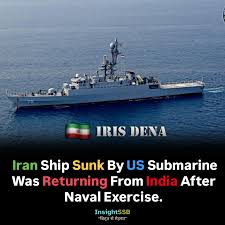
India’s Guest. America’s Kill.

On the 4th of March 2026, a US submarine torpedoed the Iranian frigate IRIS Dena in the Indian Ocean, 40 nautical miles off the coast of Galle, Sri Lanka. At least 87 sailors were killed. Over a hundred remain missing. Pete Hegseth called it “quiet death” from the Pentagon podium; bragging it was the first torpedo kill since World War II.

MILAN at Vyzag

The IRIS Dena had just left Visakhapatnam. It had been India’s guest. Formally invited to MILAN 2026, the International Fleet Review hosted by the Indian Navy, attended by 86 ships from 74 nations. The Eastern Naval Command had tweeted a welcome photograph two weeks earlier: “reflecting long-standing cultural links between the two nations.”
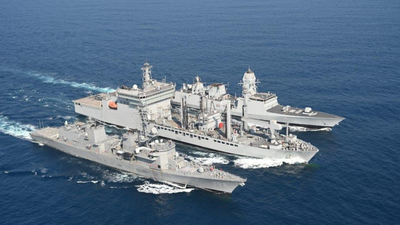
42 warships, submarines and 29 aircraft: How Navy's mega exercise MILAN unfolded - The Times of India

Two weeks later, that ship is on the ocean floor. And from New Delhi, silence. Iran’s Foreign Minister Araghchi said it plainly: Frigate Dena, a guest of India’s Navy, was struck in international waters without warning. That line will not be forgotten in Tehran. It should not be forgotten in New Delhi either; because it is the most precise summary available of what Modi’s diplomatic positioning has actually cost India.

When guests are murdered

Image

Say what you want about Pakistan’s post-colonial elite; and there is plenty to say. But since Pahalgam they have been reading the room better than New Delhi has. Not because Islamabad became richer or more competent. Neither of those things happened. What happened is simpler: when the bombs fell on Iran, Pakistan said nothing loud, and that silence was itself a signal. Across the Muslim world that signal was heard. Loyalty travels farther than power. Whether that loyalty is strategic or genuine is a separate question. The effect is the same.
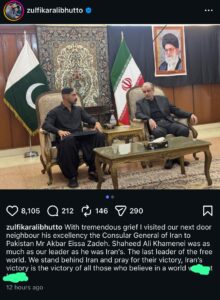
Pakistan Post-Pahalgam Continue reading India’s Guest. America’s Kill.
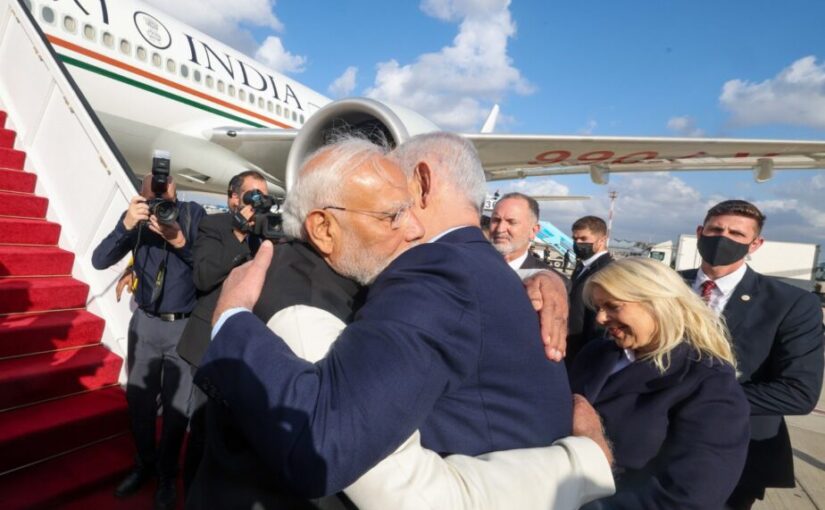
Modi Puts India Firmly in the Israel-US Camp

Modi’s strong support for Israel – and refusal to condemn the Israel-U.S. strikes on Iran, a long-time friend of India’s – have ā€œdiminished India’s stature in the eyes of the world.ā€

Journalist Bharat Bhushan wrote in Deccan Herald that with the recent visit, Modi has put India ā€œfirmly in the U.S.-Israeli camp.ā€

That is not a space that India should be in if it is hoping to lead the Global South, especially in the context of Israel’s continuing war on Gaza and the latest Israel-U.S. military strikes on Iran.


What Was the Point of Israel’s Iran Strike?

The Limits of Provocation

At some point, the world will have to ask: what exactly was Israel hoping to achieve?

In the days following the dramatic escalation between Tel Aviv and Tehran, we are left not with clarity but with a deepening sense of confusion. If the intention was to disrupt Iran’s nuclear program, there is little to show for it—centrifuges still spin, scientists remain in place, and the infrastructure of Iran’s deterrent capability stands unshaken. If the aim was to trigger chaos within the Iranian regime, then that too has failed—Tehran did not descend into disarray; it retaliated, measured and intact. And if the goal was symbolic, to remind the world of Israel’s reach and resolve, then the moment has already passed, clouded by questions of proportionality, legality, and consequence.

For all the fire and fury, the strike landed with the strategic weight of a gesture. Continue reading What Was the Point of Israel’s Iran Strike?

šŸ•Šļø On Iran, Israel, and the Right to Self-Defense

Why loving Israel, believing in peace, and opposing regimes means defending Iran’s right not to be bombed.

Dear Friends,

I don’t usually write about politics. And when I do, I try to centre peace — not provocation.

Anyone who knows me knows I have always believed in the dignity of Israel, the rights of Palestinians, and the intertwined destinies of both peoples. I love Israel. I love Iran. I believe in Palestine. I believe in peace. And I believe that each nation — each people — has a right to their own story, their own future, and yes, their own defense.

Which is why I write today, with care and some sorrow, in response to the recent Israeli strikes on Iran’s nuclear facilities. Let me be clear: I oppose the Iranian regime. Vehemently. I stand with the brave women and men who chanted ā€œZan, Zendegi, Azadiā€ — women, life, freedom. But I cannot condone this unprovoked assault.

Read the rest at this link and please subscribe to my newsletter.

Israel, India, and the Rise of Defensive Asymmetry

A Pause in the Offensive:

Without getting into the ideological or emotional dimensions of current conflicts, one point stands out: both Israel and India seem quietly surprised by the defensive resilience of their adversaries.

Whether it’s Iran-Israel, India-Pakistan, or even Russia-Ukraine, a pattern is emerging: offensive campaigns that assumed rapid success are stalling against increasingly capable—and surprisingly tenacious—defensive postures.

In classic military doctrine, a successful offense requires a 3:1 superiority. That logic appears to be inverting. What we may be witnessing is a shift in the scientific and technological balance—not just in weaponry, but in surveillance, cyber, and even psychological endurance as evidenced by the Iranians on national television in this clip, IMG_0631.

Continue reading Israel, India, and the Rise of Defensive Asymmetry

Brown Pundits