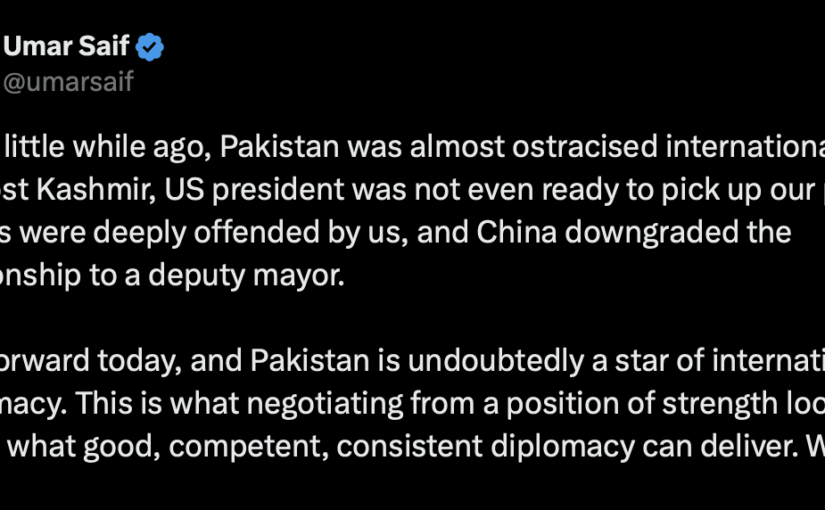
Pakistan’s Diplomatic Triumph (Trump?)

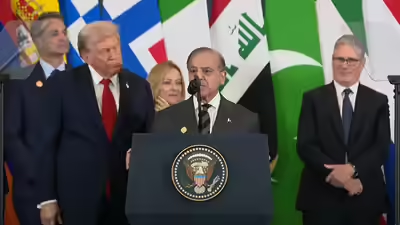
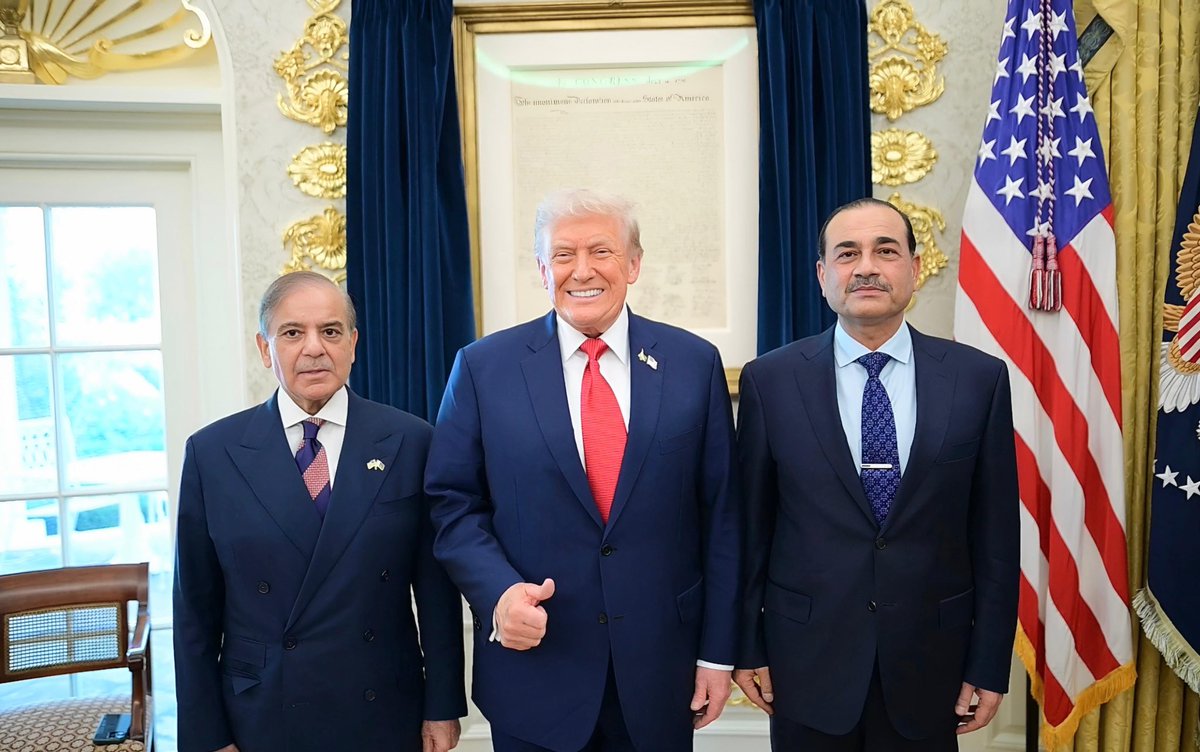
United States President Donald Trump especially thanked Prime Minister Shehbaz Sharif and “my favourite” Field Marshal Asim Munir on Monday for their efforts in achieving peace in Gaza, among many other world leaders.

Trump thanks PM Shehbaz and ‘my favourite’ Field Marshal Asim Munir for Gaza peace efforts

I might expand on this tomorrow, but it’s telling that Dr. Lalchand finds all this quite amusing—Pakistan back again with a begging bowl. I, on the other hand, see it as something closer to a post-Pahalgam pivot. Perhaps India is underestimating Pakistan’s deep instinct for adaptation, especially as the region continues to drift in unpredictable directions.

Pahalgam and Aftermath

Someone on Twitter asked me for my opinion on Pahalgam and its aftermath now that several months have passed. I wrote up a quick reply, which I am posting here. I realize I am not writing much on this blog these days, but life has been busy and I barely keep up with Twitter and reading books, this blog gets pushed down.. But lets see if this sparks some discussion. Continue reading Pahalgam and Aftermath

Brown Pundits and the Echo Chamber Problem

The Echo Chamber of the Commentariat

It has been on my mind that Brown Pundits, for all its liveliness, risks drifting into an echo chamber. The commentariat is our lifeblood: their activity sustains the blog far more than page views alone. And yet, the very strength of that community can also be its blind spot.

I do not want Kabir to end up being the Cassandra of BP, always warning of decline, and being proved right in the end. If we are not careful, we could slide into a right-wing echo chamber where challenging voices fade, and the capacity for deep interrogation, the core of what makes BP unique, is diminished.


Pahalgam and the Question of Narrative Continue reading Brown Pundits and the Echo Chamber Problem

Homebound with Ishaan Khatter

Last night Dr. Lalchand & I watched Homebound, India’s submission to the Oscars, at Apple Cinemas in Cambridge, Mass. This sad film follows a Dalit (Chandan Kumar) and a Muslim (Mohammed Shoaib Ali) struggling against the odds during the pandemic, their solidarity fictionalized as a fragile bridge across India’s deepest divides.

On the surface, it is a familiar story: the disenfranchised facing systemic barriers. But what struck me was how privilege itself performed disenfranchisement. Ishaan Khatter, brother to Shahid Kapoor, plays the marginalized Muslim. Janhvi Kapoor, descended from Bollywood royalty, embodies a Dalit woman. Vishal Jethwa, a bright-eyed Gujarati, portrays the Bhojpuri Dalit lead. This is not unique to India; Hollywood, too, casts elites as workers. Yet it raises the question: when poverty is performed rather than lived, is it “Dalit-washing”?


Poverty, Emotion, and Representation

Watching the film, I reflected on poverty’s emotional landscape. For elites, emotions can be expansive, indulgent, aestheticized into art. For the working poor, emotions are often constrained by survival — narrowed into necessity. Homebound tried to humanize its characters, but I wondered whether it romanticized what in practice is a relentless narrowing of possibility.

The West rewards this narrative. Parasite in Korea, Iranian cinema, Slumdog Millionaire — poverty & Global South tribulations as spectacle becomes “poverty porn.” The Guardian gave Homebound four stars. Great art often tilts melancholic, yes, but here the melancholia is curated for Western consumption.


Identity, Vectors, and Islamicate Selfhood

More unexpectedly, the film stirred something personal. I realized how much I have vacated my own Islamic identity. It was not traumatic. As a Bahá’í with Persian cultural roots, I found overlap — even comfort — in Hindu traditions. Dalits, in their rapid Hinduization, represent one vector of assimilation; Muslims and scheduled-caste Muslims, often in tension, another. Homebound imagines solidarity, but in life these vectors pull unequally. Continue reading Homebound with Ishaan Khatter

Pakistan: The Realpolitik State

In a recent exchange, Kabir suggested that Pakistanis often feel unwelcome in our discussions on Brown Pundits, and that constant criticism of their country creates a sense of unease. It is worth pausing to reflect on this. Pakistanis, like all of us, are shaped by history and circumstance. And yet, there is something in the cultural tenor of Pakistan that makes open engagement difficult.

I say this not to provoke but to observe. Pakistan, as a society, often leans heavily on hierarchism, patronage, and a culture of deference. To borrow an old saying about the Somalis, that every man thinks himself a Sulṭán, one might say that Pakistanis often view themselves through the prism of status and validation. This instinct is hardly unique; Indians, too, have their caste-bound privileges and invisible hierarchies. But in India, these structures are embedded in a dense cultural fabric; family, caste, neighbourhood, ritual, that, for all their flaws, anchor society. Pakistan, by contrast, feels less rooted. It is a younger country (with old traditions), with fewer inherited cultural layers to draw on.

This is not simply an abstract point. When I married, we drew freely from Hindu rituals (dual ceremonies, Bahá’í incl.), Persian customs, and Sindhi traditions, blending them into something whole. But I realised there was nothing distinctly “Pakistani” to contribute; no cultural motif that stood outside India or Iran (we didn’t do a Walima, which is Muslim). Pakistan is, in many ways, a derivation: a state forged through separation, rather than a civilization with deep roots of its own. The cultural space it occupies has been overlaid with militant nationalism and, too often, Hindu-phobia (Kabir is so inured to it that he isn’t able to recognise that but on the flipside so is the Commentariat towards Islam).

To acknowledge this is not to deny the prejudices of Indians toward Muslims, which are very real and enduring. Nor is it to ignore the deracinated, secular archetype embodied by figures like Benazir Bhutto, who seemed neither fully Muslim nor fully Western, suspended between worlds and who are the cultural elite of Pakistan (what they give up on their bridge is their Hindu origins; more than being half-Persian, Benazir’s nani was Hindu). It is simply to note that Pakistan’s cultural story remains unsettled & thus interesting.


Validation and Audience Continue reading Pakistan: The Realpolitik State

Moderation Note: On Gaza, October 7, and the Limits of Tolerance

Kabir’s Muslim nationalism cosplaying as liberalism is vexatious (it would be excellent if he just disclosed his priors), but I give the admin full authority to handle that directly.

My immediate concern is with BB-HS. I have barred him from becoming an author and have removed his last twenty comments. Despite his earlier misrepresentation about being “half-Muslim,” I allowed him to return under a new handle, tabula rasa. His output, however, is increasingly defined by “fantasies” about what a model minority should be; deracinated and devoid of meaningful character.

BB’s Response (after I had deleted his past 20 comments)

“Why though? The only animus I have is with Kabir because he represents a demographic I loathe – The soft Islamist | The ‘liberal’ English-speaking version who whitewashes his more hardcore cousins’ atrocities. Actual people have died due to Islamists which Kabir downplays (Pahalgam, October 7th). Some ribbing online is nothing in comparison. And I haven’t even said anything insulting.”

My Response

    1. Kabir is not an Islamist. He is a Muslim nationalist—since Pakistan itself is sine qua non Muslim nationalism (the idea that Indian Muslims were entitled to their own nation). Just as every Israeli is, by definition, a Zionist/Jewish nationalist, even if individuals disagree with its implications, Kabir represents that current.
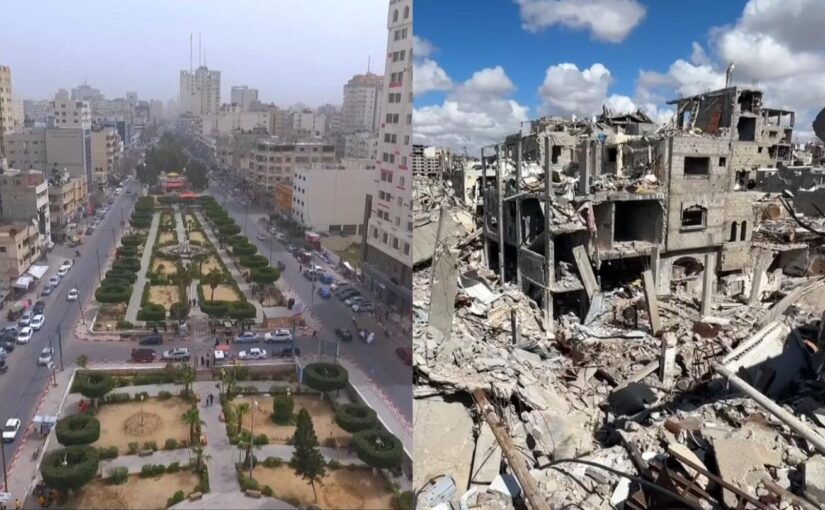
    2. What stands out is that BB mentions only Pahalgam and October 7—both undeniably tragic events, and I say this as someone who is not Muslim—while omitting the ongoing genocide in Gaza.It is akin to referencing 9/11, a devastating moment in history, without also acknowledging the destruction of Afghanistan and Iraq and the millions of lives lost in their aftermath.
    3. Unlike Kabir, vexatious, but rarely personal, BB makes his attacks direct. He is not Kabir’s friend indulging in ribbing; he is simply “Honey” under another guise.
    4. What sets him apart is an openly hierarchical stance: non-Muslim lives ranked above Muslim ones, echoing the very post-colonial divide-and-rule strategies we are meant to reject.
    5. Kabir manipulates through weaponised victimhood; BB chooses blunt hostility, lacing personal abuse into his commentary. I have permanently removed Honey’s comments for that reason, vulgarity leaves no space for debate and I treat BB and Honey as a single entity.
    6. Beneath the very different styles of BB-HS & Kabir lies the same contempt: the belief that the only acceptable minority is one hollowed out, compliant, and dead on the inside.

Moderation Philosophy

As a Founder, my job is to ensure Brown Pundits does not become an echo chamber. I have repeatedly critiqued Kabir’s contradictions, but once I accepted him as a Muslim nationalist cosplaying liberalism, I could also accept his place in the debate. We have multiple Hindu nationalists here, and when Kabir is challenged\moderated, the balance tends to restore itself. The ecosystem can correct for his presence.

Finally, let me stress: the comment boards are not the only heart of this site. Too often they descend into noise. If regular commentators want to influence debate constructively, they should apply to become Authors; where they can speak directly to our 2,000+ daily readers, not just the dozen or so regular commentariat.

Brown Pundits is rapidly emerging as the most interesting Indo-Pak cross-channel precisely because it is not an echo chamber. We literally upset everyone and that is a great thing because it means we are covering new difficult terrain. My moderation began with strict principles, but like everyone else, I have a life, job, and family. That means I must also be pragmatic.

🇮🇳Op Sindoor: A Podcast on Pahalgam, Pakistan, and the Limits of Peace

I’ve just listened to the first half-hour of Op Sindoor, the latest Brown Pundits Browncast featuring Amey, Poulasta, and Omar. The full episode runs over 90 minutes; I’ll be reflecting on the rest in due course. For now, some thoughts on the opening segment, which focuses on the recent terror attack in Pahalgam and its aftermath.


🧨 The Attack Itself: Pahalgam as a National Trauma

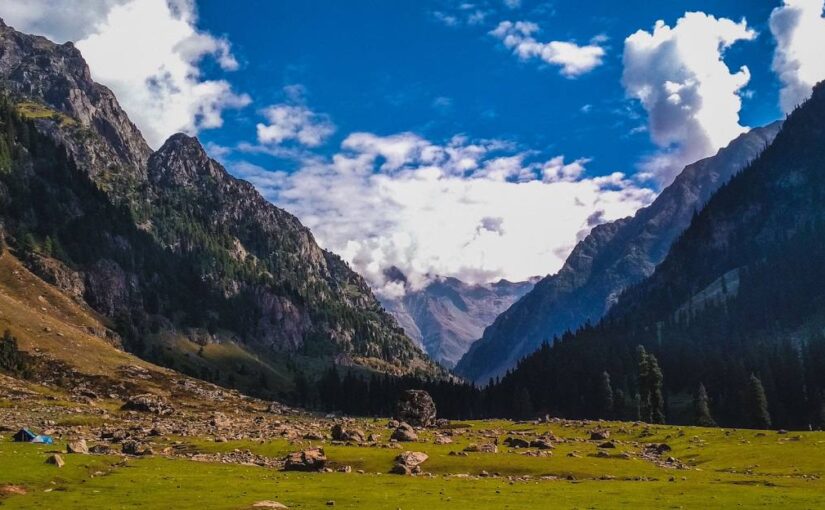
The episode begins by recounting the massacre in Pahalgam, Kashmir—a tourist meadow turned execution ground. Twenty-six people, most of them honeymooning Hindus, were murdered after being identified through religious markers: circumcision, Kalma recitations, names. The hosts don’t shy away from calling it what it is: a targeted Islamist attack. The group responsible, the TRF (The Resistance Front), is introduced as a Lashkar-e-Taiba cutout, designed to launder Pakistan-backed militancy through a local Kashmiri lens.

There is a palpable sense of cumulative fatigue in how the Indian speakers describe it—not as an aberration, but as part of a 30-year continuum of such violence. The emotional register is high, but justified. The use of plain terms like terrorists over euphemisms such as militants or gunmen reflects a long-standing frustration with how such attacks are framed in international discourse.


🤝  Modi, Nawaz, and the Civ-Mil Waltz Continue reading 🇮🇳Op Sindoor: A Podcast on Pahalgam, Pakistan, and the Limits of Peace

India and Pakistan, Back to the Future..

A group of terrorists attacked tourists in a remote meadow in Kashmir, identified those who were non-Muslim, and shot them dead (they also shot dead a Muslim tour guide who tried to oppose them). The horrendous and barbaric attack has led to a predictable outburst of harsh anti-Pakistan (and in many cases, anti-Muslim) outrage in India and the govt has already announced some steps against Pakistan and is presumably planning to undertake some more in the coming days.

Meanwhile, Pakistan (and individual patriotic Pakistanis) have taken to social media and traditional media to paint this as a “false flag attack” (i.e. carried out or planned by the Indian authorities themselves, presumably to allow them to retaliate against Pakistan; why?) or at least as India being “too quick to accuse Pakistan” (ie “we did not do it, and they are accusing us without proof”). This is all as expected in the usual India vs Pakistan show, but it is important to keep in mind that the situation has supposedly changed a little since 2019. Before that date there were many terrorist attacks in Kashmir and every major event would be followed by tit for tat exchanges along the line of control, but with both sides respecting “red lines”. Then in 2019 there was a large attack in Pulwama that was followed by an Indian retaliatory attack on a militant camp in Balakot in Pakistan proper (which crossed the previous red line of what retaliation was permissible). Since then there had been relative peace in kashmir and many commentators felt that the balakot bombing had established a new “red line”, that India will respond to any major attack in this or similar manner, so Pakistan has dialed down the terrorism it previously promoted in Kashmir. But if that is the case, then this attack obviously crosses that threshold and will lead to response. Irrespective of who is at fault and who did what, this was the supposed line and it has been crossed, so what next? 

As usual, i dont know. But lets list the questions and possible answers.

  1. IF this was indeed planned by Pakistan, then the question is “why”? Why now?

Possible answers and objections: Continue reading India and Pakistan, Back to the Future..

Brown Pundits