The clip is short and damning. Alia Bhatt walks the Cannes red carpet as L’Oréal’s global face, waving at a thicket of photographers who never quite lift their cameras.
Sanam Saeed arrives in a white peacock couture by Hussain Rehar, fifty artisans and 2,354 hours, a tribute to Shamim Ara that the photographers actually shoot. Rehar’s accompanying showcase at Château St George is titled Lahore: A Knot in South Asia’s Loom, sitting one cabinet over from Gucci and Roberto Cavalli. The title is doing the work.
Cannes 2026 was supposed to be Bollywood’s annual export ritual. Instead, Pakistanis slid past the L’Oréal machinery and produced the festival’s most discussed South Asian image.
The following article is the original work of the author – Dr Rajorshi Datta. As such its views should be taken to be the opinion of the author and does not represent the opinion of Brown Pundits. If you find this article controversial the author invites you to post a respectful comment below to voice your arguments and perspectives.
I’ve gone back to 2014 looking at articles and podcasts posted about caste. There is information on the social and religious origins of caste within sacred texts like the Vedas and Dharmasutras. For the astute reader there are accounts from Megasthenes, Fa Hien and Xuanzhang whose writings present oblique perspectives on how caste or varna and jati was viewed by contemporary people living within or visiting the system. There’s a lot been said about the fact it exists strongly in India compared to China and Europe, and the genetic evidence to support this.
But there’s not so much about why this phenomena was so strong and strict in the Indian subcontinent and nowhere else. Here I present my thesis as to why it wasn’t luck but structural predisposition which sent India down its unique path of strict caste endogamy.
A controversial topic – why did the caste system form in India?
This post grew out of an exchange with EK, the kind that can only happen in a forum that has paid for its openness. Kabir, to his credit, has imposed the hard internal checks that keep the blog from collapsing into the views of its editors.
The high culture built by the three great gunpowder empires (Ottoman, Safavid, Mughal) is one of the supreme achievements of human civilisation. All three were Turkic in dynastic origin, Persianate in literary and aesthetic register, and Islamic in faith. The Blue Mosque in Istanbul, the Naqsh-e Jahan complex in Isfahan, the Taj Mahal at Agra: these are not regional artefacts. They are a single coherent civilisational signature, expressed in tilework, ghazal, miniature, garden, cuisine, and chancery prose, across a belt that ran from the Bosphorus to the Bay of Bengal.
The question this post is about is simpler than it sounds. Who inherits it?
Comments of late have drifted, as they sometimes do here, into territory where the Bahá’ís are invoked as a rhetorical chess piece by people who know very little about them. We believe in free speech, and on this blog more than most, in authorial autonomy; contributors and commenters speak for themselves, and we are not in the business of policing opinion. But because the question of Palestine sits adjacent to much of what has been said, we thought it worth setting down what the actual position is.
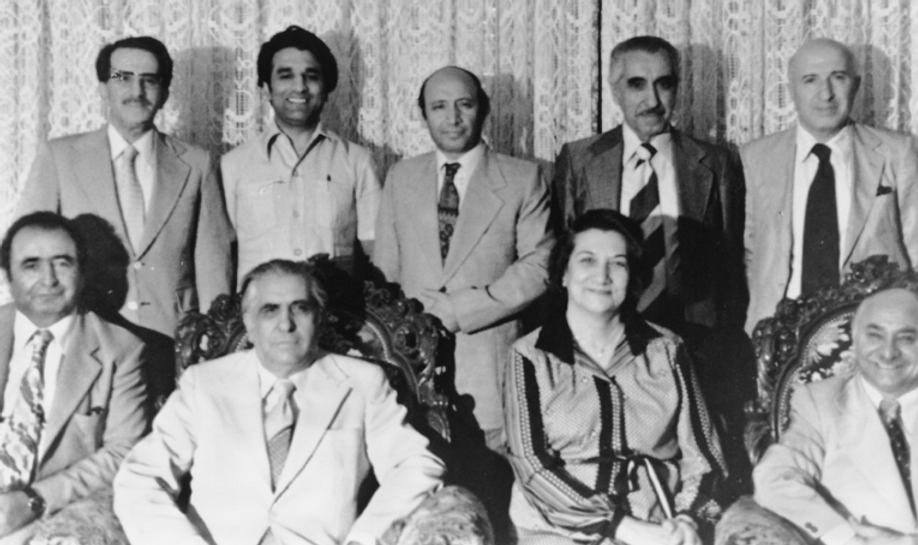
“Members of the National Spiritual Assembly who disappeared in August in 1980. All are presumed to have been killed” by Bahá’í Media Bank.
One caveat first. When we write or administer here, we do not speak for our Faith in any official capacity. We are members of it. That is the limit of our standing.
The clearest statement of the Bahá’í position comes from the pen of the Beloved Guardian of the Faith, Shoghi Effendi, who in July 1947 was asked directly by the United Nations Special Committee on Palestine to clarify the relationship of the Bahá’í community to the country and its political future. His reply, written from Haifa and reproduced in The Bahá’í World, Volume 11, is as close to a foundational text on this question as exists. We quote it at length, because paraphrase would not do it justice.
On July 9, 1947, Shoghi Effendi received a letter from the chairman of the United Nations Special Committee on Palestine requesting a statement on the relationship, which the Baha’i Faith has to Palestine and the Baha’i attitude toward any future changes in the status of the country. From Shoghi Effendi’s reply, the following paragraphs are quoted in The Baha’i World, Volume 11 (1946-1950), pp.43-44.1
HAIFA, ISRAEL—15 July 1947
“The position of the Baha’is in this country is in a certain measure unique: Whereas Jerusalem is the spiritual center of Christendom it is not the administrative center of either the Church of Rome or any other Christian denomination. Likewise although it is regarded as the second most sacred shrine of Islam, the most Holy site of the Muhammadan Faith, and the center of its pilgrimages, are to be found in Arabia, not in Palestine. The Jews alone offer somewhat of a parallel to the attachment which the Baha’is have for this country, inasmuch as Jerusalem holds the remains of their Holy Temple and was the seat of both the religious and political institutions associated with their past history. But even their case differs in one respect from that of the Baha’is for it is in the soil of Palestine that the three central Figures of our Religion are buried and it is not only the center of Baha’i’ pilgrimages from all over the world but also the permanent seat of our Administrative Order, of which I have the honor to be the Head.”
“The Baha’i Faith is entirely nonpolitical and we neither take sides in the present tragic dispute going on over the future of the Holy Land and its people nor have we any statement to make or advice to give as to what the nature of the political future of this country should be. Our aim is the establishment of universal peace in this world and our desire to see justice prevail in every domain of human society, including the domain of politics. As many of the adherents of our Faith are of both Jewish and Moslem extraction, we have no prejudice towards either of these groups and are most anxious to reconcile them for their mutual good and for the good of the country.”
“What does concern us, however, in any decisions made affecting the future of Palestine, is that the fact be recognized by whoever exercises sovereignty over Haifa and Acre, that within this area exists the spiritual and administrative world center of a world Faith, and that the independence of that Faith, its right to manage its affairs from this source, the right of Baha’is from any and every country of the globe to visit it as pilgrims (enjoying the same privilege in this respect as Jews, Moslems and Christians do in regard to visiting Jerusalem), be acknowledged and permanently safeguarded.”
I have often noticed something distinctive that Brown pundits—especially Pakistani Muslim commentators—bring to the table.
I will highlight two or three comments from previous posts that shed light on an important aspect often missing from Indian discourse.
One comment by Kabir from about 25 days ago stated:
“Muslims tend to be more intransigent vis-à-vis conversion of a spouse.” Sharia is very clear on this point. A Muslim man may marry a Christian or Jewish woman without her converting. A Muslim woman, however, cannot marry a non‑Muslim man; there are no exceptions for women. Of course, Kareena Kapoor married Saif Ali Khan without converting to Islam, but that was not a nikaah. Under Islamic law, they are not considered married—though I doubt either of them is concerned about that.
Gaurav’s post on the asymmetry of Hindu and Islamic worldviews deserves a response from the third corner of the room. We are not Hindu and we are not Muslim, though our community emerged from inside the Islamicate and is now demographically clustered in the Indic world. The Bahá’í position on the questions Gaurav raises is not a centrist mush. It is a specific civilisational stance, and it begins with a woman taking off her veil.
We were in Revere earlier this evening, the working-class strip north of Boston that the city has quietly handed over to its Spanish-speaking and Muslim arrivals. The playground was alive. Salvadoran grandmothers, Moroccan mothers, a small republic of children negotiating the slide. What struck us was how many of the pubescent girls already wore the hijab. Not the older women alone, not adults making a choice. Eleven year olds. Twelve year olds.
For most secular observers this registers as a costume detail. For us it lands harder. The hijab is the one piece of Islamic practice against which our faith was built.
My views and politics has changed in last 5 years and i would write a follow-up to this in a week or so. Just thought i would share this in light of recent traffic and comments on this blog.
This blog post was triggered by a Twitter exchange with Akshay Alladi where he questioned why I identify with the label liberal. A lot of people have – on this blog as well as on Twitter or in person have labeled me a Hindutva liberal or closet Sanghi (from the left) or a Hindutva rebel, yet I personally don’t feel comfortable with those labels. Maybe it is positive tribalism on the Saffron side or parochial wokism on the left.
Akshay also referred to me in his blogpost about Liberalism vs Conservatism and I promised I would also come up with an elucidation of my position. Before I go into attempts at formulating my position, a fair warning – I am not a particularly deep thinker on matters of philosophy and do not have an intellectual bent. I get bored with long essays and books about philosophy and religion, it’s the interactions of these abstract ideas with politics, people, and histories (as an art/science) that interests me than the ideas themselves.
It is fair to get some personal biases (which may appear contradictory) I hold out of the way
I am a staunch Republican and Secularist. In my early twenties years, I was more partial towards the Laicite as I grow old I become more partial towards the British or American style of secularism. (Though the recent events in France have made me reconsider my position).
I have had a very low opinion of Religions in the 21st century in general and Monotheisms in particular.
I have some sympathies with Savarkarite Hindutva (not RSS) and I have often been accused of being a closet Sanghi by leftists.
Though I think of myself as a patriot who is well aware of British exploitation of India, I am an Anglophile. I adore the Brits with their language, literature, culture, models of governance (Westminster model). I don’t have shame in saying “Anglo West is the best”.
I would like to explain my identification with liberalism in three progressive strains.
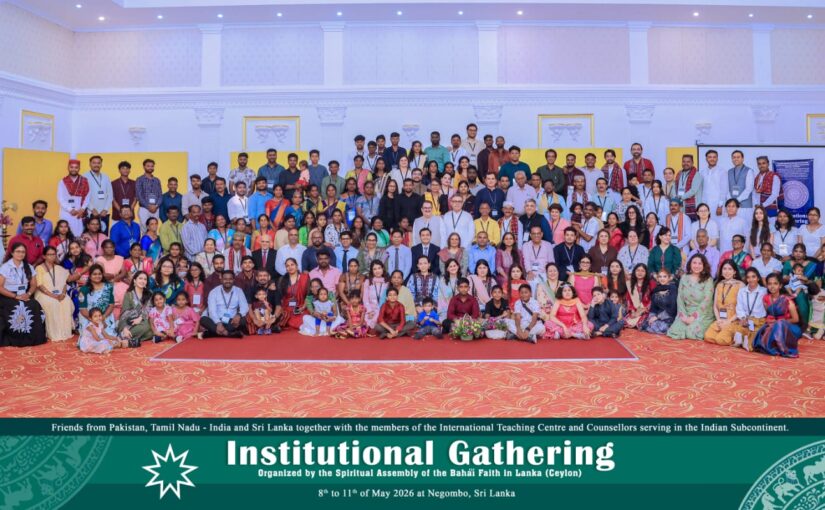
The photograph above was taken on the 11th of May in Negombo, on the western coast of Sri Lanka. The caption records the occasion plainly: friends from Pakistan, from Tamil Nadu, and from Sri Lanka, gathered with members of the International Teaching Centre and the Counsellors serving in the Indian subcontinent, at an Institutional Gathering convened by the Spiritual Assembly of the Bahá’ís of Lanka.
We want to say something about what this image makes possible, and where.
Indians & Pakistanis cannot meet any longer
The hard fact first. There is no longer any practical way for an ordinary Indian and an ordinary Pakistani to sit in the same room inside either of their own countries. Visa regimes have hardened to the point of farce. The land border is sealed in spirit if not in law. What remains are the smaller states of the subcontinent and the wider diaspora. Of the smaller states, Sri Lanka is the one that handles the meeting most gracefully: visa-on-arrival to both passports, no overland complication, no political theatre, and a civic culture that does not ask either side to perform a position.
Which brings us to the older question, whether Sri Lanka belongs to our civilisational space at all. Some friends north of the Palk Strait still treat the island as adjacent rather than constitutive. We think this is wrong, and the reasons are not sentimental.



 The following article is the original work of the author – Dr Rajorshi Datta. As such its views should be taken to be the opinion of the author and does not represent the opinion of Brown Pundits. If you find this article controversial the author invites you to post a respectful comment below to voice your arguments and perspectives.