Vantara, Caste, and the Fragile Commons

I was speaking with Dr. Lalchand about a number of things, from Anant Ambani’s wildlife project to the recent caste discourse on Brown Pundits. Both, strangely enough, converge around the theme of scrutiny; of who gets to build, who gets to critique, and who sets the rules of engagement.

Let’s start with Vantara. Anant Ambani’s wildlife refuge is coming under sustained criticism. But I ask: why shouldn’t Bharat, arguably the only major civilisation that views animals as divinely inspired, have a world-class zoo or rescue center? If done with sensitivity and vision, this could be a profound expression of India’s Hindu civilisational ethos.

Vantara houses over 200 elephants, 50 bears, 160 tigers, 200 lions, 250 leopards, and 900 crocodiles; albeit imported from across the world into the baking flatlands beside an oil refinery. The scale is staggering. Yes, there are questions: about captive animal welfare, about the case of Pratima the elephant, about transparency. But we should also be able to think of Indian megafauna conservation at global scale especially in a nation where sacred animals are part of dharmic memory.

America had its Gilded Age. The robber barons left behind libraries, parks, and museums. Can’t India do the same? Or do we reflexively dismiss anything built by wealth as vanity? Can there not be a deeper Dharma behind patronage?

And that brings me yet again to caste, controversy, and the structure of Brown Pundits. Continue reading Vantara, Caste, and the Fragile Commons

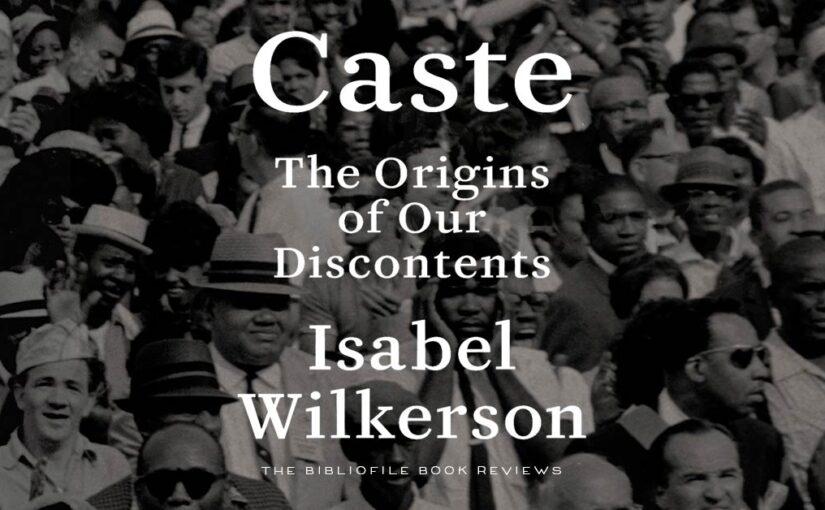
Caste and the Structure of Discourse

I’ve come to realise that it’s often more productive to write full posts than to engage in fragmented comment threads. The richness of thought requires a form that can hold tension, contradiction, and nuance but comments, by design, resist that.

The Upper-Caste Template of South Asian Dharmic Discourse

Take, for example, sbarrkum, who shares personal reflections and images from his life on the common board. While one might raise questions about permissions or boundaries, it’s also important to respect dialectical differences in how people choose to engage. There’s no single valid mode of expression.

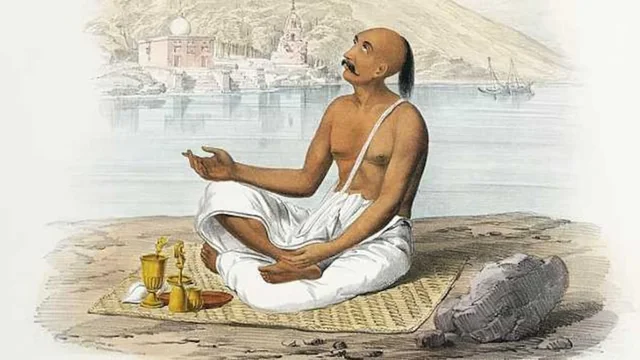
That brings me to a broader reflection: how the very structure of discourse in Dharmic South Asia has long been shaped by upper-caste templates; especially under Western influence. Over two centuries, upper castes have Brahmanised, Saffronised, Persianised, and then Westernised themselves, adopting and enforcing norms of discourse, authority, and ‘rationality.’

Why Intermarriage Doesn’t Erase Hierarchy Continue reading Caste and the Structure of Discourse

Brown Pundits and the Echo Chamber Problem

The Echo Chamber of the Commentariat

It has been on my mind that Brown Pundits, for all its liveliness, risks drifting into an echo chamber. The commentariat is our lifeblood: their activity sustains the blog far more than page views alone. And yet, the very strength of that community can also be its blind spot.

I do not want Kabir to end up being the Cassandra of BP, always warning of decline, and being proved right in the end. If we are not careful, we could slide into a right-wing echo chamber where challenging voices fade, and the capacity for deep interrogation, the core of what makes BP unique, is diminished.


Pahalgam and the Question of Narrative Continue reading Brown Pundits and the Echo Chamber Problem

Homebound with Ishaan Khatter

Last night Dr. Lalchand & I watched Homebound, India’s submission to the Oscars, at Apple Cinemas in Cambridge, Mass. This sad film follows a Dalit (Chandan Kumar) and a Muslim (Mohammed Shoaib Ali) struggling against the odds during the pandemic, their solidarity fictionalized as a fragile bridge across India’s deepest divides.

On the surface, it is a familiar story: the disenfranchised facing systemic barriers. But what struck me was how privilege itself performed disenfranchisement. Ishaan Khatter, brother to Shahid Kapoor, plays the marginalized Muslim. Janhvi Kapoor, descended from Bollywood royalty, embodies a Dalit woman. Vishal Jethwa, a bright-eyed Gujarati, portrays the Bhojpuri Dalit lead. This is not unique to India; Hollywood, too, casts elites as workers. Yet it raises the question: when poverty is performed rather than lived, is it “Dalit-washing”?


Poverty, Emotion, and Representation

Watching the film, I reflected on poverty’s emotional landscape. For elites, emotions can be expansive, indulgent, aestheticized into art. For the working poor, emotions are often constrained by survival — narrowed into necessity. Homebound tried to humanize its characters, but I wondered whether it romanticized what in practice is a relentless narrowing of possibility.

The West rewards this narrative. Parasite in Korea, Iranian cinema, Slumdog Millionaire — poverty & Global South tribulations as spectacle becomes “poverty porn.” The Guardian gave Homebound four stars. Great art often tilts melancholic, yes, but here the melancholia is curated for Western consumption.


Identity, Vectors, and Islamicate Selfhood

More unexpectedly, the film stirred something personal. I realized how much I have vacated my own Islamic identity. It was not traumatic. As a Bahá’í with Persian cultural roots, I found overlap — even comfort — in Hindu traditions. Dalits, in their rapid Hinduization, represent one vector of assimilation; Muslims and scheduled-caste Muslims, often in tension, another. Homebound imagines solidarity, but in life these vectors pull unequally. Continue reading Homebound with Ishaan Khatter

The River Cannot Go Back

I wanted to share something that floored me. Through Sahil Bloom, I came across this poem by Kahlil Gibran, and it struck me with its simplicity and depth. As an aside, it is worth remembering that Gibran was deeply inspired by ʻAbdu’l-Bahá, whose vision of unity and spiritual renewal touched many thinkers and artists of his time.

For the Commentariat, it’s worth noting that one of the 20th century’s greatest poets had Muslim antecedents: Gibran’s maternal great-grandfather converted from Islam to Christianity, a reminder that conversion did happen, and that traditions were more porous than the common perception that “Muslims can never leave Islam.”


The River Cannot Go Back

It is said that before entering the sea

a river trembles with fear.

She looks back at the path she has traveled,

from the peaks of the mountains, Continue reading The River Cannot Go Back

The Changing Demographics of Undivided India (1900–2025)

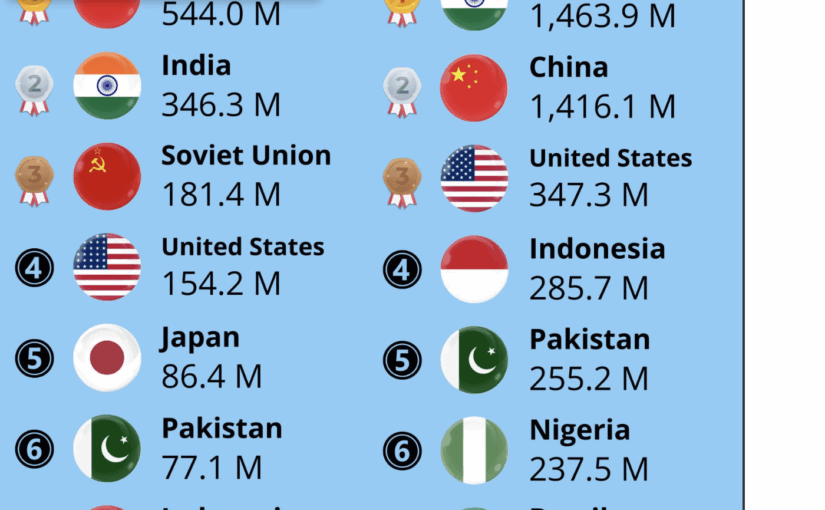
South Asia’s demography is one of the great untold stories of the modern world. Too often we look at the subcontinent through today’s partitions — India, Pakistan, Bangladesh — but the real insight comes when we view the region as a single whole. Across 125 years, the balance of populations has shifted dramatically.


📊 1900: A Baseline

At the turn of the twentieth century, Muslims made up about 20% of undivided India’s population. The rest were overwhelmingly Hindu, with significant Sikh, Christian, Jain, and other minorities.


📊 1950: Partition and Realignment Continue reading The Changing Demographics of Undivided India (1900–2025)

Travelling – Open Thread

🔗 Links shared from the comments


💬 Keep the links and thoughts coming — BP works best when the Commentariat bring their own sources into the mix.

On Islamism, the Oneness of Mankind, and the Burden of Public Bahá’ís

For too long, the term Islamism has functioned as a lazy shorthand in Western discourse; one that often sanitizes the dehumanization and securitization of Muslim bodies. And when it’s used by those claiming spiritual insight, especially from within a global Faith like the Bahá’í Faith, it becomes more than just a rhetorical misstep. It becomes a betrayal.

This week, a prominent British Bahá’í comedian made such a misstep.

A Moment of Caution — Dismissed

When Omid Djalili posted a news clip, which gently reframed the Bahá’í concept of the Oneness of Mankind, I appreciated the gesture. In fact, I said so. The “toe-stubbing” analogy was clever, and there was something moving in seeing profound principles gently repackaged for a wider audience.
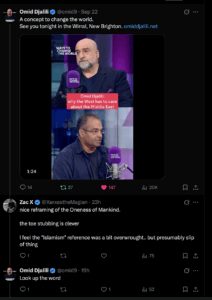
But I raised one concern: the reference to Islamism. It was, I suggested, overwrought, unnecessary, and ultimately unwise. I proposed an alternative: perhaps rephrasing the same concern as “security anxieties around mass migration” or similar language that doesn’t dog-whistle. This wasn’t a condemnation. It was, as any Bahá’í should recognize, consultation. An invitation to reflection.

Instead, I was told: “Look up the word.”

The Burden of Bahá’ís in Public

It’s not about semantics. It’s about responsibility. And especially so when one is invoking sacred teachings, teachings that thousands upon thousands have died for; on public platforms. The Bahá’í Faith is not a marketing device to win over a Western liberal audience by soft-launching its principles in the language of border panic and counter-terrorism.
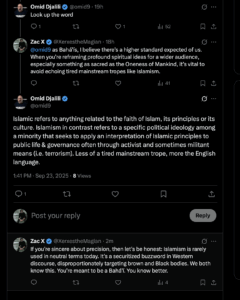
To reduce Islamism to a “technical English-language distinction” is disingenuous. The term has never been neutral. In nearly all Western contexts, it has become a floating signifier for violence, extremism, and “dangerous Muslims.” It serves to other, to isolate, and to justify state and vigilante violence often against entirely innocent people (Afghanistan, Iraq & Palestine).

And when Bahá’ís, of all people, repeat that language without self-awareness, without contrition, and without consultation, we should all be worried.

The Problem Isn’t the Joke. It’s the Response.

I understand the pressures of performance. I’ve done media. I know how easy it is to slip. What matters is what happens next. When another Bahá’í, someone you know, someone with many mutual connects, raises a concern gently and in good faith, the correct response isn’t smugness. It isn’t defensiveness. It certainly isn’t “learn English.”

That response is hurtful, racist, and deeply contrary to the values we both claim to serve. And that’s what cut. Not the line in the show but the refusal to listen afterwards. The arrogance of elite Bahá’ís who believe proximity to celebrity, applause, or power gives them carte blanche to reframe revelation in their own image.

This Is Why We Need to Talk

As Brown Pundits reshapes itself, I’m re-examining my own priors, too. What voices we platform. What values we uphold. Who gets to speak for our communities and under what banner.

So I say this plainly: The oneness of mankind cannot be proclaimed by marginalizing Muslims. And Bahá’ís, especially public ones, must hold themselves to the standard of humility, consultation, and truthfulness we profess to believe in. We cannot serve justice while echoing injustice. We cannot preach unity while casually reinscribing division. The world is watching. Let’s be worthy of what we claim.

Brown Pundits