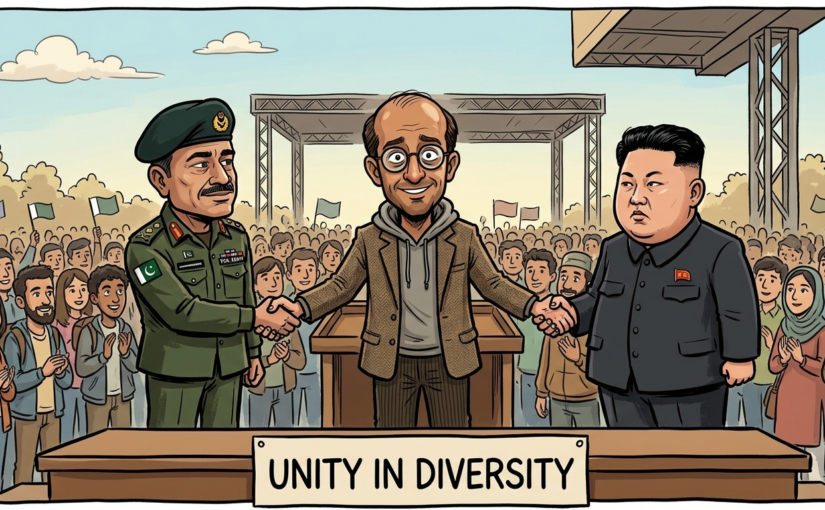
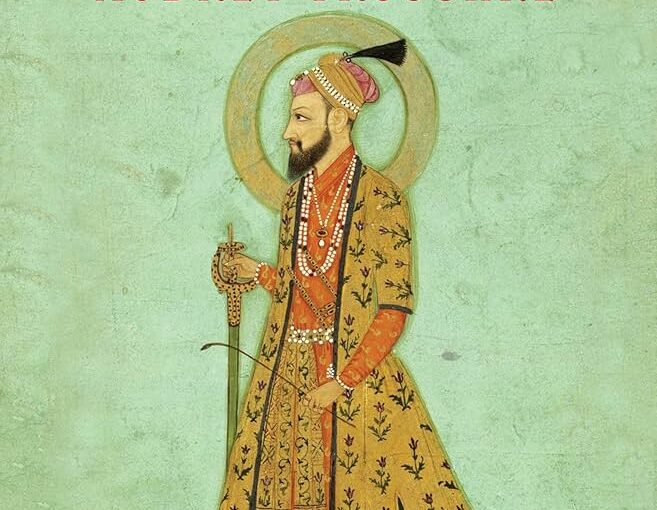
the Shah and the Saint

A month ago the Shah wrote to the Saint:

Naah it is a good film… I will make you say Bharat Mata ki Jai by infiltrating into Pakistan and pointing a gun at your head.

The threat to Kabir, however jocularly framed, is the trigger. BB has a habit of strict adherence to the Letter of the Law while frantically attempting to violate its Spirit, and BP’s continued tolerance is contingent on Kabir’s goodwill. If Kabir lodges a reasonable complaint, the sanction escalates.

The next rung is a 40-comment fine and a one-week revocation of authorial and commentator privileges. This applies to BB under any handle or avatar as a lasting Precedent.

We are not heavy-handed and Authorial Autonomy deeply matters to us, but the issue is what the transgression actually was. We want genuine contrition, not a mea culpa followed by the old tricks in slightly more sophisticated form.

The “Prakrisation” of Hindi

FlyeDie, presumably not one of BB’s handles, has left an excellent high-signal comment on the Hindification of East India. It posits Prakrit as a Latin analogue that spurred the development of the various Indic languages, and reads modern Hindi as walking the same path.

A wider blog admin note. We have been encouraging the Saint and the Shah to litigate their ongoing duel through the mechanism of high-signal posts, and this is the spirit in which we offer FlyeDie’s theory.

As an aside, there is also a very good comment by Calvin on the segregated political nature of the Indian Muslim community, which we may return to separately.

Brown Pundits exists to advance the bounds of niche knowledge on the Subcontinent. Our specific role is to stimulate excellent conversations, or guftugū as nos ancêtres les Mughalois would have punned it, and the comment below is one such endeavour, the more valuable because so much of our past has been lost or distorted. We reproduce it unedited.

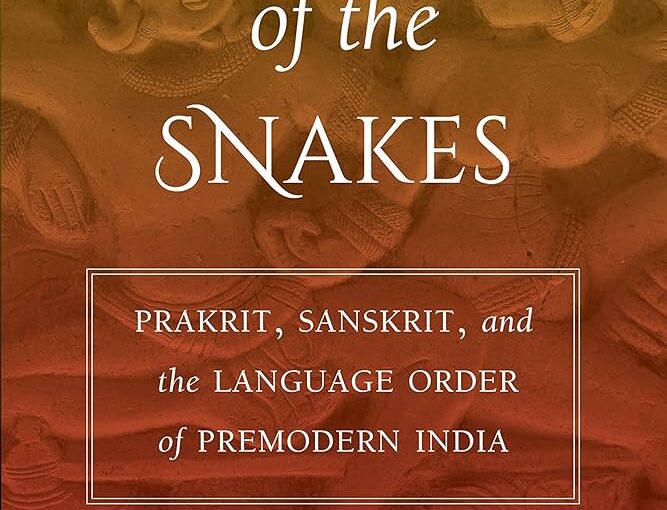
Okay, I think I am going on a weird comment streak and losing my mind. So, I have a weird tin foil theory; it is going to be long, and it is going to sound like bullshit, but please bear with me. Here is my tin foil hat theory: Hindi is the Prakrit of the modern age, and it is destined to follow the same path as Prakrit. To explain what I am trying to say, I am going to talk about my favorite book about Prakrit: “Language of the Snakes Prakrit, Sanskrit, and the Language Order of Premodern India” by Andrew Olett.

Continue reading The “Prakrisation” of Hindi

You cannot be a leftist if you support fundamentally illiberal positions

There is a lot of recurring debate in the comments repeatedly about who is a leftist, especially pertaining to subcontinental politics.

Rather than aim this post at a specific country or an individual, I would like to give some general thoughts regarding this.

Firstly, what is a leftist? This is the Wikipedia definition.

Left-wing politics or leftism is the range of political ideologies that support and seek to achieve social equality and egalitarianism, often in opposition to social hierarchy either as a whole

So you can say that democracy is a very leftist idea as it achieves a semblance of “social equality”. No matter how rich or poor you are, no matter your gender/race/caste/creed, you get one vote which counts the same as everyone else’s.

Similarly equal rights for all is also a very leftist idea as it aims for “social equality”. Of course, in real life it is not so clear cut because certain groups do have advantages over other groups due to historical reasons. But having equal rights “on paper” is at least a start towards leftist utopia. If you don’t have that at all, then equality is a non starter.

Continue reading You cannot be a leftist if you support fundamentally illiberal positions

What Being a “Center-Left” Pakistani Means to Me

Since my center-left credentials are frequently questioned on BP, I am sharing this post here.  Perhaps  it can stand as a precedent post so that this debate can be put to rest once and for all.

I have been repeatedly accused on BP of not actually being “Center-Left”. A commenter has said “Pakistani liberal is an oxymoron”. I have been called an “Islamist” and “Islamofascist”. While it doesn’t particularly make a difference to my life what some random people (whom I am unlikely to ever meet in reality) think of me, I would like to take this opportunity to define what precisely being center-left means to me. I do not attempt to speak for other Pakistanis–though I believe there is a significant proportion of the population who share some of my beliefs– but only to describe my own personal background and ideology. This exercise will also hopefully help me to examine some of my own assumptions.

As I have previously mentioned in some comments, I come from a family that believes in Nehruvian Secularism and in the “idea of India”. This ideological influence comes primarily through my father. My paternal grandmother was from Agra and came to Pakistan only after her marriage to my grandfather (who was from Peshawar). My grandfather was an official in the Pakistan Railways and prior to the 1965 war, my father and his siblings used to travel by train to Agra every year to see their maternal grandparents and relatives. The war unfortunately put an end to that. While I never had an in-depth discussion with my grandmother about what exactly Pakistan meant to her, my father has told me that she was deeply saddened by the fact that she was separated from her parents and one of her brothers. Such tragedies were common in many Pakistani and Indian Muslim families. I was lucky enough to be able to visit India as a child and spend time in my dadi’s ancestral home. There are pictures of me in front of the Taj.

On my mother’s side, my maternal grandfather was born in Amritsar (though he was ethnically Kashmiri). In 1947, he was living in Sialkot and married to my nani (who was from West Punjab). However, his relatives came to Sialkot as refugees from Amritsar. For decades, they continued to carry the keys to their houses in Amritsar. In fact, when my mother spent time in Indian Punjab in the 1990s (while doing some international development work) people there were surprised to learn that she could describe Amritsar neighborhoods in great detail without ever having been there before.

It is also important to note that though I was born in Pakistan, I spent most of my formative years growing up in the United States. My parents had many Indian friends. Also, my entire family was deeply involved with Hindustani classical music and this naturally tends to be an Indian diaspora activity. My ustad was Bangladeshi-American but very few of his students were Muslim. While I was learning to sing khayal, I also learned bhajans and shabads in various ragas. Continue reading What Being a “Center-Left” Pakistani Means to Me

The god of small comments

Fly Die:

Actually, it’s a lot more complicated than that in Kerala. Christians are deeply divided into multiple sectarian groups that started with schism in the Pre-colonial period and increased greatly moving into the colonial period. Historically, the original pre-colonial Christian communities that existed in the state were heavily interrelated with Levantine Christian groups such as the Assyrians, and mainly centered their religious activity around their center of operation in Iraq specifically. 

After the initial migration to India happened around the same time as the Gondhpharid Kardamaka dynasty ruling over Gujarat, as seen in the traditional literature, there were a few other waves. In one of these migrations, a set of Jewish-Christians from southern Mesopotamia led by Thomas of Cana, who settled and gradually developed into the modern sub-Nazarene group called the “Knanaya”. These new groups of Christians conflicted with the old Christians, leading to the North-South Divide between the old and new groups. Eventually, more divisions kept on happening as theological disagreements continued over time. 

Continue reading The god of small comments

The Shijrah and the Y-Chromosome

A sequel to “Arab Fathers are not fabrications (entirely)

The previous post answered BB. The comment thread produced an objection from Q, who concedes the cultural point and grants that Sayyid status mattered, then argues that Y-DNA is unreliable because Central Asian Sufism accepted matrilineal Sayyid descent and that South Asian Sayyids are 95 per cent autosomally local in any case. BB and Q essentially reach the same conclusion by different routes.

The mother’s status

Hinduism and Christianity both carry the mother’s status as load-bearing. Varna purity is bilineal, and the maternal line is policed: pratiloma unions, where a lower-status man fathers a child on a higher-status woman, are catastrophic in Manusmriti. The Christian veneration on the Virgin runs the same logic by inversion. A story of “foreign father, local mother” collapses status in both systems, so it gets erased. Brahmin origin narratives almost never claim foreign paternity.

Islam does not police the maternal line the same way. The line is the father’s, and a slave concubine’s son inherits paternal status undiluted. The eleventh Imam was the son of a Nubian concubine. The Abbasid caliphs from the mid-period onward were almost all sons of Turkic, Greek, Berber, or Slavic mothers. Classical fiqh weighs maternal lineage in kafa’ah and in some legitimacy disputes, but that is stratification, not pollution metaphysics.

The same asymmetry produced two radically different slavery histories. In the Atlantic system, partus sequitur ventrem fixed the child to the mother’s status; the descendants of African slaves remained enslaved and congealed into a marked descendant class. In the Islamic system, the child of an African concubine inherited his father’s status as a free Muslim; the descendants assimilated into the general population over generations. The genetics ratify the divergence: Sub-Saharan ancestry is diffused across Arabian, Iranian, and Turkish populations rather than concentrated in a separated descendant community.

Hence the asymmetric record. Mappilas, the Hadhrami diaspora, the Swahili coast all preserve foreign paternal lineage, and the Y-DNA converges with the claim. Arab nasab tradition demands at least ten generations of fathers in living recall.

Shia and Sunni Sayyids

Continue reading The Shijrah and the Y-Chromosome

South Asian Symphony Orchestra

I learned about the South Asian Symphony Orchestra today–an organization which I had been previously unaware of.  I thought I’d share it here since it is a rare example of positivity in the region.

The organization’s website explains the aim of the organization as follows:

The aim of the South Asian Symphony Foundation (SASF) is to promote greater cultural integration for the cause of peace in our region of South Asia, through the medium of music and the creation of a South Asian Symphony Orchestra. The inspiration has come from Ambassador Nirupama Menon Rao’s years in diplomacy and what she saw as a felt need for providing a platform to promote more dialogue, cultural synergy, and friendly understanding among the youth of the eight countries in South Asia, including India.

The website goes on to answer the question of “Why South Asia?”:

Why South Asia, you may ask. South Asia has often been defined as just India and Pakistan, but the history of the region is much more nuanced and incredibly vibrant. South Asia extends from Afghanistan, through Pakistan, Nepal, Bangladesh, and Bhutan, through India, Sri Lanka, and to the Maldives. Nationalism has trumped regionalism in this space. We would like our Orchestra to point the way to recognition of the fact that South Asia is in many ways an integer, bound more together by our commonalities than our differences. To quote the famous words of Ambassador Vijayalakshmi Pandit, before the United Nations, “Let us sweat in peace, not bleed in war”.

I do find it kind of ironic that the music that is being used to promote peace is Western classical music rather than the systems of classical music indigenous to South Asia–such as Hindustani or Carnatic classical music.

I will end this post by linking to a piece I had written called “In Defense of ‘South Asia'” (which was earlier published on BP).


British India was not a Nation-State

I am just briefly highlighting Calvin’s excellent comment on BB’s thread.

Calvin writes:

Also there was no country or state called British India, it was a part of the British Empire like British Australia or British Kenya. Resting a lot of the system the British developed does not make us a continuation.

Over the last year, I have consistently made the point that there was no nation-state of “India” prior to August 15, 1947. Thus, the Indian and Pakistani nation-states were created at the exact same time.  The argument that India was always there while Pakistan is a made-up entity is a common Indian nationalist trope and is basically just a way of de-legitimizing Pakistan.

This position has gotten me in a lot of trouble on this forum but I stand by it intellectually.  Presumably, now that this same argument has been made by a non-Pakistani and a non-Muslim, it will get a fairer hearing.

Of course, the fact that there was no such thing as an Indian nation-state doesn’t mean there was no sense of a geographic entity called “India”. That has never been my argument.  Prior to British India, there was the Mughal Empire etc.  Most of these geographical entities included what is now Pakistan. It is just a fact that for most of history the land that is now Pakistan has been part of Delhi-based empires. As a Pakistani, I’m absolutely fine with that.   However, it is also true that it was the British who created the borders that are commonly taken to be the natural borders of India.  For example, the Mughals never ruled the Northeast or the very southern bits of India.

I have no problem with BB arguing that the Republic of India is the successor state  of British India.  The arguments about the UN seat etc cannot be argued with. I would simply add that, in some ways, Pakistan is also a successor state of British India. For example, Pakistan inherited the Durand Line–the legal border between British India and Afghanistan.

On a related note: I came across this article about South Korea yesterday which discusses how the South is debating what to officially call the North.

The article notes:

Continue reading British India was not a Nation-State

India is the successor state of British India – it got independence, Bangladesh and Pakistan were formed

Admin Note: we have brought this picture to the top of BB’s excellent post, which is a Precedent Post, because it deeply move us. Haifa has huge spiritual and sacral significance for us. The Spectacular Shrine of the Báb, the Divine Forerunner of the Bahá’í Faith (and the Symbolic Return of the 12th Imam), overlooks the City.

No photo description available.

Modi at Haifa, Israel paying tribute to the Indian soldiers who died during the Battle of Haifa
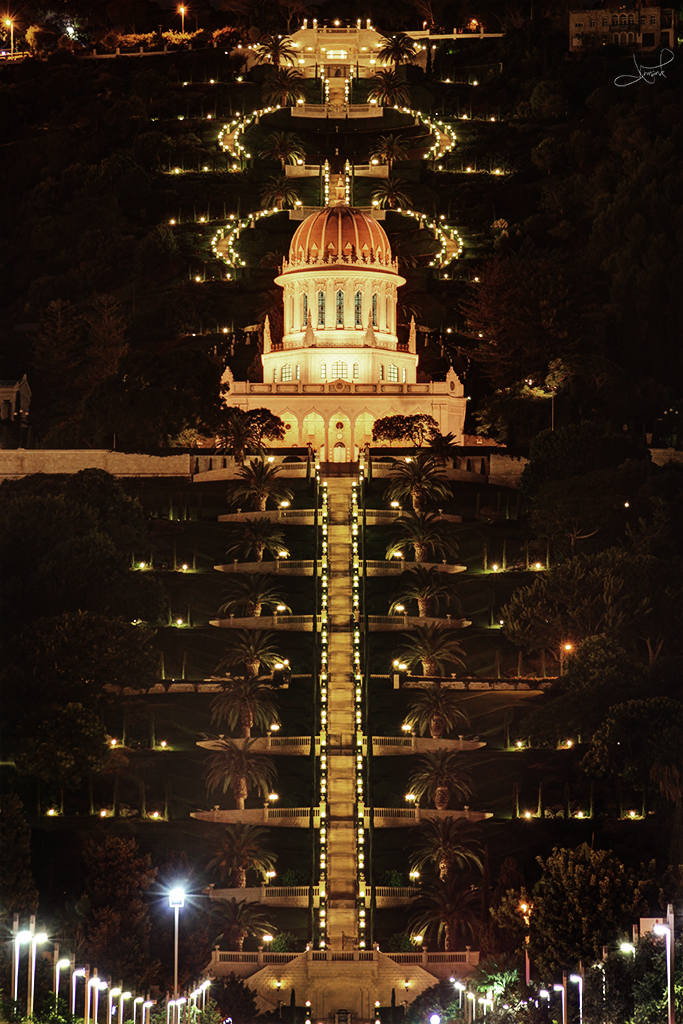
File:Shrine of the Báb, Haifa, Israel (8139739814).jpg - Wikimedia Commons

Bharat Mata Ki Ja and the Holy Land join together to shine light on the World. Hurrah.. Both Israel & India house extensive Bahá’í buildings, apparently the most visited Monument in New Delhi is the Lotus Temple. Nowhere else in the Muslim world does the Bahá’í Faith have Sites of Worship (Pakistan has been very good to Bahá’ís but terrible to the Ahmadis).

Explore the Tranquility: 5 Best Things to Do in the Lotus Temple

Apologies for the Hijacking but back to the Badshah of Balochistan, our very own Humza.

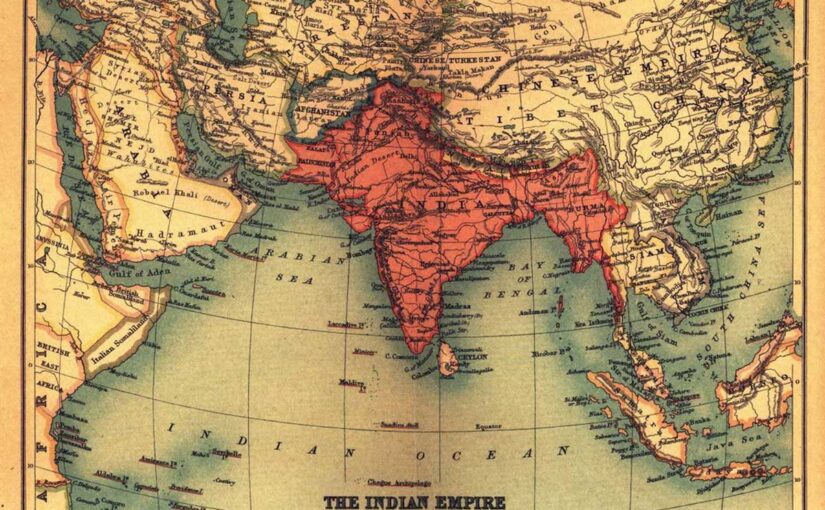
In my previous post about India being the successor state to the Mughal Empire, I mentioned how India was also the successor state to hundreds of other polities which existed across many millennia. British India is one such polity which I will discuss today.

Note: As before, when I use India below I mean the current day Republic of India, not the region of “India” which also encompasses some territories of the modern day states of Bangladesh and Pakistan

The Inheritance

Unlike the previous post, I won’t give as detailed a picture because in the modern age the definition of “successor state” is very well defined.

Some examples of succession in the modern period are the Russian Federation taking over from the USSR in 1991 and the French Fifth Republic taking over from the French Fourth Republic in 1958. Both of them got their predecessor’s UN seats as well as the permanent Security Council spot.

The United Nations

Since we are talking of the United Nations, let us begin with that.

India is a founding member of the United Nations, signing the UN Charter on June 26, 1945, and formally joining on October 30, 1945.
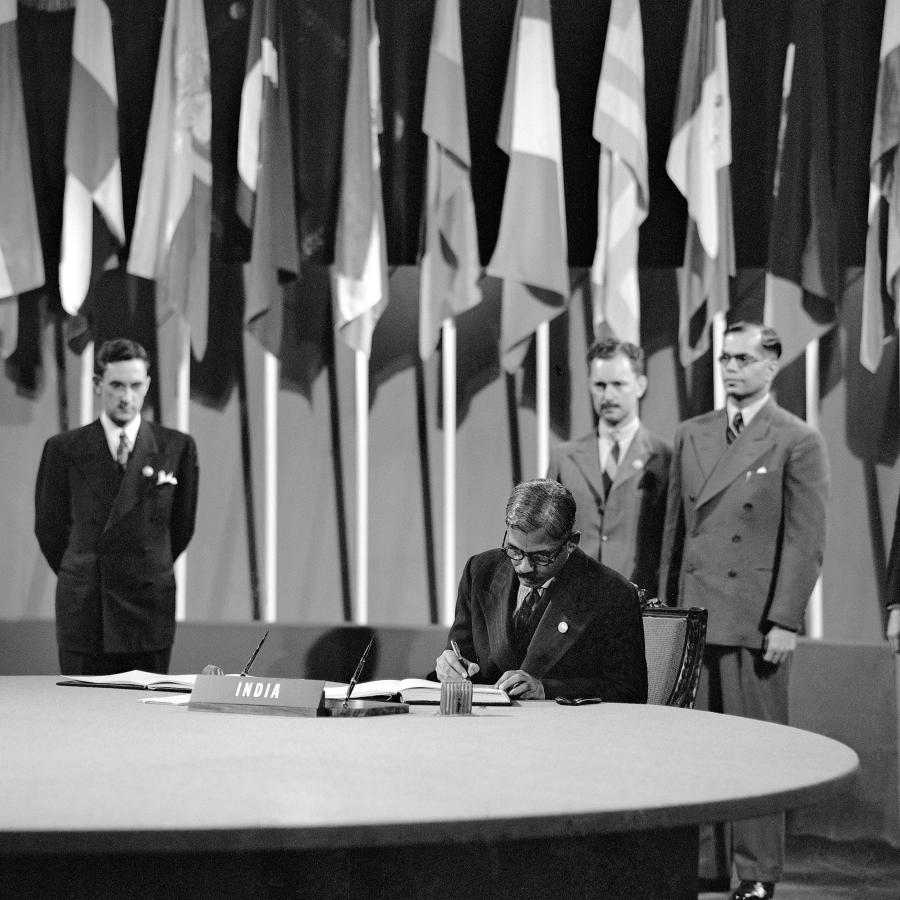
https://india.un.org/sites/default/files/styles/focal_point_square/public/2021-12/235930.jpg?h=cd225dda&itok=sAHVgB5u

Sir Arcot Ramasamy Mudaliar led the Indian delegation and signed the United Nations Charter on June 26, 1945, in San Francisco, United States

Continue reading India is the successor state of British India – it got independence, Bangladesh and Pakistan were formed

Brown Pundits