REPOST: Sphygmomanometer (Translation from the Urdu)

This translation was originally published in The Peshawar Review in January 2026.  I am sharing it here because it provides some insight into Pakistan at the beginning of the General Zia era.  Fiction also makes a nice change from the usual topics on this blog.  The entire story can be read here

One day, Naveed Bhai hadn’t returned from college by five o’clock. Usually, this wouldn’t have been cause for concern — a slight delay in returning home. But, over the past few days, Naveed Bhai had been behaving in a way that caused Abba to worry that he might be getting involved in something that would land him in trouble with the government of the cartoonish General Zia. Sitting at the dining table one day, Naveed Bhai had said angrily, through clenched teeth, that “we should teach these ignorant student union thugs a lesson.” On hearing this, Abba stared at him and said they had sent him there to study, not to get involved in useless things. Naveed Bhai should go straight to college and come right back. He shouldn’t even think about getting involved in union affairs and getting mixed up with dangerous people. Instead of being quiet after this reprimand, Naveed Bhai started speaking even more loudly:

Continue reading REPOST: Sphygmomanometer (Translation from the Urdu)

REPOST: On identifying as a liberal

Old post – Reproduced;

My views and politics has changed in last 5 years and i would write a follow-up to this in a week or so. Just thought i would share this in light of recent traffic and comments on this blog.


This blog post was triggered by a Twitter exchange with Akshay Alladi where he questioned why I identify with the label liberal. A lot of people have – on this blog as well as on Twitter or in person have labeled me a Hindutva liberal or closet Sanghi (from the left) or a Hindutva rebel, yet I personally don’t feel comfortable with those labels. Maybe it is positive tribalism on the Saffron side or parochial wokism on the left.

Akshay also referred to me in his blogpost about Liberalism vs Conservatism and I promised I would also come up with an elucidation of my position. Before I go into attempts at formulating my position, a fair warning – I am not a particularly deep thinker on matters of philosophy and do not have an intellectual bent. I get bored with long essays and books about philosophy and religion, it’s the interactions of these abstract ideas with politics, people, and histories (as an art/science) that interests me than the ideas themselves.

It is fair to get some personal biases (which may appear contradictory) I hold out of the way

  • I am a staunch Republican and Secularist. In my early twenties years, I was more partial towards the Laicite as I grow old I become more partial towards the British or American style of secularism. (Though the recent events in France have made me reconsider my position).
  • I have had a very low opinion of Religions in the 21st century in general and Monotheisms in particular.
  • I have some sympathies with Savarkarite Hindutva (not RSS) and I have often been accused of being a closet Sanghi by leftists.
  • Though I think of myself as a patriot who is well aware of British exploitation of India, I am an Anglophile. I adore the Brits with their language, literature, culture, models of governance (Westminster model). I don’t have shame in saying “Anglo West is the best”.

I would like to explain my identification with liberalism in three progressive strains.

Roots and Personality:

Continue reading REPOST: On identifying as a liberal

Some Thoughts on BP

I just want to briefly offer some thoughts since it’s now been a year since I have been active in this latest iteration of BP.

Over the past year on this forum, I have seen many members of the “Saffroniate” who seem to have no agenda except to disparage Pakistan.  BB is chief among them but there are others who share essentially the same views but hide behind a tone of neutrality that allows them to claim the moral high ground.  BB is the most open about his views. No other member of the “Saffroniate” has threatened to “infiltrate” Pakistan and make a Pakistani Muslim say “Bharat Mata ki Jai” at gunpoint.  Such an egregious comment had obvious consequences–as it should have.  While others have not crossed this line, it doesn’t mean that their anti-Pakistan attitude and Islamophobia is not obvious.  The word “taqqiya” has been used in reference to me. Using this word for a Muslim is Islamophobic and completely unforgivable. I find it deeply ironic that those who are the first to complain about Hinduphobia have no problem resorting to obvious Islamophobic tropes.

While Indians have legitimate grievances with Pakistanis (as Pakistanis do with Indians), the way to generate a productive dialogue is not to use triggering language like “apartheid”, “kleptocracy” etc. This only causes the other side to double down on their own position and for people to talk past each other.

I also want to address the passive aggressive complaints that I have banned certain people from my threads.  It is a settled principle on BP that authors have the right to manage their threads the way they like. This is a principle that has been hard fought for.  I have made my red lines clear. I will not tolerate anti-Pakistan commentary or people taking a hostile and combative tone with me.  If you can express your POV in a civilized manner while staying within these guidelines, then I will allow your comment to stand–no matter how much I may disagree with it. If not, it will be summarily deleted.

What’s ironic is that some of those who complain the most about this actually have author status and are able to create their own threads on whatever topic they wish.  That they don’t use this status is their choice and not a reflection on me.  It’s of course much easier to complain than it is to actually write your own posts.  To his credit, BB actually uses his author status to make his own arguments.  When he returns from his “vanvaas”, I hope he will contribute posts about Indian movies and TV shows. This would add to the varied mix of topics on this forum.

Lastly, I want to welcome the members of the “Cresenciate”.  I hope, with time, one of them will graduate from commenter to author. It is important to have more Pakistani representation on this forum.   This doesn’t mean that I always agree with them but it is good that all the work of countering the “Saffroniate” doesn’t fall on me.

It would be remiss of me not to mention those Indians who are not really part of the “Saffroniate” such as Gaurav and girmit who always contribute thoughtful points–though again I may vehemently disagree at times.

P.S. I was speaking with a new friend of mine from Hyderabad Deccan recently. He noted that the toxic obsession with Pakistan is a North Indian thing and that South Indians really don’t care all that much.  This intuitively makes sense since of course the worst Partition atrocities occurred in Punjab and Bengal.


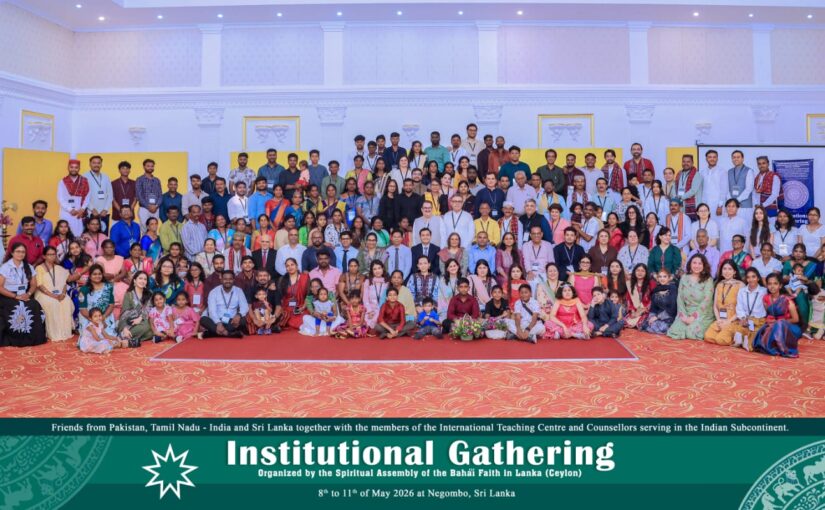
At Negombo, the Indian subcontinent meets where it still can

The photograph above was taken on the 11th of May in Negombo, on the western coast of Sri Lanka. The caption records the occasion plainly: friends from Pakistan, from Tamil Nadu, and from Sri Lanka, gathered with members of the International Teaching Centre and the Counsellors serving in the Indian subcontinent, at an Institutional Gathering convened by the Spiritual Assembly of the Bahá’ís of Lanka.

We want to say something about what this image makes possible, and where.

Indians & Pakistanis cannot meet any longer

The hard fact first. There is no longer any practical way for an ordinary Indian and an ordinary Pakistani to sit in the same room inside either of their own countries. Visa regimes have hardened to the point of farce. The land border is sealed in spirit if not in law. What remains are the smaller states of the subcontinent and the wider diaspora. Of the smaller states, Sri Lanka is the one that handles the meeting most gracefully: visa-on-arrival to both passports, no overland complication, no political theatre, and a civic culture that does not ask either side to perform a position.

Which brings us to the older question, whether Sri Lanka belongs to our civilisational space at all. Some friends north of the Palk Strait still treat the island as adjacent rather than constitutive. We think this is wrong, and the reasons are not sentimental.

Sri Lanka is Dharmic? Continue reading At Negombo, the Indian subcontinent meets where it still can

Conversion out of Hinduism and Caste


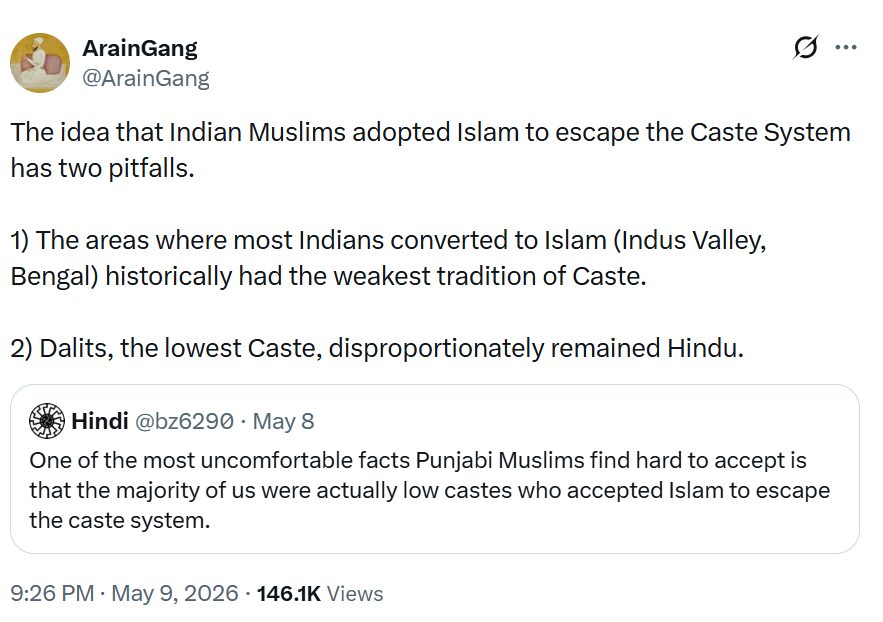
The idea that jAti-varNa – Caste system is the reason why ancient Indians converted to Islam and Christianity in olden times is often presented as a obvious wisdom. Why wouldn’t the oppressed seek new religion the instance it was offered ? But this simplistic notion is often goes against historic evidence.

As BP commentator and genetics nerd ArainGang states here – Areas of subcontinent which today form Pakistan and Bangladesh – were the least conservative regions of the subcontinent – ie – least rigid caste system. These regions also had significantly higher Buddhists than the heartland.

Christian conversions in Goa and Kerala were often but not always elite lead. Even in Maharashtra which is the birth place of Ambekarite Navayana Buddhism, significant % of Dalits remain Hindu (30-40%). Outside Maharashtra even less % of Dalits have embraced Navayana – though most regard Ambedkar as a quasi divinity. Mayawati, the longest serving Dalit CM of India hadn’t officially converted to Navayana as she assumed she would lose the non Jatav Dalit votes if she did.

Simplistic theories about history – which seem obvious to our understand often don’t stand the test of evidence. It means the simplistic models which explained the reality of Caste and mechanisms of conversion can be rejected and even their premise need to be scrutinised.


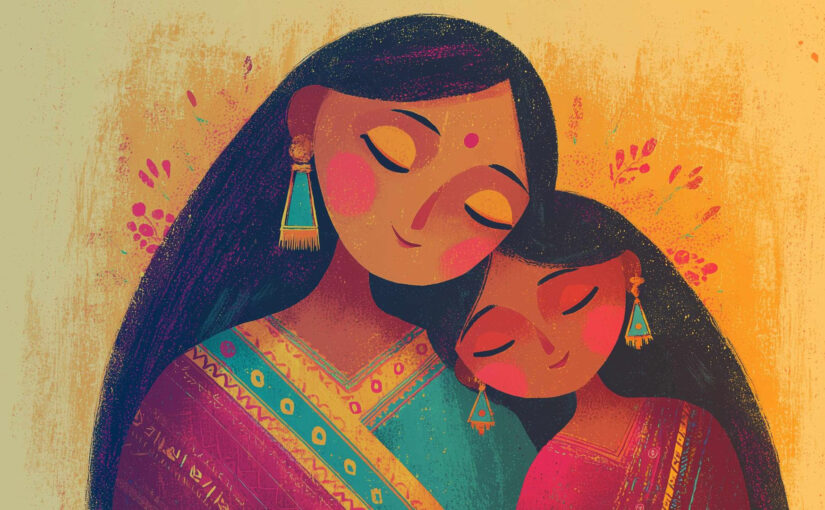
She carried an entire civilization in her hands

We have just landed back in the United States, and since we have been writing about gender all week, we wanted to share this sweet Mother’s Day note from the Hindu American Foundation here on BP.

She didn’t pack much. Maybe a small murti of Ganesha wrapped carefully in the folds of a sari. A handwritten copy of the Hanuman Chalisa. A few photos of her parents and siblings. And yet, she carried everything.

The full note is below but we wanted to share a few short thoughts as well. Q posted a tweet on the parallel thread arguing that Islam is the last holdout against total Westernisation. It is a serious claim and worth answering. Superficially he is right. The visible global resistance to Western moral universalism is largely Muslim, and the Manosphere is paying heed.

But the deeper claim is more complex, and the Hindu American Foundation’s letter illustrates why.

Continue reading She carried an entire civilization in her hands

Footnotes|Bollywood, Hindu Nationalism & the Erasure of Muslims in India (Kabir’s Open Thread)

When does cinema stop being entertainment and become propaganda? Hindi film has long romanticised the nation, but what’s happening now is something else entirely. In the latest Himal Footnotes, associate editor Nayantara Narayanan sits down with film critic Anna MM Vetticad and journalist Raza Rumi to talk about how Bollywood has become a vehicle for Hindutva ideology by manufacturing mythic pasts, normalising anti-Muslim violence and lending cinematic glamour to the BJP’s political project. Using the Dhurandhar franchise as a case study, they ask harder questions about the industry: How does propaganda disguise itself as entertainment? What happens when the line between fiction and political fact-making is deliberately blurred? And what has been lost from the Hindi cinema that once held space for a more plural, secular India?

Disclosure: I know Raza Rumi and have worked with him when he was at “The Friday Times”. I was mostly doing editorial work during what was essentially a summer internship.  He has written a book about his experiences traveling in Delhi (where I believe his family was from).  The book is called Delhi By Heart: Impressions of a Pakistani Traveller.

2) Returns on multipolarity

By Umair Javed

At this admittedly early stage of a changing world order, multipolarity is cementing domestic tendencies that already prevail. The status quo, along with the economic interests aligned with it, will continue to navigate geopolitics in ways that serve regime consolidation rather than broad-based development. For that calculus to change, the three issues/ contradictions identified above would need to become the organising basis of a political challenge capable of compelling a renegotiation of state-society relations. That is a high bar. But it is the only honest answer to the question of what multipolarity can offer a country like Pakistan. The world can change its architecture without changing who benefits inside Pakistan’s borders. That part remains entirely a domestic problem and a domestic responsibility.

3) Nothing can stop the breakup of Britain. Even Farage is powerless. 

By Aris Roussinos


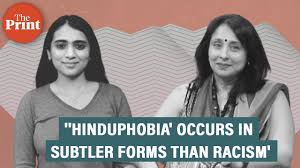
On Safety and Hinduphobia

Bombay Badshah is on vanvas. He earned it. He posted, in passing, personal details of another commenter, which he should never have been examining. He was warned, apologised, and is now serving his time in the forest. Lord Ram took Sita and Lakshman with him for fourteen years. BB is taking the IPL and Dhurandhar reruns for ten days. The proportions are different. The principle is the same. You leave the city when you have offended its order.

This is not a defence of him. It is the opposite. BP must be a safe space for reader, commenter and author. Privacy is the precondition of opinion. If a person cannot post under a handle without a hostile interlocutor looking them up, the room collapses into a lower kind of theatre. We do not run that kind of room.

Engrained Hinduphobia

But his exile is also the moment to say the thing we have been postponing. Hindus on this site have a real grievance, and it has accumulated because the language of liberal discourse equips one side of the argument with a vocabulary the other side does not have. Islamophobia is an institutional word. Hinduphobia is still scratching at the door. The asymmetry shapes every thread:

A follow up on Women’s Rights in Pakistan

Since we have been having quite an impassioned debate about gender relations in Pakistan (as an aside that thread has close to 300 comments and has become unwieldy to navigate), I thought I would briefly follow up on a few points here.

Firstly, I want to state up front that I do not agree with Q’s repeated invocations of “Onlyfans”.  Yes, he is technically on my team (the “Crescentiate”) but I am able to call him out when it is necessary.  I would expect the other team (the “Saffroniate”) to also be able to call each other out when it is justified (as for example in the case of one of their members making a direct threat of violence).  BP would be a much nicer place if some of the really egregious trolling (mostly by BB) is brought under control.

Q is of course entitled to his views and I suppose that our views differ mostly because I was raised almost entirely in the US. I was also not raised in a particularly conservative family. As an anecdote, my mother has never covered her head. When I was a young adolescent and had a bit of religious fervor and asked her to do so, I was given the firm response that I was living in her house and she would do exactly as she pleased. The conversation obviously came to an end there.

Back to “OnlyFans”:  I believe in the right of consenting adults to do whatever they want with their own bodies.  This doesn’t mean that I wouldn’t negatively judge someone who chose to start an OnlyFans. It is, after all, a kind of sex work and I don’t really understand why someone with education and opportunities would choose to get into this line of work. That said, it is of course the individual’s choice.

Q is correct that Pakistan is a conservative society and that the normative expectation is that women are kept out of the public sphere. The woman’s domain is seen to be the home.  “Chador aur char divari” (I would translate this as the veil and the four walls) is an important concept in Pakistani interpretations of Islam.

Some links of relevance:

1) Sindh govt issues Aurat March NOC with conditions for participants’ clothing, slogans 

According to the NOC, Aurat March organisers are “bound to comply with all laws in force” and shall be responsible for the “internal cordon security of the participants”.

It further stated that “all participants/organisers shall ensure peaceful conduct” during the march.

The NOC prohibited “anti-state slogans, banners, speeches or activities”, as well as “anti-religion slogans, placards or objectionable remarks”. It also ordered that “no hateful, provocative, unethical or anti-social content shall be displayed on charts, banners or flexes”.

“Participation, support or representation by any banned outfit /proscribed organisation such as BYC (Baloch Yakjehti Committee), JQSM (Jeay Sindh Qaumi Mahaz) shall strictly not be allowed,” the NOC read.

The district administration also ordered participants not to “wear objectionable clothing” or carry out “promotion for the LGBTQ” community, which includes transgender persons.

The “Aurat March” participants have also been told that they cannot make speeches against the “ideology of Pakistan” or speak against the armed forces.

For the record, I am against this decision that the participants cannot promote the rights of the “LGBTQ” community. This is homophobic and transphobic.

2) Review: Kafeel Offers A Rare Glimpse Into How Trauma Travels Between Generations 

3)India refuses to criminalize marital rape. This new series shines a light on it 

(Hat tip to Nivedita for mentioning this series “Chiraiya”.  Incidentally, this word is usually spelled “Chiriya” in Urdu).

The BBC article notes:

Some 6.1% of Indian women who have ever been married women have experienced sexual violence, according to government data. But despite years of campaigning by activists, India remains among three dozen countries – along with Pakistan, Afghanistan and Saudi Arabia – where marital rape is not outlawed.

Activists have filed a number of petitions in recent years in the Supreme Court calling for marital rape to be criminalised. But the government, religious groups and men’s rights activists oppose any plans to amend the Colonial-era law, which exempts a man for having forced sex with his wife if she is not a minor.

On marital rape, I just want to mention that even in the UK, this was only criminalized as late as 1991, which is surprisingly late.  As I mentioned in my review of John Galsworthy’s The Forsyte Saga, marital rape plays a major role in the plot of this novel and was not at all considered a crime during the Edwardian era (the time period in which the novel is set).



Brown Pundits