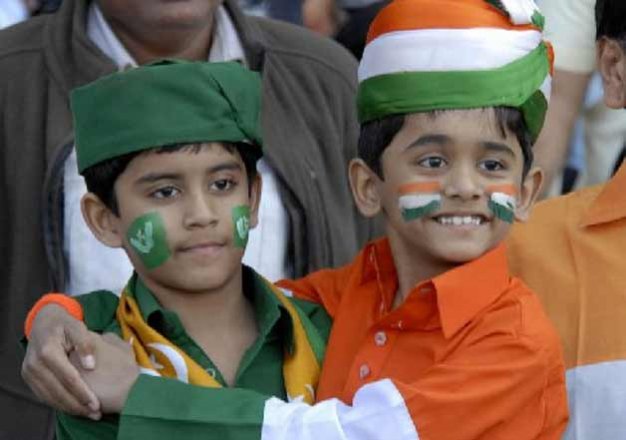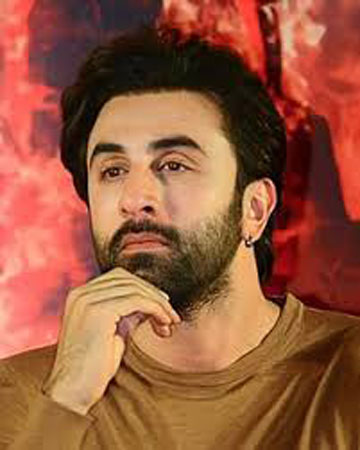
Dhurandhar showcases Bollywood’s New Obsession: The Sexy Pakistani Villain

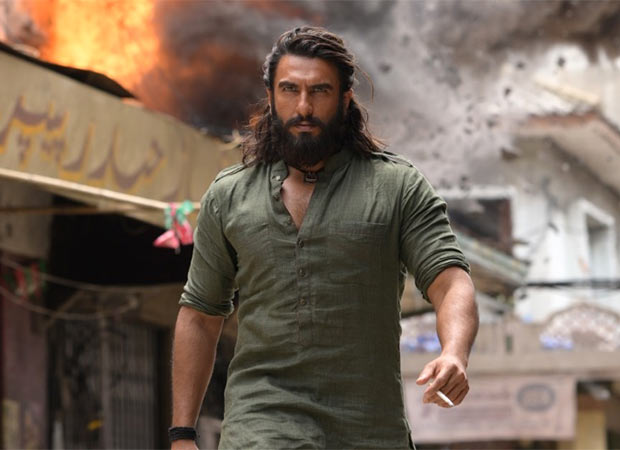
We watched Dhurandhar last night at Apple Cinemas (the last time we went to see Ishaan Khatter’s Homebound). It is the best mass-market Bollywood film I’ve seen since Animal, and far more immersive. What struck me most was not the action, nor the plot, but Bollywood’s new formula: a full-scale fetishisation of Pakistan.

Kabir keeps claiming that Bollywood casts Pakistanis as villains. This misses the point. The villain is always the sexiest figure in any film. Bollywood has finally realised this. Raazi hinted at it. Animal stumbled on it with Bobby Deol’s star stealing turn. Dhurandhar perfects it.

For the first time, Hindu actors are not performing cartoon versions of Pakistan. They are cosplaying Pakistanis with forensic precision; the clothes, the diction, the swagger, the social codes. In earlier decades the attempt was clumsy. Now the calibration is exact. Pakistan, in these films, becomes the Wild West of the subcontinent: familiar enough to feel intimate, distant enough to feel dangerous. Continue reading Dhurandhar showcases Bollywood’s New Obsession: The Sexy Pakistani Villain

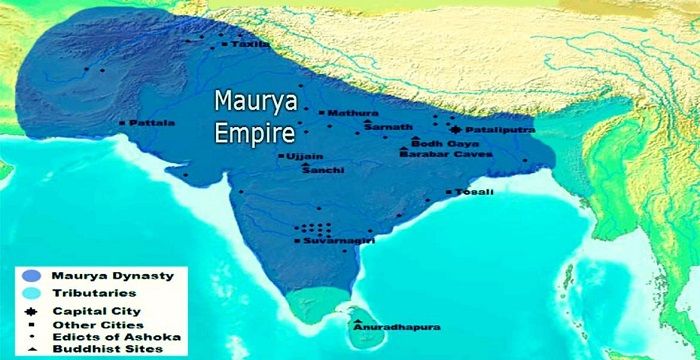
When was India’s Golden Age?

When people claim that India and Pakistan are “equally artificial,” they erase the long, uneven civilisational trajectories that produced both. Kabir, who is generally more courteous than the average Saffroniate imagines, still falls into this conceptual trap. But the question this raises is larger than contemporary geopolitics:

When was India’s Golden Age, and for whom?

A Golden Age can be political, cultural, philosophical, or civilisational. The answer depends on what we measure: scale, radiance, confidence, or continuity. Asking it forces us to examine whether India is a recent invention or a very old organism repeatedly broken and reconstituted.

Pakistan complicates this picture. As the Indus zone, it has deep civilisational roots of its own; older than Islam, perhaps as a geographic expression even older than the Vedic world. This is why, despite its ideological volatility, Pakistan will likely persist: it sits on a basin that has generated coherent cultures for five millennia. Its anti-India posture gives it political definition, but its underlying geography gives it durability. Continue reading When was India’s Golden Age?

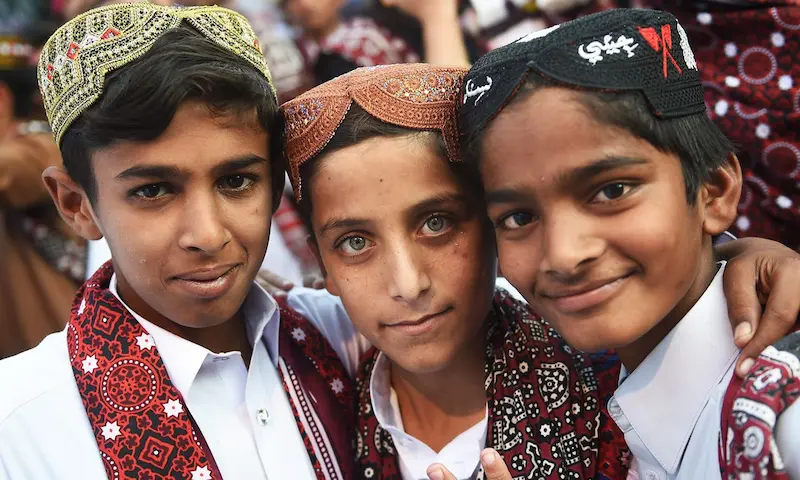
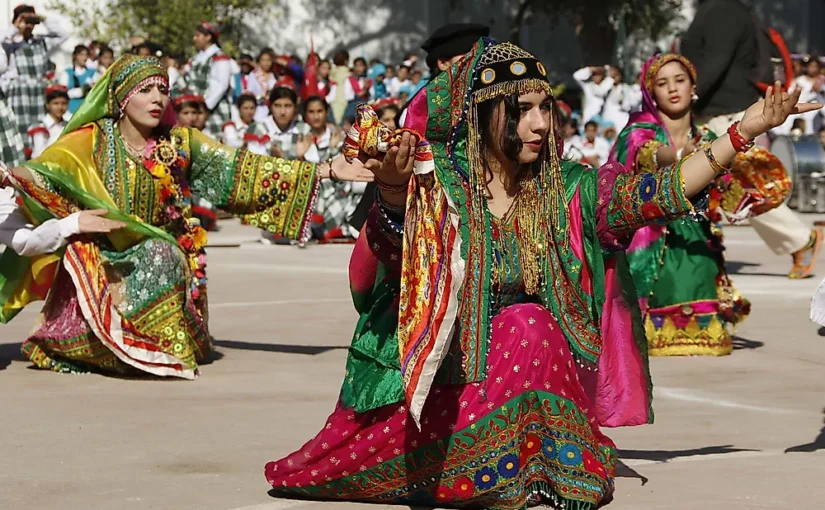
On the Question of Who “Owns” the Indo-Muslim Legacy

Reading Sophia Khan’s superb piece on the lost Muslim cities of Hindustan, and then watching the BP comment-thread unfold, a few thoughts crystallised for me; less about “ownership,” and more about the intellectual pattern that keeps resurfacing whenever Indo-Muslim history is discussed.

First: I genuinely did not know that Khan was originally pronounced with a silent n, nor that paan had such a deep Islamicate turn in its social history. Much like music, I had long assumed paan to be a largely Hindu-coded practice. The article forces a re-examination of how intertwined everything actually was. The same goes for Hindustani music: I once thought of it as essentially a Hindu, temple-rooted tradition. Then you realise how much of the courtly synthesis, Persian, Hindavi, Turko-Central Asian, was shaped by Muslims, even if the Vedic lattice underneath remained foundational.

This is partly why I found Bombay Badshah’s objection (“Pakistan cannot claim any of this”) an odd line to draw. One can, of course, make the territorial argument; but it collapses immediately once you observe what India itself is doing: aggressively appropriating the Indo-Muslim aesthetic while deracinating its historical context. If Bollywood, tourism, cuisine, and the Indian cultural machine can freely claim Delhi, Lucknow, Agra, and Hyderabad as national inheritances, then Pakistanis whose families actually come from those cities are hardly crossing an intellectual red line by acknowledging lineage, memory, or loss. Continue reading On the Question of Who “Owns” the Indo-Muslim Legacy

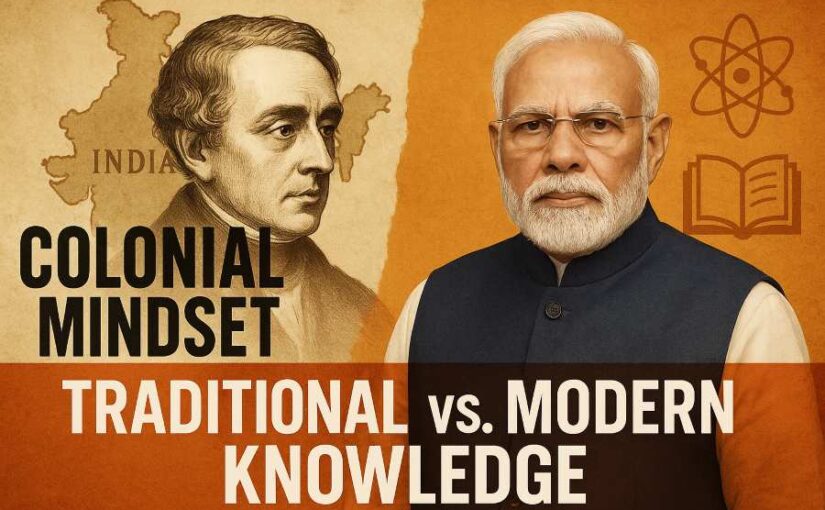
Macaulay, Macaulayputras, and their discontents

We had some discussion about Macaulay on X and I wanted to write a piece about it, but I also know I probably wont get the time soon, so I am going to just copy and paste the discussion here, I am sure people can follow what is going on and offer their comments.. (Modi’s speech link at end, macaulay minute text link as well)

It started with this tweet from Wall Street Journal columnist Sadanand Dhume:

In India, critics of the 19th century statesman Thomas Macaulay portray him as some kind of cartoon villain out to destroy India. In reality, he was a brilliant man who wished Indians well. Link to article. 

I replied: 

I have to disagree a bit with sadanand here bcz I think while cartoonish propaganda can indeed be cartoonish and juvenile, there is a real case to be made against the impact of Macaulay on India.. Education in local languages with hindustami or even English (or for that matter, sanskrit or Persian, as they had been in the past during pre islamicate-colonization India and islamicate India respectively) as lingua franca would have been far superior, and the man really did have extremely dismissive and prejudiced views, the fact that they were common views in his world explains it but does not excuse it. The very fact that many liberal, intelligent and erudite Indians of today think he was “overall a good thing” is itself an indication that his work has done harm.. BTW, there were englishmen in India then who argued against Macaulay on exactly these lines..

Akshay Saseendran (@Island_Thought) replied: Continue reading Macaulay, Macaulayputras, and their discontents

Open Thread: From Floods to LaBal

A few updates from this week:

Sri Lanka is facing severe flooding. Sbarkkum reports major damage to rail and road networks, with Dutch support expected for reconstruction.

Sana Aiyar’s “World at MIT” video touches on her life and work

Sam Dalrymple has a clip on Lahore and Delhi—another reminder of how closely the two cities mirror each other despite partition.

Pakistan’s minority rights bill is worth watching. Continue reading Open Thread: From Floods to LaBal

The Unfinished Contract II: Citizenship, Partition, and the Questions Liberalism Won’t Ask

A far-right senator, Pauline Hansen, recently walked into the Australian Senate wearing a burqa. Muslim MPs (one of whom wearing a hijab) angrily called it racist, bigoted, Islamophobic. They were right. But they also dodged the underlying question: What does citizenship mean when communities fracture along religious lines?

The same evasion dominates debates about Indian Muslims after 1947. One camp says: “They stayed, they’re citizens, case closed.” The other mutters about loyalty tests and fifth columns. Both positions are intellectually lazy. Neither grapples with what Partition actually did to the social contract.

This isn’t about defending bigotry. It’s about refusing to let bigots monopolize legitimate questions.

I. The Contract That Never Closed Continue reading The Unfinished Contract II: Citizenship, Partition, and the Questions Liberalism Won’t Ask

The Partition of Elites: India, Pakistan, and the Unfinished Trauma of 1947

I was speaking recently with a cousin who grew up in India. Their family has been Bahá’í for generations, but their older relatives once lived as Sunni merchants in Old Delhi. When they visited their grandparents as a child, they noticed something striking: in many lanes of Old Delhi, long after Independence, the sentiment was not Indian nationalism but Pakistan-leaning nostalgia. This was not hidden. It was ambient.

That single observation exposes something almost no one in Indian liberal discourse wants to say aloud: post-Partition India inherited a large Muslim population whose political loyalties were, at best, ambivalent. That is not a moral judgement. It is a historical one.

And once you notice this, a second truth becomes obvious: Kabir’s secularist vision of an emotionally unified India makes sense only in a world where 1947 never happened.

Continue reading The Partition of Elites: India, Pakistan, and the Unfinished Trauma of 1947

What Is Not India Is Pakistan

As Dave mentioned, there is a lively WhatsApp group of BP authors and editors, and it inevitably shapes the comment ecosystem. But one comment on the blog stood out:

“The very foundation of Pakistan is an anti-position. What is not India is Pakistan. So isn’t it obvious?”

It’s an extraordinarily crisp description of Pakistani identity-building. What is not India is Pakistan. That is not a slur; it is, in many ways, a psychologically accurate frame for how the state narrates itself.

What I increasingly find misplaced on this blog is the recurring assumption that Pakistanis are somehow “Indians-in-waiting,” or that Punjab is “West Punjab,” Pakistan “Northwest India,” or Bangladesh “East Bengal.” These are irredentist projections that simply do not match lived identities. This is not “North Korea” or “East Germany,” where both sides continue to imagine themselves as fragments of one common nation.

Yes, Pakistan consumes Bollywood and Hindi music, which themselves derive from Mughal and Indo-Persian syncretic traditions. Yes, Pakistan is culturally embedded in the greater Indo-Islamic civilizational sphere. But emotionally, Pakistan has severed itself from the Indian Subcontinent as a cohesive landscape. It has constructed a hybrid identity; part Turko-Persian, part Islamic internationalist, part anti-India.

I don’t personally agree with this move, and my own trajectory has been toward a strong Hinducised, Dharmic identification. But my view is irrelevant here. What matters is that Pakistani identity is defined negatively; as the commentator put it, “What is not India is Pakistan.

Whether that is healthy or sustainable is another matter. But identities can persist in unhealthy configurations for a very long time; the stock market can be irrational longer than your liquidity can survive.

What’s in a name? That which we call a Swastika, isn’t exactly a symbol of hate

Disclaimer: As this post deals with an academic discussion on the Swastika symbol, I have included various images containing Swastika below. If you are repulsed by the symbol or do not like to look at it, please consider yourself warned. Also, for the same reason, this post is NSFW.

Growing up in India, I had developed this habit of drawing symbols of auspiciousness and good luck on my exam answer sheets. I have no recollection of who taught me to do that or when I started doing it but I can clearly remember even during my bachelor studies, I would collect the answer sheet from the invigilator and immediately proceed to draw an ‘ॐ’ (Om), a ‘श्री’ (Shree) and a ‘卐’ (Swastika, albeit with 4 dots in the middle as one would draw in India) at the top of the first sheet of the answer paper. This rather innocent practice wasn’t unique to me. Apparently many other students used to do this until the universities started cracking down on this ‘malpractice’ for ‘displaying symbols of faith on answer sheets’ and ’emotionally appealing to the evaluators’. In a religiously polarized India of the 2010’s, I don’t expect any less ham-handed response from our University VCs. But, personally, what prompted me to stop this practice was my move to Germany for my master’s.

In the first few weeks of the semester, all international students took part in an orientation program at the university. One of the most shocking things I learnt  that day was that any public display of Swastika was BANNED in Germany. I was not ignorant of Germany’s sordid past. Watching ‘Schindler’s list’ beamed onto the wall of a dark classroom with my fellow drama club members in high school is one of the most vivid memories I have. I was just 15 then and the movie shocked me to my core. It was one of those instances of loss of innocence in my life when cruelty, inhumanity, Germany, Hitler, Jews and hate took on a whole other meaning in my psyche. In spite of that, discovering Swastika, an omnipresent sign in India that I had grown up seeing everywhere and that which is considered good and auspicious by everyone around me, could be a banned symbol of hate in the country I had just moved to, was another instance of loss of innocence.

Just like me, many Indians who have moved to the west have discovered this in their own way. The subreddit r/AITA (no connection with raitas 😛 ) has quite a few posts from hindus who have been mistaken for a white-supremacist (Oh! The irony!) for displaying Swastikas as a pendant gifted by grandmother, in the form of a rangoli/kolam in their frontyard, a tattoo on the arm they got while in India, having portraits of hindu gods at home, etc. All these instances happened in the US. From my personal experience, I have found the germans to have better awareness about Swastika; it’s use as the Nazi party symbol, a hate symbol of neo-Nazis and also as the auspicious symbol for many asian religions and cultures. This is because of two reasons:

1. The curriculum at schools explore all aspects of Germany’s sordid past with a level of frankness that I can only describe as ‘very German’. The curriculum makes the differentiation between the two symbols very clear as you can see from this children’s website that takes them on a german historical journey of the last 100 years.

2. The germans use two different words for this symbol. The symbol of hate used by Hitler and the neo-Nazis is called ‘Hakenkreuz’ while the auspicious symbol of the orient is called ‘Swastika’. Just the existence of two different words makes it easy to differentiate the meaning of the two symbols.

Funnily enough, even though I lived in Germany for 5+ years, I was not aware of the existence of ‘Hakenkreuz’. I only came to know about it in the past year or so through twitter! It was probably through a thread by True Indology (lost when his account was suspended) that I became aware of the german word ‘Hakenkreuz’ that when translated to english means hooked cross and not Swastika. The problem lies with the current mistranslation of Hakenkreuz in English.

Google translate translates Swastika as Hekenkreuz in German. Notice the possible translations of the word – das Hakenkreuz and die Swastika. Also notice the definition of Swastika in english. It only defines the Hakenkreuz, the symbol used by Hitler.

Instead of translating into hooked cross, it is translated as Swastika, which is clearly wrong. So, why IS it mistranslated to Swastika? Who first translated Hakenkreuz to English as Swastika and how did that translation stick? More importantly, did Hitler adopt the eastern symbol Swastika as the anti-semitic symbol of his political party or did the inspiration come from elsewhere? These were some of the questions that recently led me to write a thread on twitter (you could also read it on the thread reader app here). I will summarize my findings below.

Colonialism and imperialism in the 18th and 19th century CE brought about a great deal of interest in the eastern cultures by the west which gave rise  to the field of oriental studies and orientalism. All things east were considered exotic and the ‘popular’ phenomenon of cultural appropriation led to the adoption of various eastern symbols in the west. One among those was the Swastika. It shot up in popularity among the western academicians in the 1880’s and pretty soon entered the pop culture scene as a symbol of good luck, akin to today’s good luck charms like Maneki-neko (Japanese beckoning cat), Chinese fortune cookies or the Irish shamrock.

A report by Thomas Wilson titled ‘THE SWASTIKA, The earliest known symbol, and its migrations; with observations on the migration of certain industries in prehistoric times” for the US National museums in 1894 wonderfully compiled the then existing knowledge of Swastika. It is meticulous and very clearly written with almost no bias from Mr. Wilson. This also happens to be the first recorded instance where an English speaker tried to compile all the crooked cross like symbols and used the umbrella term of Swastika in English. Until then, the word Swastika did not exist in any english dictionary or encyclopedia. He writes in the preface:

An English gentleman, versed in prehistoric archæology, visited me in the summer of 1894, and during our conversation asked if we had the Swastika in America. I answered, “Yes,” and showed him two or three specimens of it. He demanded if we had any literature on the subject. I cited him De Mortillet, De Morgan, and Zmigrodzki, and he said, “No, I mean English or American.” I began a search which proved almost futile, as even the word Swastika did not appear in such works as Worcester’s or Webster’s dictionaries, the Encyclopædic Dictionary, the Encyclopædia Britannica, Johnson’s Universal Cyclopædia, the People’s Cyclopædia, nor Smith’s Dictionary of Greek and Roman Antiquities, his Greek and Roman Biography and Mythology, or his Classical Dictionary. I also searched, with the same results, Mollett’s Dictionary of Art and Archæology, Fairholt’s Dictionary of Terms in Art, “L’Art Gothique,” by Gonza, Perrot and Chipiez’s extensive histories of Art in Egypt, in Chaldea and Assyria, and in Phenicia; also “The Cross, Ancient and Modern,” by W. W. Blake, “The History of the Cross,” by John Ashton; and a reprint of a Dutch work by Wildener. In the American Encyclopædia the description is erroneous, while all the Century Dictionary says is, “Same as fylfot,” and “Compare Crux Ansata and Gammadion.” I thereupon concluded that this would be a good subject for presentation to the Smithsonian Institution for “diffusion of knowledge among men.”

In this report, Wilson examined different forms of crosses that had been found all around the world and concluded that Swastika is the most ancient one of them all.

Different cross-like symbols examined by Thomas Wilson in THE SWASTIKA

He complied various definitions of Swastika as recorded by different researchers and it was commonly understood to mean ‘good being’ or ‘good fortune’ in Sanskrit. The symbology was interpreted by different academicians differently. Although mostly everyone agreed that it is an auspicious symbol for the hindus and buddhists, there was no consensus on how to interpret the symbology. He writes,

Many theories have been presented concerning the symbolism of the Swastika, its relation to ancient deities and its representation of certain qualities. In the estimation of certain writers it has been respectively the emblem of Zeus, of Baal, of the sun, of the sun-god, of the sun-chariot of Agni the fire-god, of Indra the rain-god, of the sky, the sky-god, and finally the deity of all deities, the great God, the Maker and Ruler of the Universe. It has also been held to symbolize light or the god of light, of the forked lightning, and of water. It is believed by some to have been the oldest Aryan symbol. In the estimation of others it represents Brahma, Vishnu, and Siva, Creator, Preserver, Destroyer. It appears in the footprints of Buddha, engraved upon the solid rock on the mountains of India. It stood for the Jupiter Tonans and Pluvius of the Latins, and the Thor of the Scandinavians. In the latter case it has been considered—erroneously, however—a variety of the Thor hammer. In the opinion of at least one author it had an intimate relation to the Lotus sign of Egypt and Persia. Some authors have attributed a phallic meaning to it. Others have recognized it as representing the generative principle of mankind, making it the symbol of the female. Its appearance on the person of certain goddesses, Artemis, Hera, Demeter, Astarte, and the Chaldean Nana, the leaden goddess from Hissarlik, has caused it to be claimed as a sign of fecundity.

Until then, Swastika, as a symbol was known by different names in different languages because the symbol existed almost everywhere in the world, in Asia, Europe, northern Africa and the Americas. Also in Great Britain. So, what did the English call the symbol? Fylfot. Wilson writes,

In Great Britain the common name given to the Swastika, from Anglo-Saxon times by those who apparently had no knowledge whence it came, or that it came from any other than their own country, was Fylfot, said to have been derived from the Anglo-Saxon fower fot, meaning four-footed, or many-footed.

So, there existed a word for the 卐(crooked cross) symbol in english but only for the 卐 found in and around great britain. Instead of using this word for all crooked crosses in English, Mr. Wilson instead chose to use the word Swastika since he found it to be the most ancient of them all. This was a ham-fisted move because the Indic name swastika corresponded to the 卐 that symbolized auspiciousness which the other crooked crosses did not. Even Wilson admits that by quoting a letter by the famous Indologist Prof. Max Müller,

I do not like the use of the word svastika outside of India. It is a word of Indian origin and has its history and definite meaning in India. * * * The occurrence of such crosses in different parts of the world may or may not point to a common origin, but if they are once called Svastika the vulgus profanum will at once jump to the conclusion that they all come from India, and it will take some time to weed out such prejudice.

So, in 1894, the word Swastika was proposed by Mr. Wilson to denote all crooked crosses in english language and we see that the practice stuck since the use of the word in english language increased since then. So, is this when the German word ‘Hakenkreuz’ started being called as Swastika? Interestingly, no! In fact, the report mentions finding variants of swastika in Germany but mentions no name in German. ‘Hakenkreuz’ was barely used until then and was relegated to 19th century vocabulary books like the Bailey-Fahrenkrüger’s Wörterbuch der englischen Sprache and the Deutsches Wörterbuch von Jacob Grimm und Wilhelm Grimm (yes, they are the Brothers Grimm of Grimm’s fairy tales). So, to answer one of the questions posed above, ‘Hakenkreuz’ wasn’t actually translated into English. By the time germans started using Hakenkreuz as the word for the infamous anti-semitic symbol, the English speaking world had already picked up on the word Swastika and called any crooked cross symbol as such.

So, when and why did the Nazis adopt the Hakenkreuz as their anti-semitic symbol? The reason goes all the way back to Troy, the location of the fabled trojan war (it’s an interesting story, you can read a detailed article here). When a german businessman and amateur archeologist Heinrich Schliemann found the remains of the mythical city of Troy in modern day Turkey in 1871, along with the ruins, he found the 卐 symbol on everything – pieces of pottery, ruins of buildings, marble carvings, etc. Being an amateur archaeologist he did not understand the significance of his find. So, he consulted his orientalist friends – Max Mueller(yes, the same guy who didn’t want to call ‘Swastika’ found outside India as Swastika) and Émile-Louis Burnouf, a leading expert of Sanskrit. Fun fact: Bernouf was also an anti-semite and a propounder of Aryan master race.

Burnouf made a bunch of dubious claims (debunked by Wilson in his monumental report on Swastika) which was covered in Schliemann’s book ‘Troy and its remains‘ and concluded that Suastika (that was the spelling he went with) is an essential symbol of the Aryan race. The popularization of this flawed idea led to its appropriation as the symbol by the German ‘Völkisch‘ national movement gaining steam at the juncture of 19th and 20th century. It was a nationalistic movement which propounded that Germans belong to the Aryan ‘master race’ and hence need to dominate the world. Poetically, the year Burnouf breathed his last, 1907, was also the year when the Swastika was first used as a symbol of Aryan dominance by a secret society called ‘Order of the New Templars’ (Ordo Novi Templi, or ONT) in Austria by Lanz von Liebenfels, an Austrian racialist. So, in early 20th century, as most of the west started embracing Swastika as a ‘cool’ motif, it was also being appropriated secretly by an anti-semitic and racist underground movement becoming a symbol of racial supremacy for various organizations until it was mainstreamed by Hitler in the Nazi flag in 1920.

Flag of the ‘Order of the new Templars’. This was the first instance of Swastika used as a symbol of Aryan dominance in 1907.


What inspired Hitler to choose this symbol for his political party? Was it just the connection to Aryan race or did the inspiration come from elsewhere? The anti-semitism displayed by the Nazis did not arise from a vacuum. Anti-semitism or anti-Judaism has existed in Europe since pre-Christian times but morphed into ‘religious anti-semitism’ due to the early christian belief that jews were collectively responsible for the death of Jesus Christ. This sentiment and the associated conflict intensified after Christianity spread as a state religion in Europe. However, the pseudo-scientific racial theories that became widespread in 19th century Europe threw up an additional strain of ‘racial anti-semitism’ where the basis of discrimination and persecution was the ‘scientific evidence’ that jews belongs to a separate lower ‘non-Aryan’ race. The combination of these two strains of anti-semitism, one historic and one modern, manifested politically in the form of Hitler’s Nazi party.

Professor William Brustein’s book, Roots of hate delves deep into pre-Holocaust anti-semitism in Europe

Adolf Hitler was a complicated man to understand. Forests have been felled to publish books speculating his inspirations and motives. Most scholars however agree that although Hitler distanced himself away from Christianity in his later years, he leaned heavily towards christianity in his early years. His catholic upbringing, his admiration for

Pakistan’s Inner Logic

On Nivedita & Archer’s joint request (Mamnoon/Tashakor/Merci for the kind words); I’m going to expand on my comment:

Kabir is definitely right. Ethnicity in Pakistan is complex; there are three tiers of society. The English speaking elite (Imran is part of that so is Kabir), who are “Pakistanis” and ethnicity isn’t really reflected on…

This comment, which the BP archives have tons of similar posts on (BP was venerable even in 2014), sketches the bones of Pakistan’s sociological map. But what lies beneath the skin?

Pakistan is feudal; India is not.

That one statement alone explains much. Landholding elites dominate politics, rural economies still function on patronage, and class mobility is rare. Caste, though “denied,” is real and sharper, in some ways, than it could ever be in India (the reservation system does not really exist in Pakistan except for religious minorities but not for socio-economic castes). Pakistanis can sniff out class in one another with a dexterity that’s probably only matched in the United Kingdom, which is the home of class stratification (I remember reading Dorian Gray in Karachi in the early millennium and shocked how similar late Victorian early Edwardian England was).

The postcolonial state froze itself in amber. There has never been a serious leftist rupture, excepting 1971’s successful Bengali revolution. Even Imran Khan, who styled himself a reformist, is a product of elite schools, Aitchison College, Oxford, and aristocratic lineage. His “Islamic socialism” was only ever viable because Pakistanis still believe in myths of the benevolent landlord.

And yet, Pakistanis sometimes seem happier than their Indian counterparts, even if not remotely successful. Why? Continue reading Pakistan’s Inner Logic

Brown Pundits