Gurdaspur and Siliguri: The Two Necks That Held

A precedent post on Pakistan’s self-exile from the subcontinent, and the geography that outlasted it

This is not anti-Pakistan polemic. Pakistan can flourish in the role she has chosen, and may continue to do so (Pakistan’s pivotal role in the US-Iran war is, on any honest reading, a legitimisation win for the current hybrid government)). The point being made here is structural, not personal.

Pakistanis are a subset of the British Raj’s Muslim population. As Punjabis, as inheritors of the Mughal cultural complex (alas one cannot destroy his Masjid and simultaneously claim to be his heir), as native carriers of the Hindustani register that becomes Urdu under one stylisation and Hindi under another, they began with a favoured position inside the subcontinent. They have traded it for a subordinate position inside the wider Muslim world. The internal hierarchies of the Islamicate, where Pakistanis rank against Arabs, Turks, and Persians, are dense and unflattering and deserve their own treatment another day.

The cause of the trade, in the end, is theological. The subcontinent runs on iconographic generosity, painted shrines, sung saints, plural deities, devotional excess. Strict iconophobia cannot live inside that civilization without breaking it. Pakistan chose the stricter line in 1947 and has progressively tightened it since. The Urdu denial, the recent insistence in some Pakistani quarters that Urdu is not really an Indian language, is the cleanest evidence of the opt-out.

Irreducibly Indo-Persian

Continue reading Gurdaspur and Siliguri: The Two Necks That Held

India and Pakistan Are Playing Chicken; simply to hurt themselves

Two comments are worth picking up on, and one claim worth interrogating.

N disagrees that contact ameliorates ties. EK suggests the only Islamicate voices the Indian RW respects are those who have “debased their own civilizational integrity.” We do not know who he is shadow-tweeting. It could be us, the Founders of this blog, who are Islamicate by heritage and recognisably friendly to Hindu right-wing readings. Either way, the framing is off. And then there is Q, on the thread as we write, claiming Pakistanis “will eventually take over the Islamicate world.

The cost of distance

The dominant idea of the last decade is that less contact means more security. Fewer visas. Less trade. No cricket. No artistic exchange. Reduced diplomatic warmth. This is sold as realism. It is, in large part, self-harm.

Distance does not produce clarity. It produces mythology. When people stop meeting one another, they begin imagining one another. The imagined neighbour is always simpler, darker, and easier to hate than the real one.

He is also, as Dhurandhar showed, sexier. Hatred and desire run on the same current. The more villainous the Pakistani on screen, the more the Indian audience leans in.

Civility is built by proximity. Not sainthood. Habituation. When people share space, study, trade, marriage, and culture, the room for fantasy narrows. One can still dislike the other side. But one dislikes actual people, not cartoons.

N’s response to this is that contact theory is “akin to blaming a victim for not engaging with the perpetrator.” That feels like the Israeli security story applied to the Indian Sub-continent. It assumes Pakistanis are a permanent terror-source requiring permanent counter-violence.

Pakistan obliges the narrative by behaving badly enough often enough to keep it alive. India obliges the frame by treating every bad actor as the median Pakistani. Both governments are now invested in the loop.

Pakistanis no longer defend hybrid Islamicate culture Continue reading India and Pakistan Are Playing Chicken; simply to hurt themselves

Revisiting Somnath–A Review

Since we have been recently discussing history, I am sharing this review of Romila Thapar’s Somanatha: The Many Voices of a History (Verso 2005). 

In 1026, Sultan Mahmud of Ghazni raided the Hindu temple of Somnath (located in the present-day Indian state of Gujarat). In retrospect, this event has had tremendous repercussions for contemporary South Asian history and is traditionally regarded as marking Hindu-Muslim animosity in the region from the outset. To this day, perceptions of Mahmud continue to be polarizing. While many Indians regard him as an iconoclastic invader bent upon loot and plunder, their counterparts in Pakistan view him as a conqueror who “established the standard of Islam on heathen land.” The Pakistani attitude is perhaps best exemplified by the fact that the country’s military has named the Ghaznavi missile in honor of Mahmud. However, despite this conventional understanding, modern historians are attempting to question the received wisdom surrounding Somnath.

One of the modern scholars attempting to arrive at a new understanding of Somnath is Romila Thapar, considered among India’s most eminent historians. In her book Somanatha: The Many Voices of a History (Verso 2005), Thapar argues that the dominant view that Mahmud’s raid caused great psychological trauma to the Hindu community is largely a colonial construction that gained prominence during the British Raj. She goes beyond the Turko-Persian histories favored by colonial historians to examine contemporaneous Sanskrit inscriptions, biographies of kings and merchants, and popular narratives. Studying these sources complicates the traditional view, posing important questions about how one version of the event became hegemonic. Continue reading Revisiting Somnath–A Review

The 1000 Years Frame Erases 80% of India

girmit, high signal as ever as the Comment threads threaten to get engulfed in flames (the Crescentiate are being more provocative than usual). Will return to this properly in a separate post. as an aside when we see girmit, we think Kermit. Probably one of our wises voices in BP.

Indians and their gratitude for Partition

You will be hard pressed to find a normal person in India who doesn’t accept this. If you listen to young people talk they would treat the fact that India-Pakistan were once part of the same polity as some kind of surprising trivia. My point is that, while TNT was used to litigate for partition , and the results of that have been accepted by all parties, the *further* application of TNT will find no takers among liberals. An example would be a statement like “Kashmir should have gone to Pakistan because of having a muslim majority”. There are excellent reasons why one can argue for Kashmir as an independent state in 1947 or even part of Pakistan, that don’t depend on TNT. The foremost being the idea that the process of accession was corrupted somehow. J&K had the same exact right to self-determinaton as Travancore for instance. But the underlying principal is self-determination in the Wilsonian sense i suppose, not TNT. (This goes both ways, as Indians use an imperial logic of their own that a fully intact successor state to the british raj was their entitlement, which is quite outageousely grandiose to be fair).

BJP is a broad tent

Continue reading The 1000 Years Frame Erases 80% of India

Review: Manboobs by Komail Aijazuddin

As a followup to the discussion of gender and sexual norms in Pakistan, I am sharing this book review of Komail Aijazuddin’s Manboobs: A Memoir of Musicals, Visas, Hope and Cake. 

A painting by Komail Aijazuddin depicting two boys embracing in Aitchison College uniform

Manboobs–Komail Aijazuddin’s new memoir–joins a short list of books describing the experience of being a queer South Asian man. Aijazuddin–a Pakistani-American visual artist and writer–tells the story of growing up as an effeminate and overweight boy in 1990s Lahore and of his later life first studying in and then immigrating to the US. He describes the dilemma of being perceived as too gay in Pakistan and too Pakistani for the US gay community. In the US–especially in the immediate aftermath of 9/11– Aijazuddin feels he is perceived first and foremost as a brown skinned Muslim and thus doesn’t fit in with the mainstream gay community. At the same time, he faces difficulties adjusting to adult life in Pakistan since–as an unmarried man living apart from his parents–he is treated with a certain amount of suspicion. He also has to face the increasing fundamentalism of Pakistani society in the early 2000s. This latter aspect comes through most strongly when he describes his father’s reaction to the murder of Salman Taseer–the incumbent Governor of Punjab at the time of his assassination.

The book opens with little Komail wearing his mother’s high heels and singing along with a video of the Broadway musical A Chorus Line. He describes wanting to play Ariel in The Little Mermaid and being forced to play Prince Eric instead because of his gender. Later, he details how he is bullied at “The Academy” (which Pakistanis will recognize as the prestigious Aitchison College) because of his lack of interest in playing sports. These experiences will be relatable to effeminate boys everywhere. As a fan of musical theatre, I was particularly intrigued by Aijazuddin’s use of Broadway references. For example, he describes the temptation to quote from Evita during a hookup with an Argentinian student in college. Musical theatre aficionados will appreciate these little in-jokes. Continue reading Review: Manboobs by Komail Aijazuddin

Pakistani Centrists, Not Muslim Extremists

A Precedent note

The most important thing to understand about the Pakistani voices on this site is that they are centrists, not extremists. Kabir, El Khawaja, S Qureishi: none of them is a fringe figure in Pakistani society. They are roughly where a literate, urban, employed Pakistani sits, and that fact deserves attention.

It deserves attention because India, over the last decade, has stopped engaging with Pakistanis altogether. Visas have collapsed. Cricket is gone. Cinema is gone. Academic exchange is gone. The everyday oxidation of one society against another, the slow correction by which extreme positions get rounded down through exposure to people who hold different ones, has been switched off. What is left is each side talking to itself about the other.

Brown Pundits is one of the few places where that has not happened.

The thread that prompted this note will illustrate. A week ago, S Qureishi observed that the only downside of the Islamic Revolution was that “there is no OnlyFans.” We were deeply offended by this line seriously enough to write the next piece on counterfactual analysis of Iranian society. Q then returned, under another post, with a fuller thesis: female sexuality must be controlled to sustain a civilisation. Pressed on enforcement, he listed disownment, violence, lawsuits, vandalism. Finally when pressed on honour killing, he admitted it was “horrible” and “immoral.”

Three voices took shape on the thread. The most salient asked that the comment be deleted as misogynist.

We are not deleting it.

We disagree with Q on almost every line he wrote. The thesis that female autonomy is the load-bearing crack in civilisation is one we reject in full. The post on Virginity Policing that triggered this thread was our own. But Q is not a Taliban spokesman. He is a Pakistani who, when challenged in writing by other commenters, was forced to articulate his position, defend it under hostile examination, and concede that violence is wrong. That is not platforming. That is engagement. It is the slow work India has decided it no longer needs to do.

Continue reading Pakistani Centrists, Not Muslim Extremists

Humsafar and Shakespeare

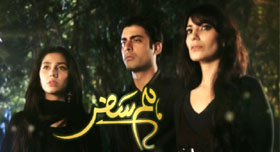
Since we were recently discussing gender norms in Pakistan, I am sharing this TV review I wrote some years ago. “Humsafar” was one of the most popular Pakistani TV dramas and it revolved around the theme of gender relations. This continues to be a major theme in Pakistani dramas. Part of the reason that I don’t watch Pakistani TV is that the dramas are largely full of crying women and toxic men. However–according to a family friend of mine who writes TV plays— this is actually what the (largely female) audience wants. 

It’s also interesting to note that “Humsafar” is the drama that made Fawad Khan and Mahira Khan a star couple on Pakistani TV. (They are not married. “Khan” is a very common last name in Pakistan). 


Since last September, one TV serial has taken Pakistan by storm, becoming a major topic for conversation and forcing people to reschedule social occasions so that they don’t clash with the program’s time slot. Entitled Humsafar (Companion), the drama has made stars out of its leading couple, Fawad Afzal Khan and Mahira Khan.  The play is a typical melodrama, centering around the relationship between Ashar and Khirad and the intrigues that drive them apart, intrigues created by Ashar’s controlling mother, Farida. Yet somehow, this hackneyed plot line has had the entire nation hooked for six months.

To briefly summarize the plot: Ashar is the son of a rich man living in Karachi and working in his father’s company.  His cousin, Khirad, meanwhile lives a middle-class life with her mother in Hyderabad. Khirad’s mother finds out that she has cancer and calls her brother (Ashar’s father) and asks him to help her. Her brother brings her to Karachi and gets her treatment, but it is too late. As she waits to die, she begs her brother to get her daughter married so that she is assured a secure future. Her brother agrees, telling her that he will marry Khirad to his own son.  Ashar agrees to honor his father’s promise, but his mother, Farida, is totally against the marriage, believing that Khirad is beneath her son’s standard. Farida has also hoped that her own niece, Sara, will become Ashar’s wife. Sara loves Ashar and believes that she will eventually marry him.  However, under threat of divorce, Farida is forced to accept the marriage. While her husband is alive, she pretends to accept Khirad but as soon as he passes away she begins plotting to get rid of her. Her plot involves making Ashar believe that Khirad has been unfaithful to him. Ashar is made to witness a scene in which Khirad is alone in the kitchen with another man who is holding her dupatta in his hands. Farida immediately accuses Khirad of infidelity, and though Khirad begs Ashar to believe she is innocent, he rejects her. Farida than throws Khirad (who is pregnant, unknown to Ashar) out of the house in the middle of the night.  Khirad writes a letter to Ashar, telling him that what he saw was orchestrated by his mother, and that she is pregnant. However, Ashar doesn’t read this letter until much later.

Khirad gives birth to a daughter, Hareem, and the story moves ahead four years.  Hareem has a congenital heart condition, and Khirad comes to Ashar to tell him that he has a daughter who needs open-heart surgery.  She herself shows no desire to reconcile with him, but simply wants him to do his duty towards his child.  Ashar takes the responsibility of getting the child treated, and mother and daughter move into Ashar’s house. Ashar begins to fall in love with Khirad again, but Khirad decides that once Hareem is well, she will leave her with her father, and go back to Hyderabad, believing that Ashar can provide her daughter with a much better life than she can. When she leaves, Ashar discovers her letter of four years ago and learns the truth. He rushes after Khirad to bring her back. Meanwhile Sara has realized that she was manipulated by her aunt and that Ashar will never love her. She commits suicide. Ashar returns and confronts his mother, who subsequently has a nervous breakdown. Ashar and Khirad reconcile. Continue reading Humsafar and Shakespeare

Passive Aggression is bullying

Just a short note on passive aggression.  I really didn’t want to do this but having been forced to call out passive aggression directed towards me multiple times now–from a commenter who shall remain nameless– I feel it is worthwhile to provide a definition of the phenomenon.

According to Wikipedia, passive aggressive personality disorder:

can be described as a personality trait marked by a pervasive pattern of negative attitudes and characterized by passive, sometimes obstructionist resistance to complying with expectations in interpersonal or occupational situations. This includes behaviors such as condescension, belittling, snubbing, subtly insulting insinuations, contrarianism, etc….

Passive aggression is a form of bullying–particularly when the person concerned has repeatedly been asked to desist from this behavior.

I also want to take this opportunity to–once and for all– clarify the way I moderate my posts.  Anti-Pakistan commentary is an absolute red line.  I am not going to belabor here what “anti-Pakistan” entails but suffice it to say I know it when I see it. Since these are my posts, there is no court of appeal beyond my subjective judgement.  Generally, if you can make your point without insulting the Pakistan Army or the Field Marshal, you are on safe ground.

The word “Islamist” is considered a slur–particularly when used towards me– and is an absolute red line.  I do not tolerate people getting personal with me or questioning my center-left credentials.

In general, any arguments made that are neither anti-Pakistan nor personal attacks are acceptable and will be engaged with respectfully. I have no problems with people expressing views that I disagree with as long as that expression is done in a civilized manner.

Finally, if your views go against the academic consensus on any subject, be prepared to have them challenged on those grounds.  It is preferable to cite your sources whenever possible.


Two Colonisations, One Border: What the Data Actually Says About Bengal’s Post-1971 Demographic Story

Check BB’s personal anecdote on the Northeast.

As mentioned, the Special Intensive Revision of electoral rolls in West Bengal has removed 9.1 million names, 2.7 million of them under contested adjudication. The argument has compressed itself into two bad positions. Either every deletion is disenfranchisement, or every deletion is a Bangladeshi caught. Neither is true, and the census of the last hundred years tells a more specific story than either side wants.

The received wisdom on Northeast India collapses into one sentence: Bangladeshi Muslims are flooding across the border. The received wisdom is partly wrong and mostly incomplete. A narrower reading of the census, focused on the actual border districts, tells a stranger story. There are two demographic colonisations in eastern India, not one. They run in opposite religious directions, and Indian statecraft has treated them as opposites: one ratified, one criminalised.

Tripura: the Hindu Bengali takeover

Tripura*: 1951: 71% Hindu, 7% Muslim (with ~21% still counted under tribal religions separately).

Today: 83% Hindu, 9% Muslim.

In 1941, tribals were 50% of Tripura. By 2011, 32%. Partition and the 1971 war did the rest.

The population that replaced the Kokborok, Reang, and Jamatia is Bengali Hindu, not Muslim. Tripura’s Muslim share today is 9%, below the all-India average. The Northeast state most transformed by Partition and 1971 is the one that became a Hindu Bengali colony.

South Tripura district is the cleanest data point. The ST share there is 17%. The Bengali Hindu majority there is overwhelmingly composed of descendants of refugees who crossed between 1947 and 1971.

*Note on Tripura: the Hindu figure jumped partly because tribals were reclassified as Hindu between 1951 and 1971 in the census. Real Hindu Bengali influx adds on top of that statistical shift.

Assam border districts: the Muslim Bengali case

Assam: 1951: 72% Hindu, 25% Muslim.

Today: 61% Hindu, 34% Muslim. Continue reading Two Colonisations, One Border: What the Data Actually Says About Bengal’s Post-1971 Demographic Story

Honour and Acid: The Great Indus Split

We published on the virginity economy yesterday. In the thread, we remembered a very line to us we could not leave alone. Honour killing is what Pakistan took from Indus culture. Acid throwing is what the Indian side took. The data is messier than the line. The line is still broadly right.

The Honour Killing Skew

Between 2018 and 2022, Punjab alone booked 841 incidents with 1,058 victims, 799 of them women. UNFPA’s working estimate is up to 5,000 deaths per year once karo-kari, siyahkari, and “natural cause” burials are folded back in.

India’s NCRB figures for honour killing sit in the low tens per year. This is an undercount so severe it is a category error. Most Indian cases are filed under IPC Section 302 as ordinary murder. The same is true in Pakistan. The difference is that Pakistan’s press, HRCP, and Dawn keep the score. India’s hotspots are Haryana, western UP, and Tamil Nadu (caste-coded).

Adjusted for population, Pakistan’s honour killing intensity is roughly an order of magnitude higher than India’s.

The Acid Attack Skew Continue reading Honour and Acid: The Great Indus Split

Brown Pundits