Mardana’s Children: The Rababis of Lahore (Short Film)

I don’t want to post too much in one day but this short film is worth sharing. On BP, there is a lot of focus on the negative side of Pakistan (understandably since this blog’s commentariat is mostly Indian nationalists and of a “Saffron” persuasion). Often, I feel that this commentariat finds the very existence of Pakistan personally offensive.  

This film serves as a counter to that discourse. 

A short film on the Rababis of Lahore, a community of Pakistani Muslim musicians with deep-rooted ties to the Sikhs by way of a centuries-old music tradition. Mardana’s Children traces the current descendants of Bhai Mardana (the 15th century musician and disciple of Guru Nanak), piecing together a story of shared devotion across India and Pakistan, traversing the modern boundaries of religious and nation, and highlighting the unifying power of music in the face of the divisive legacy of identity politics and the partition of 1947.

Disclosure: I know one of the producers (Kirit J Singh) from SOAS where he was doing a Phd on Sikh Music.  My father facilitated one of Kirit’s research visits to Lahore.

A useful piece to accompany this documentary is Arieb Azhar’s essay “Soundscape: When Punjab Sang as One” published in yesterday’s DAWN.

Finally, I would like to share a clip of myself performing the Shabad “Suraj Kiran Milay”. This shabad was composed in Raga Darbari by Ustad Hamid Hossain.


BB’s Open Thread – British Pakistani Grooming Gangs

Pakistan and North India

Pakistan is more “North Indian” than India. India has a much greater chunk of North India, both by area and population but it has a much bigger non North Indian population which changes the overall nature of India. Pakistan doesn’t so it remains steadfastly North Indian – in culture, language, food etc.

One of the side-effects of this is that Pakistan views India through the North Indian lens.

And while Pakistan is diverse in its own right, Indian diversity is orders of magnitude higher – in terms of race, language, culture, religion etc. India is a continent as a country. You could call it a “subcontinent”.

The nature of diaspora

Now the thing about this diversity is that when people emigrate, it does not happen in a manner similar to Noah’s Ark. The emigrant population demographics are not proportionately the same as the home country’s.

Indians in the Caribbean are from the Eastern UP-Bihar-Bengal region mostly with a smattering of Tamils and Telugus. They still have surnames like “Persad”, “Narine”. In Singapore and Malaysia, they are mostly Tamil (primarily from Dalit/OBC castes) with a few Punjabis. In the UK it is mostly Punjabi and Gujarati (via Africa). Canada is primarily Punjabi but that is changing with the recent waves. The US had a Gujarati wave and now has a Telugu wave fueled by IT.

Again, this is not an Indian thing. Italian Americans are primarily from the poorer South (including Sicily) and not from the richer North. Chinatowns around the world were established by Cantonese speakers, who are a minority amongst the Chinese.

Sampling bias

So when Pakistanis in the diaspora interact with “Indians” they do primarily with North Indians due to shared culture/language. They can bond over their love for Bollywood or Punjabi music. I don’t think they will be able to bond with the Tamil over Vijay Sethupathi movies or the Bengali over Feluda novels.

Also, the emigrant class to the west from North Indian states tend to be more “upper-caste” heavy. And these castes tend to be primarily vegetarian.

So, when a Pakistani interacts with an Indian, they are primarily interacting with North Indian vegetarians.

But to use that to extrapolate to the entirety of India is what is called a “sampling bias” in statistics.

In statistics, sampling bias is a bias in which a sample is collected in such a way that some members of the intended population have a lower or higher sampling probability than others.

https://media.geeksforgeeks.org/wp-content/uploads/20250731175913119431/population-2.webp

If we are speaking of diaspora populations, let us consider the British Pakistani population. The vast majority of “Pakistanis” in the UK are from the Mirpur region.

Now members of this community have been often found involved in child sexual abuse – Rotherham, Oxford etc.

Now if “most” Indians are vegetarian due to selective diaspora experiences, what does that make most Pakistani men?

Aasiya (Translation from the Urdu)

I’m sharing another translation of an Urdu short story from Bilal Hasan Minto’s Model Town.  There has been a lot of discussion on BP recently about gender dynamics in Pakistan and this is relevant in that context. 

There are people who might have felt the neighborhood was against Apa Sughra just like that, without a reason. They could have wondered how anyone could be against a woman so devout that she had fired her cleaning lady Alice on a matter of principle when she found her drinking water from glasses reserved for Apa Sughra’s Muslim household. A woman so righteous that she had summarily dismissed Susan because her husband supplied alcohol to a Muslim. But such people who question our hatred of Apa Sughra are ignorant of the facts.

We had not always been against her. When she rented the house next door, Ammi sent her both meals that first day because her kitchen wouldn’t be ready. So obviously, we hadn’t hated her from the very beginning. Quite apart from all the terrible things we found out later, what she did to her own daughter Pari, soon after moving to our neighborhood, was enough for us to condemn her, vilify her, and treat her with hostility. Pari was not at all to blame for the incident. Whoever heard of it said “What did the poor girl do wrong?” Naveed Bhai had been really angry and said Apa Sughra needed to be taught a lesson but Ammi strictly forbade him, saying there was no need to mess with that witch. It’s a different matter that I suspected Naveed Bhai didn’t have any way to do anything to Apa Sughra even if Ammi hadn’t said so. I thought he was just boasting.

Ever since Apa Sughra began living in our neighborhood we had noticed she didn’t allow her twin daughters, Fari and Pari, out of the house at all. Meeting us was out of the question; they weren’t even allowed to play with the neighborhood girls. We always thought the poor things were locked in the house after school. What did they do all day? Did they play with each other or was that not allowed either? And if they were so constrained, why did Apa Sughra even send them to school? Why was she educating them? Continue reading Aasiya (Translation from the Urdu)

Open Thread: Mother Indus is on Fire

The Commentariat on the “Long Night” has been busy. The Saffroniate counts Hindu babies, the Crescentiate counts Muslim babies, both sides argue with conviction over a future neither seems to have read the Weather Report for.

A heatwave advisory graphic maps much of Pakistan’s plains into extreme-risk zones for the final week of May 2026. Jacobabad, Multan, Bahawalpur, Sukkur, D.G. Khan and Sargodha sit in an extreme zone marked 47 to 50°C. Lahore, Faisalabad, Rawalpindi, Peshawar and Islamabad sit in a high zone at 42 to 45°C. Karachi, sea-cooled, stays at a relatively merciful 35 to 38.

The Indus does not read Radcliffe. The Punjab that cooks at 45°C on the Lahore side is the same alluvial plain that sears the Amritsar side. The Thar runs through both Sindh and Rajasthan. The Gangetic plain inherits the same dome of heat a fortnight later. The cradle of Desidom that the Commentariat are fighting over, will soon turn into a Heat Dome. Conversations on who fills it faster, who outbreeds whom, ultimately elide that Radcliffe drew a paper line. The thermometer does not pause at Wagah.

What It's Like Living in One of the Hottest Cities on Earth—Where It May Soon Be Uninhabitable

Continue reading Open Thread: Mother Indus is on Fire

Deepa Mehta as Auteur

Continuing on from my essay on Indiana Jones and Bride and Prejudice,  I am sharing another essay related to film. This piece was originally written for an Intro to Film Studies course at George Washington University.  I am sharing it here since it is related to South Asia and makes the case that Deepa Mehta is an auteur. 

In his 1954 essay “A Certain Tendency in French cinema”, the founder of auteur theory, French filmmaker Francois Truffaut, argued passionately against the “Tradition of Quality” which privileged the work of the screenwriter who created adaptations of literary works. Truffaut believed that films should reflect the creative vision of the director, as if he or she were the primary author, or auteur. In his view, all good directors have such a distinctive style or consistent theme that their influence is unmistakable in the body of their work.

Traffaut’s theory was popularized in the United States by Andrew Sarris. In his article “Notes on the Auteur Theory in 1962”, Sarris proposed a sort of scientific definition of the auteur. He compared his three criteria to a set of three concentric circles. The outermost circle corresponds to technical capability, the middle circle to personality and the innermost circle to interior meaning or “elan of the soul”.  In Sarris’s view, it is only when a director’s work satisfies all three criteria that he or she can be considered an auteur.  This theory was critiqued by film critic Pauline Kael in her essay “Circles and Squares.” Kael disputed the notion that the great director must be technically competent. She also criticized the concept of “elan of the soul” arguing that it was mere mystical mumbo jumbo.

In this essay, I will discuss the work of the Indian-Canadian director Deepa Mehta in the context of Sarris’s definition of the auteur and its criticism by Kael. I will draw my examples from Mehta’s “Elements Trilogy”, which consists of the films Fire (1996), Earth (1998) and Water (2005). All three of these films were both written and directed by Mehta and reveal her substantial influence on the work. They also deal with similar themes, depicting various moments in Indian history and focusing on oppressed groups and on women’s issues. In all three films, one can sense that Mehta is clearly aligned with the oppressed. Continue reading Deepa Mehta as Auteur

The Diaspora Saved The Mullahs. Pahlavi Helped.

Farhad’s thesis, delivered without prompting:

during the Woman Life Freedom protests, the Islamic Republic appeared more vulnerable than at any point in a generation. Women had started it, men had joined, opposition-minded Iranians inside the country felt the floor shifting. Then Pahlavi stepped forward, declared himself the advocate of Iranians, launched his petition, and pulled the diaspora’s attention outward at the exact moment Iranians on the ground needed it inward. He picked the wrong time. He saved the IRGC.

The Royal positioned as the alternative to the regime is the man Farhad blames for keeping the regime alive.

We are not endorsing this view. We are reporting that an Iranian who follows the country obsessively, who rallies behind Pahlavi today as the best of bad options, still holds him responsible for a historic missed moment. That is a serious accusation from a sympathetic source.

The Court In Exile

Continue reading The Diaspora Saved The Mullahs. Pahlavi Helped.

The Long Dark Night for India’s Muslims

Our own Hindufication

We write this not as outsiders pretending to diagnose India, but as people who have undergone a gentler version of the same process. Over fifteen years of family and work on the subcontinent, our own Islamicate inheritance has been quietly sifted. The Persianate was retained. The Arabic was allowed to fall away. The qawwali, the food, the manners, the ghazal, the Mughal grammar of taste. All survived. The devotional Islamicate self did not. We arrived as something close to a Anglo-Islamicate hybrid. We are leaving, slowly, as a Hindu-Persianate one. We did not plan this. We watched it happen to ourselves.

The Persian survives. The Arabic does not. The poetry survives. The prayer does not. This is the formula. Once you see it, you cannot unsee it.

We made this passage with privilege, with distance, with choice, and with somewhere else to be if we changed our minds. The Indian Muslim, the one with no other passport and no other country, is being asked to make the same passage on terms set by people who never had to make it themselves. That asymmetry is this post.

The morning song

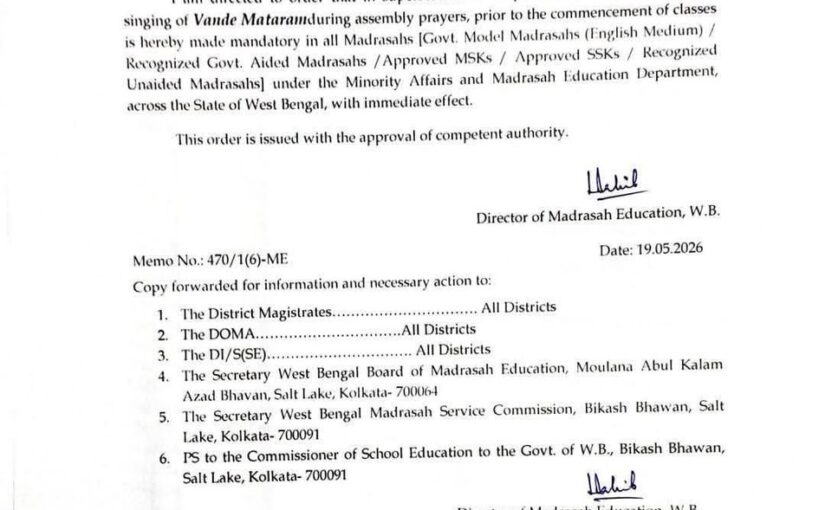
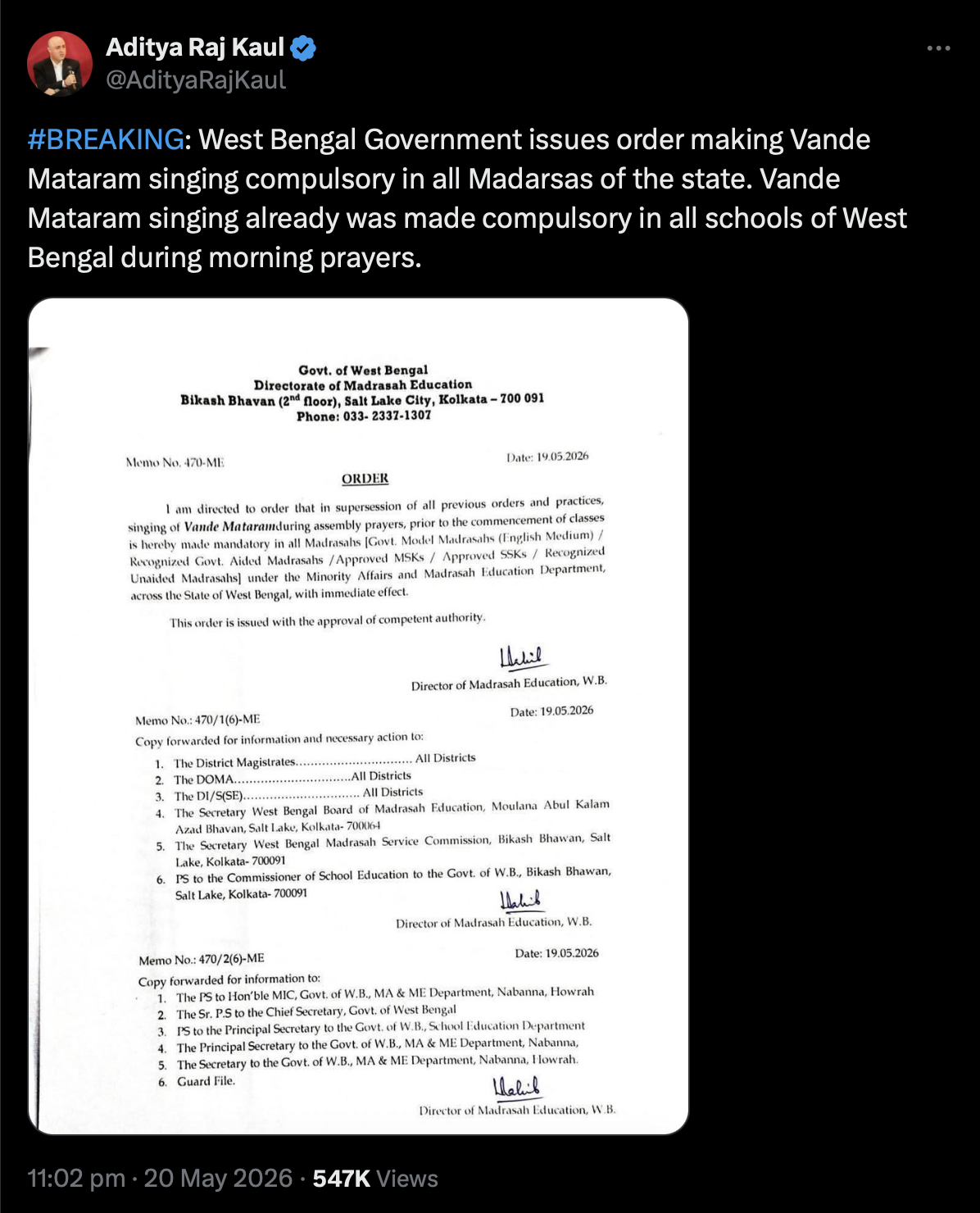
The news this week was Memo No. 470-ME, dated 19 May 2026, signed by the Director of Madrasah Education, Government of West Bengal. The order makes the singing of Vande Mataram mandatory at morning assembly in every state-recognised madrasa: government, aided, unaided, all of them. Immediate effect. Approval of competent authority.

Note the date. Suvendu Adhikari was sworn in as the first BJP Chief Minister of West Bengal on 9 May, ten days earlier, on a 207-seat mandate that ended Mamata Banerjee’s fifteen-year run. The order is ten days into the new government. Of all the actions available to a freshly-installed state administration, this is the gesture chosen. The first major item on the agenda was the Muslim schoolchild’s morning. The signal is the signal.

The Pakistani faction of our commentariat is aghast, and not unreasonably. The song is a hymn to the Great goddess Durga, drawn from a novel that called for war on Muslims, and forcing a Muslim child to recite it is a small humiliation that announces a large arrangement. One of our Pakistani commenters compared it to forcing a vegetarian Hindu to eat beef. The comparison overstates and understates at the same time. It overstates because nobody is forcing food into anyone’s mouth. It understates because food is forgotten by the afternoon, and a song sung daily for ten years writes itself into the spine.

The row is the symptom. The disease is older. Bengal is the latest frontier, not the first.

The Persianate without the Muslim

Continue reading The Long Dark Night for India’s Muslims

The High Signal Mandate

Brown Pundits is not in the news business. We are not in the takes business. We are not in the engagement business. We are in the signal business. This is our creed.

Signal is the mandate. Noise is the enemy. Every piece (like the Prussia of the Ummah) on the blog must clear that bar or it gets rapidly down-posted. We owe the reader nothing less.

The signal compounds.

What does signal mean here? Three things, in order of weight.

Continue reading The High Signal Mandate

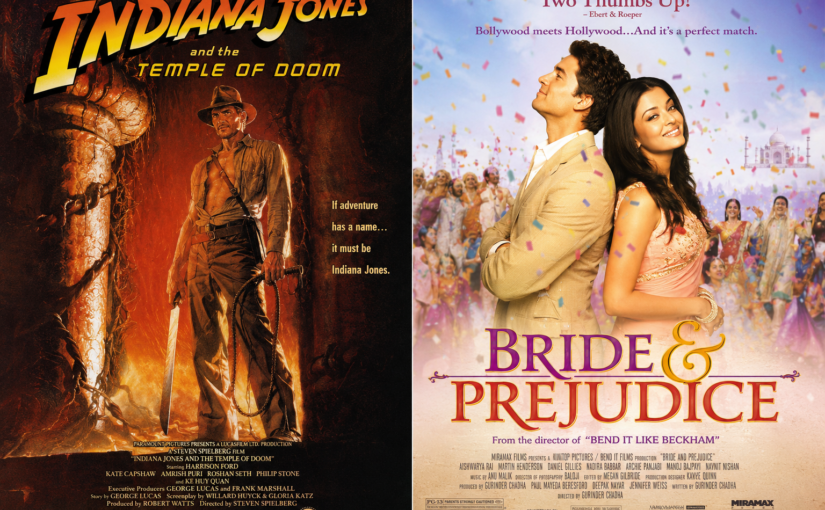
A Comparison of the Representation of India and Indians in Indiana Jones and the Temple of Doom and Bride and Prejudice

To make a change from some heavy topics, here is an essay I wrote during my undergraduate for a course at LUMS entitled “Culture, Media and Representation”. I just found a hard copy of this in my files and re-typed it.  If I recall correctly, the two films under review were chosen by the instructor. 

Cinema is a very powerful medium that can influence how people view the world. However, it is mainly a commercial industry concerned with maximizing profit through entertainment and audience appeal. For this reason, films often do not project a balanced view of reality, relying instead on stereotypes. Stereotype, according to Stuart Hall, reduces people to a few, simple, essential characteristics which are represented as fixed by nature (Hall 257). The two films that I will be reviewing in this paper, Indiana Jones and the Temple of Doom and Bride and Prejudice represent India and Indians in very different ways, neither of which are accurate or realistic depictions.

The particular ways that a film represents its subjects depends on many factors, including genre, creator, time period, and audience. Indiana Jones is an action/adventure movie made in 1984 by Steven Spielberg and George Lucas. One of the main conventions of the adventure movie is that character development and complexity are sacrificed in favor of plot. The conflict often revolves around confrontations between stereotypical “good guys” and “bad guys”. In this film, the good guys include Indiana Jones and his sidekicks, while the bad guys are the Thugees led by the fanatical priest Mola Rom.

The film does not depict all Indians in the same way. Rather, they are presented as two distinct groups, one consisting of dark and evil fanatics, and the other consisting of naive and childlike peasants. The “evil” group consists of Mola Ram and his followers, devotees of the Thugee cult that worship Kali Ma, the Hindu goddess of destruction. Throughout the film, these characters are shown as eating such things as snakes and chilled monkey brains, practicing voodoo and committing human sacrifice. They are also shown as oppressive, having enslaved all the children of a nearby village to dig for sacred stones. The naive and childlike group consists of the villagers who look to Indiana Jones to save them. A scene which typifies the behavior of this group is one that occurs near the beginning of the movie. As soon as Indian Jones steps off his boat and arrives in the village, all the villagers gather around him and hail him as their savior. The priest tells him “You were sent by Shiva to save us from evil.” This relation of the Western man as hero and the natives as supplicants strongly recalls the notion of the “white man’s burden” that obliges the West to civilize and save the natives from themselves. Continue reading A Comparison of the Representation of India and Indians in Indiana Jones and the Temple of Doom and Bride and Prejudice

The Hijras of India

Note: This is an academic essay originally written for an anthropology course. It is by no means intended to cause offense to anyone.  Rather, it is intended to add to the conversation on gender and sexuality we have been having on BP. 

In the context of this essay “India” refers to the Indian subcontinent. 

See also my review of Queen Zarqa–a novel about a Pakistani transgender. 

In the West, it is generally believed that there are only two sexes, male and female, and that each sex has its own particular role in society. However, in their ethnographic fieldwork across the world, anthropologists have noticed that the roles of men and women vary significantly across societies. This has led them to distinguish sex, which is based on biology, from gender which is defined as “the cultural construction of beliefs and behaviors considered appropriate for each sex” (Schultz and Lavenda 237). In addition, anthropologists have also noticed that several societies around the world have supernumerary (e.g. more than two) sexes. These include the xanith in Oman, the Native American two-spirit and the Indian hijra. Appropriate behavior for these “third-sex” groups is defined by a third gender role, which is distinct from traditional masculine and feminine identities (Schultz and Lavenda 238).

In fact, even the hegemony of the Western “two-sex model” is a relatively recent development. Prior to the eighteenth century, the dominant way of understanding sex was Plato’s “one-sex model” which emphasized the similar nature of men and women’s sex organs and viewed women as “inverted, inferior versions of men” (Potts 4). Thus, it is clear that the “two-sex” model is not unquestionable and is just one out of several possible gender classification systems.

In this paper, I will focus on the Indian hijra. I will be examining various Western constructs such as “homosexuality” and “transexualism” that are used to define hijras and I will contrast these with how the hijras define themselves. Secondly, I will compare the hijras with examples of “third-sex” groups in other societies. Finally, I will discuss the relationship between the hijra community and mainstream Indian society, specifically the two main roles of the hijras as ritual performers at weddings and births, and as homosexual prostitutes. Continue reading The Hijras of India

Brown Pundits