The Diaspora Saved The Mullahs. Pahlavi Helped.

Farhad’s thesis, delivered without prompting:

during the Woman Life Freedom protests, the Islamic Republic appeared more vulnerable than at any point in a generation. Women had started it, men had joined, opposition-minded Iranians inside the country felt the floor shifting. Then Pahlavi stepped forward, declared himself the advocate of Iranians, launched his petition, and pulled the diaspora’s attention outward at the exact moment Iranians on the ground needed it inward. He picked the wrong time. He saved the IRGC.

The Royal positioned as the alternative to the regime is the man Farhad blames for keeping the regime alive.

We are not endorsing this view. We are reporting that an Iranian who follows the country obsessively, who rallies behind Pahlavi today as the best of bad options, still holds him responsible for a historic missed moment. That is a serious accusation from a sympathetic source.

The Court In Exile

Continue reading The Diaspora Saved The Mullahs. Pahlavi Helped.

The Long Dark Night for India’s Muslims

Our own Hindufication

We write this not as outsiders pretending to diagnose India, but as people who have undergone a gentler version of the same process. Over fifteen years of family and work on the subcontinent, our own Islamicate inheritance has been quietly sifted. The Persianate was retained. The Arabic was allowed to fall away. The qawwali, the food, the manners, the ghazal, the Mughal grammar of taste. All survived. The devotional Islamicate self did not. We arrived as something close to a Anglo-Islamicate hybrid. We are leaving, slowly, as a Hindu-Persianate one. We did not plan this. We watched it happen to ourselves.

The Persian survives. The Arabic does not. The poetry survives. The prayer does not. This is the formula. Once you see it, you cannot unsee it.

We made this passage with privilege, with distance, with choice, and with somewhere else to be if we changed our minds. The Indian Muslim, the one with no other passport and no other country, is being asked to make the same passage on terms set by people who never had to make it themselves. That asymmetry is this post.

The morning song

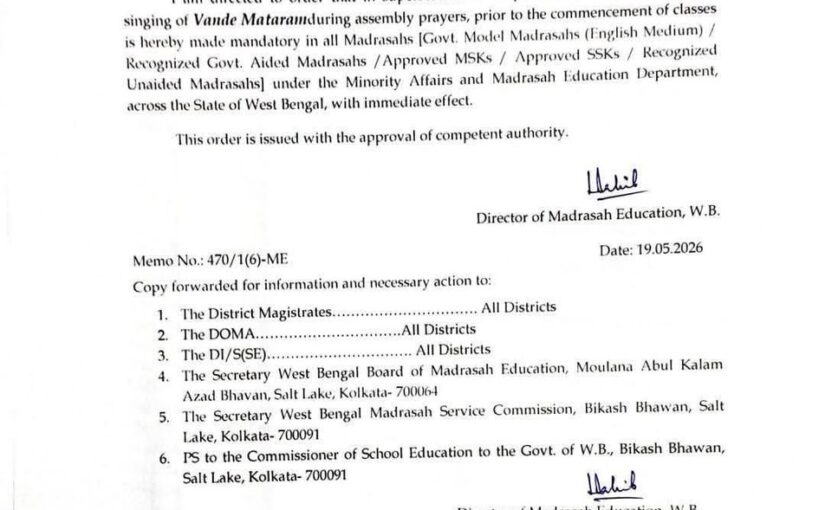
The news this week was Memo No. 470-ME, dated 19 May 2026, signed by the Director of Madrasah Education, Government of West Bengal. The order makes the singing of Vande Mataram mandatory at morning assembly in every state-recognised madrasa: government, aided, unaided, all of them. Immediate effect. Approval of competent authority.
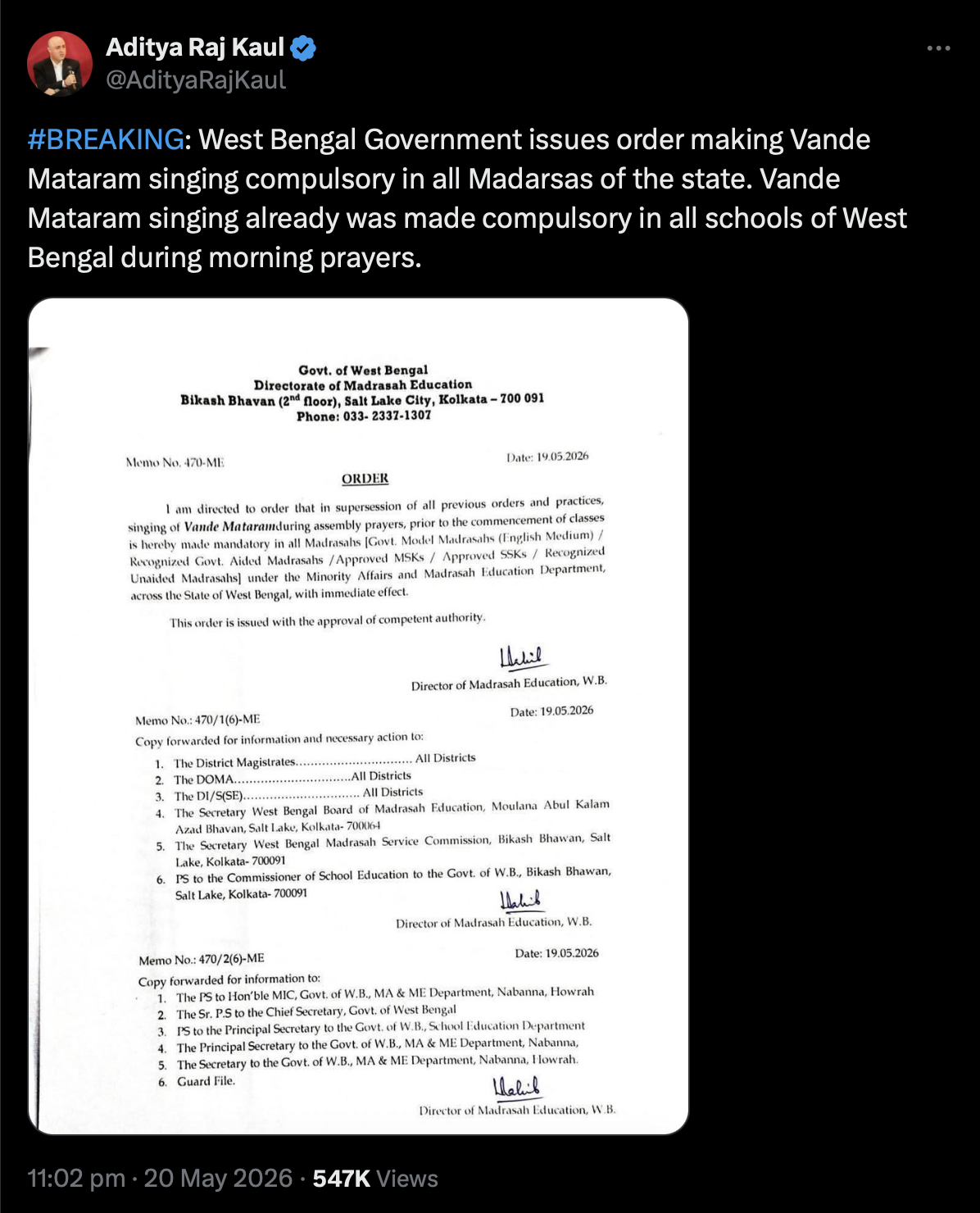
Note the date. Suvendu Adhikari was sworn in as the first BJP Chief Minister of West Bengal on 9 May, ten days earlier, on a 207-seat mandate that ended Mamata Banerjee’s fifteen-year run. The order is ten days into the new government. Of all the actions available to a freshly-installed state administration, this is the gesture chosen. The first major item on the agenda was the Muslim schoolchild’s morning. The signal is the signal.

The Pakistani faction of our commentariat is aghast, and not unreasonably. The song is a hymn to the Great goddess Durga, drawn from a novel that called for war on Muslims, and forcing a Muslim child to recite it is a small humiliation that announces a large arrangement. One of our Pakistani commenters compared it to forcing a vegetarian Hindu to eat beef. The comparison overstates and understates at the same time. It overstates because nobody is forcing food into anyone’s mouth. It understates because food is forgotten by the afternoon, and a song sung daily for ten years writes itself into the spine.

The row is the symptom. The disease is older. Bengal is the latest frontier, not the first.

The Persianate without the Muslim

Continue reading The Long Dark Night for India’s Muslims

The High Signal Mandate

Brown Pundits is not in the news business. We are not in the takes business. We are not in the engagement business. We are in the signal business. This is our creed.

Signal is the mandate. Noise is the enemy. Every piece (like the Prussia of the Ummah) on the blog must clear that bar or it gets rapidly down-posted. We owe the reader nothing less.

The signal compounds.

What does signal mean here? Three things, in order of weight.

Continue reading The High Signal Mandate

Dhurandhar, Netflix and the India-Pakistan Asymmetry

Netflix’s analytics for last week are out, including Pakistan. Dhurandhar: The Revenge is at the top of the Pakistan charts. The OG Dhurandhar is at 7th, completing 16 weeks in the top 10.

Even the main Netflix handle (not Netflix India, but the one based in the US) has been openly promoting the release.

Continue reading Dhurandhar, Netflix and the India-Pakistan Asymmetry

CJP and colour revolutions

1) Rashid kidwai writing in ndtv.com, says that the CJP “movement ” might boomerang on opposition and not necessarily on BJP.
2) OTHERS have started seeing a new AAP.
3)The point to be considered is that, there is a generation that is rootless and is not connecting to the main stream parties. Will this turn into votes is still a question mark.
4) while the revolts in Sri Lanka and elsewhere (colour revolution ) succeeded ,it failed in Iran and Bangladesh to change the system.
5) It looks increasingly possible to do a TVK type upheaval with media’s help.

Who Sees? A Caste Audit of an Anonymous Elite Indian Hospital

Excerpt:

We pulled the consultant roster of a leading Indian hospital, well-known, charitable, multiple metros, decades old, and ran the surnames against caste. The institution does not publish anything beyond name, sub-specialty and city. We have anonymised the hospital because the point is structural, not gossip. The pattern here is the pattern at twenty others. What we found will not surprise anyone who has sat in an Indian waiting room, but the numbers are worth tabulating.


The Methodology

This is not a census. It is surname sociology. Indian surnames are imperfect caste signals, especially in Tamil Nadu where initials often suppress jati markers altogether, and elsewhere where regional surnames detach from their origin communities through migration and intermarriage. We are not building a genealogical claim about any individual on the list. We are reading the aggregate. Elite institutional patterns in India are often visible precisely through these imperfect signals: when the noise floor is what it is, a strong signal still tells you something. The exercise is probabilistic, not deterministic, and we have tried to keep the language commensurate with that.

The Numbers

Continue reading Who Sees? A Caste Audit of an Anonymous Elite Indian Hospital

On “Press Freedom” and Prejudice.

This is what Norway’s leading newspaper chose for its coverage of the Indian Prime Minister’s visit to Norway.

https://x.com/_Tracer_Bullet_/status/2056737017460089173

While the usual suspects on BP chose to focus on an aspiring influencer’s stunts and dramatic heckling, I am not surprised that such blatant bigotry in the ‘mainstream’ newspaper of the supposedly Number one ranked Press has not been discussed on BP. Hilariously, a non-trivial subset of the Indian media and political opposition actually supported a rookie aspiring journalist’s publicity stunt.

Its a time-tested pattern. Rage-baiting and attacking Hindus and India earns notoriety, while the pushback and negative consequences if you push the envelope too far into nakedly racist territory, is minimal if there at all.

For all the cacophony and chaos that the Indian media landscape consistently generates, it has yet to demonstrate ability to even capitalize on such low-hanging fruit. A more capable media ecosystem wouldn’t allow such nonsense unpunished.

This is the overton window that needs to be shifted – the coverage ‘rules’ on India allow for a lot more mainstream ‘phobia’ and assault. And we see that on BP as well, the Pakistani tribal ‘patriot’ squad repeatedly find themselves facing pushback which to them is unexpected. After all, why shouldn’t they be allowed free rein in rage-baiting and plying bigoted stereotypes.

Bangladesh whitewash Pakistan again

Bangladesh completed a whitewash over Pakistan yesterday in the test series they were playing at home, winning it 2-0. This follows the 2-0 whitewash they achieved in the test series before this, in Pakistan two years ago (in Rawalpindi, of all places). Bangladesh have also won the last ODI and T20I series between the two sides.

During my vanvaas, apart from enjoying the IPL (on which I will do a post later, maybe after the final) I also watched a decent chunk of the test series. Test cricket has its own flavour of joy, distinct from the more immediate rush of T20 cricket. Its slower and more meandering pace means you can actually put it on the background while tending to other stuff. 

Some thoughts about the series.

Bangladesh has overtaken Pakistan

Bangladesh has been doing economically well over the past few decades and now surpasses Pakistan in most, if not all socioeconomic indicators – higher GDP, higher GDP per capita, higher HDI, lower poverty rate, higher life expectancy, better access to electricity etc.

Diverging HDI between Bangladesh and Pakistan

Diverging GDP pci between Bangladesh and Pakistan

Continue reading Bangladesh whitewash Pakistan again

Return of the King

The king returns from his vanvaas, refreshed and with a mind filled with clarity.

Before my self-imposed exile X.T.M said something which I have pondered upon during my time away.

Pakistan has anyway lost to India alas; thus the Pakistanis have to constantly deprecate India and everything she stands for.

I don’t need to be getting into mud fights in the comments sections writing essays.

The victor doesn’t need to proclaim his victory. The defeated know.

And as the winner, I possess an asymmetric array of “tools” to do my “Dhurandharing”. Far more civil and high-signal and in a way, more wounding.

Of course, that does not mean I won’t participate in the comments, but it will be in a more “support” role. There are many Dhurandhars here with some springing up in my absence so I need not play as active a role.

I have also changed my profile picture to reflect that change. While my earlier picture was from when Hamza was actively involved in street fights, my current one is from the later part of the movie where he takes a bit of a back seat to co-ordinate other guys. Of course just like in the movie, I won’t hesitate to personally participate if necessary.

7 Steps to Financial Freedom: My First Book


India’s GDP grew at 7.6% in the financial year 2024-2025 making it one of the fastest growing economies in the world.

It is also home to a vibrant capital market. The market capitalization of its listed companies at the end of 2025 stood at 4.75 trillion US Dollars.

India is also a young country. 65% of its population of 1.4 billion is below the age of 35.

The trifecta of economic growth, world class capital markets and a young population with access to technology has enabled breakneck growth, in the number of Indians investing in Indian equity markets via mutual funds and stock purchases.

The number of mutual fund investors in India was 2.08 crores at the end of year 2020. This number stood at 5.9 crores at the end of year 2025.

The number of Demat accounts in India stood at 4.98 crores at the end of year 2020 this number had grown to 21.59 crores by the end of year 2025.

In April 2026, Indians invested Rs 38.4 thousand crores in Indian equity markets through mutual funds.

I have been an investment adviser to individuals and institutional investors for almost 17 years now and have had front row seats as this growth has played out.

I have also had the chance to interact with investors in tier 2, tier 3 towns in India and I am also witness to the phenomenon of ‘fin-influencers’.

Fin-influencers are freelance financial advisers offering easy money schemes and ways of attaining Financial Independence and Retiring Early (FIRE) through their YouTube channels and Instagram handles.

Their channels have millions of subscribers and their videos and reels get tens of millions of views.

Viewers of these channels take home answers to the holy grail of all questions -How much money is enough to retire?

How much is enough for you to leave your job, move to a small town and spend your time tendering to your kitchen garden?

How much money do you need for you to leave your job, pack your bags and open a cafe in Dharmashala/Goa/Cochin or Tuticorin?

If you don’t like the figure, help is at hand. Viewers are given formulas to arrive at their own answers.

I have no data to prove how successful or unsuccessful fin-influencers have been in helping people achieve FIRE.

However we do have data on how Indians are investing in the derivative segment of Indian stock markets faring!

Derivative instruments are used by investors to manage risk and by speculators to make quick money.

If I want to run a cafe in Dehradun before I turn forty, my salaried job wouldn’t do.

I need to make money fast.

Enter a digital stack that lets me do derivative trades as easily as ordering a pizza online, an oversupply of ‘trade strategies’ and access to cheapest cellular data in the world.

I can now watch YouTube videos all day and ‘hone my trading skills’.

SEBI, regulator of capital markets in India, conducted a study and published a note in 2024.

The study revealed 93% of individual traders incurred losses in equity derivatives between financial years 2022 and 2024.

The aggregate losses of these traders for this three year period exceeded Rs 1.8 lakh crores.

To put the figure in perspective, the Government of India’s budgetary allocation to its Ministry of Health and Family Welfare in FY 2024 was Rs 80.5 thousand crores.

As part of my job, I am often asked- what is the rate of return one should expect from a growth oriented portfolio? My answer invariably disappoints because it does not augment dreams of early retirement.

I learnt, from some of the best investors and fund managers-investing is like watching paint dry.

My job and my experience of investing my own money have convinced me that is the only way.

There are no short cuts to financial freedom.

This book is my attempt at conveying a framework that has stood the test of time and helped people live better. 

The book has no magic formulas and final figures.

No silver bullets that will ease the path to a cake and coffee shop in Almora.

If the world is watching YouTube, why write a book ?

I believe a reader gets more out of the content than a viewer.

Physical and financial health are keys to our sense of well being and confidence. They make our world go around. The book is my attempt at making investing accessible and relatable.

If you end up reading the book, please let me know if I got it right.


The book is now available on Amazon and Kindle


Brown Pundits