Greenland, Trump, and the Comfort of White Intermediaries

What people are missing in the Greenland debate is not a technicality of citizenship or electoral legality. It is the structure of power that keeps repeating itself across the settler-colonial West.

This is not really about whether the Greenlandic Prime Minister, Jens-Frederik Nielsen, can lawfully hold office.

Of course he can. He has a Danish father and a mother born and raised in Greenland, and he meets every formal requirement. That point is trivial, and focusing on it is a way of dodging the real issue. The real question is why, across every settler-colonial society; Indigenous welfare and political destiny are so reliably mediated by white-presenting figures, even when those societies are overwhelmingly Indigenous in population.

Greenland is 90 percent Inuit. Yet when power reaches its most visible, internationally legible form, it is once again carried by someone who presents as Danish, speaks the language of European governance fluently, and is immediately readable to Western capitals as “safe.” This is not accidental. It is structural. Continue reading Greenland, Trump, and the Comfort of White Intermediaries

The Demise of Brown Pundits Is Much Exaggerated

Every few months someone asks whether Brown Pundits is “dying.” I understand the instinct. The internet is littered with abandoned blogs. Attention is fickle. Writers drift. The centre does not hold. And yet, when I actually look at the numbers, the mood often turns out to be wrong.

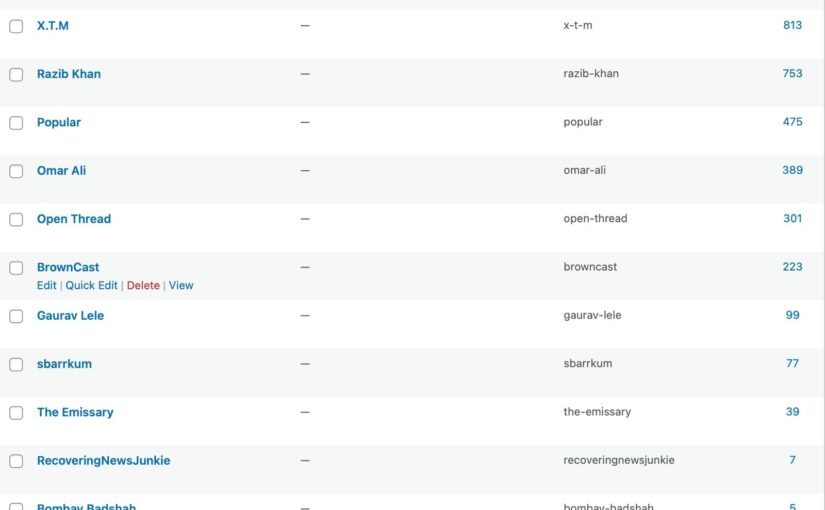
We had a real dip. In September and October we were running at roughly 55–65k monthly readers. Then we fell hard, to around 33k. This month, we have bounced back to roughly 53k. That is a 60% jump on the trough. A lot of it is mobile. A lot of it is casual readership rather than the old-school desktop cohort. But it is still real people arriving, reading, and sharing.

The geographical pattern is also telling. India and the United States remain the main pillars, as you would expect. But Bangladesh has surged in a way we did not anticipate. That matters because it suggests we are not only a niche diaspora salon. We are also being read inside the region, by people who do not need South Asia explained to them. Continue reading The Demise of Brown Pundits Is Much Exaggerated

Bollywood, Brahmins, Parsis & WASPs:

Endogamy Is Optional When You Own the Institutions

Gaurav’s excellent piece on “progressive Dravidianism” pushed me to re-examine a related elite anxiety: the melodrama around intermarriage.  I am happy to be corrected on any of the specifics below, especially where a claim could be tightened with better data.

The standard story goes like this. Elites marry out. Boundaries dissolve. The group dies. This story is intuitively appealing because it treats identity as if it were a biological substance. But elites are not reproduced primarily by blood. They are reproduced by property, institutions, credentials, and networks. In that world, intermarriage is rarely a solvent. It is more often a merger.

The English aristocracy understood this early, and acted accordingly. When the old landed families were cash-poor but title-rich, they did not preserve themselves by sealing the gates. They did the opposite. They married in money. The late nineteenth and early twentieth centuries produced a whole genre of “dollar princesses,” wealthy American heiresses who married British aristocrats, trading capital for rank. By one commonly cited compilation, between 1870 and 1914, over a hundred British aristocrats, including multiple dukes, married American women; and in the broader European set, hundreds of such transatlantic matches were recorded.  This was not cultural dilution. It was institutional self-preservation by acquisition. The class survived because it treated marriage as capital strategy. Continue reading Bollywood, Brahmins, Parsis & WASPs:

What Genetics Can, and Cannot, Explain About Caste

A recent WhatsApp exchange between GL and Sbarr captures a recurring Brown Pundits problem: how genetic data, textual tradition, and social history get collapsed into a single argument and then talk past one another. The immediate trigger was a table circulating online, showing ancestry proportions across South Asian groups; Indus Valley–related, Steppe, AASI, and East Asian components. The numbers vary by region and language group. None support purity. None map cleanly onto caste. That much is uncontroversial. What followed was not a dispute about the data itself, but about what kind of claims the data can bear.


GL’s Position (Summarised)

GL’s argument operates at three levels: historical, linguistic, and genetic.

  1. Caste as fluid history

    GL argues that the four-fold varna system hardened late. Terms like Vaishya did not always mean “merchant” but originally derived from viƛ—“the people.” In this reading, Vaishya once referred broadly to non-priestly, non-warrior populations, including farmers and artisans.

  2. Elite religion thesis

    Early Úramaáč‡a movements, Buddhists, Jains, Ajivikas, are framed as elite projects. Renunciation, non-violence, and philosophical inquiry required surplus. Most people, GL argues, worshipped local deities and lived outside these doctrinal systems.

  3. Genes as complexity, not identity

    GL points out that Steppe ancestry and Y-DNA lineages are unevenly distributed. Some peasant groups show higher Steppe ancestry than some Brahmin groups. Maternal lines are largely local. The conclusion is not reclassification, but complication: caste cannot be reverse-engineered from genes. GL’s underlying claim is modest: simple caste narratives do not survive contact with deep history.


Sbarr’s Position (Summarised)

Sbarr’s objections are structural and definitional.

  1. Varna as stable social fact

    In lived Hindu society, Vaishya has meant merchant since at least the Dharmashastra period. Etymology does not override usage. Peasants were not Vaishyas. Shudras worked the land. Dalits lay outside the system.

  2. South Indian specificity

    Sbarr stresses that the North Indian varna model does not transplant cleanly into the Tamil world, where Brahmins, non-Brahmin literati, Jain monks, and Buddhist authors all contributed to classical literature. Claims of universal Brahmin authorship are rejected.

  3. Genes do not make caste

    Even if some peasant or tribal groups show Steppe Y-DNA, this does not make them Brahmins or twice-born. Genetic percentages are low, overlapping, and socially meaningless without institutions.

Sbarr’s core concern is different from GL’s: the danger of dissolving concrete social history into abstract theory.


Where the Debate Breaks Down

The argument falters because the two sides are answering different questions.

  • GL is asking: How did these categories emerge over millennia?

  • Sbarr is asking: How did people actually live, identify, and reproduce hierarchy?

Genes describe populations. Texts describe ideals. Caste describes power. None substitute for the others.


The Takeaway (Without a Verdict)

The ancestry table does not refute caste. The Manusmriti does not explain population genetics. Etymology does not override social practice. What the exchange shows, usefully, is the limit of WhatsApp as a medium for longue-durée history. Complex systems resist compression. When they are forced into slogans, everyone ends up defending a position they did not fully intend. That, more than Steppe percentages or varna theory, is the real lesson here.

15 Years of Brown Pundits: A Platform, a Posture, a Proof

On 28 December 2010, the question was not ideology or politics, but naming.

brownpundit(s). brownguru(s). brownsmarts. brownfolks. brownidiots.

The instinct was already there: reclaim brown without asking permission, and refuse the performance of respectability that so often polices minority intellectual spaces. The reply came quickly and decisively.

Brownpundits.

The first post, Hello World, went live on 30 December 2010. Fifteen years later, what matters is not that a blog survived. Many do. What matters is how it survived: without institutional backing, without funding, without ideological capture, and without deference to credentials masquerading as truth. Brown Pundits was never designed as a platform for prestige. It was designed as an intellectual retreat; a place where arguments stand or fall on substance, not accent; where brownness is neither explained nor apologised for; where disagreement is not heresy. That posture, upright, unbought, unafraid, is why Brown Pundits still exists.

A Discipline, Not a Brand

Brown Pundits began with a simple wager: that the English-language internet still had room for a South Asian intellectual space that did not need permission. No institutional sponsor. No ideology police. No professional incentives. Just writers who believed that brown questions, Indian, Pakistani, Bangladeshi, diasporic, could be argued in public with rigor and dignity. Fifteen years on, Brown Pundits remains. That endurance is not luck. It is structure. We lasted because we never built this as a brand. We built it as a discipline.

The point has never been agreement. The point has been posture: stand upright, test claims, correct errors, refuse theatre. Independent platforms fail for predictable reasons. They chase virality. They harden into faction. Or they monetize attention until thought becomes marketing. Brown Pundits avoided those traps by being unusually boring in the right ways: we publish, we argue, we edit, we keep the record. Nobody here is paid to write. That is not moral vanity. It is why we remain unpurchasable.

Five Years of Solidarity

Over the last five years, some of the most important work has not been online at all. It has been the steady, unglamorous work of civic seriousness: reading dense documents, tracking deadlines, understanding procedure, and watching institutions scramble when they assume nobody is paying attention. During this period, there has also been sustained dialogue with a small circle of intellectually serious allies; quiet, exacting minds with a gift for clarity under pressure and an instinct for how power hides behind process. Not public figures. Not brands. Just adults: difficult to gaslight, uninterested in theatrics, precise about the record.

That kind of solidarity resets the baseline. You stop mistaking polish for integrity. You stop confusing titles with truth. You learn to clock everything. You learn that the record is not drama; it is protection. That discipline carries back into Brown Pundits. It shows in how disputes are handled, how errors are named, and how authority is tested rather than absorbed.

The SD Episode as Proof

The recent SD exchange was not, in the end, about architecture. It was about authority: who is allowed to explain, who is expected to absorb, and what happens when the subject speaks back. We engaged the way Brown Pundits always has. We read closely. We identified the errors. We insisted on precision. We treated the exchange as part of the record, not as outrage content. What mattered was not that corrections were made; corrections are normal and welcome.

What mattered was the instinct that surfaced at the start: revise quietly, respond pedagogically, assume the critique will not notice the shift. That instinct is older than any one writer. It is a patterned behaviour in how authority manages challenge in brown-facing spaces. And yet, precisely because Brown Pundits exists, the record held. The language moved. The posture changed. This was not a “victory.” It was proof of concept. The platform did what it is meant to do.

“Brown” Is Not an Ethnicity; It Is a Civilizational Composite

The deeper reason Brown Pundits still matters is that brown is not a neat identity. It is not a single bloodline, doctrine, or grievance. It is a civilizational composite with a long memory and a hard geography. The Indian subcontinent is layering, not essence:

  • ancient coastal and inland populations

  • Dravidian continuities and transformations

  • Aryan synthesis and institutionalisation

  • Islamicate overlays that became native in texture, not merely foreign in rule

  • British power, whose administrative afterlife still structures class and accent

And beyond this lie the East, the Northeast, the mountain corridors, the sea routes. This is why Brown Pundits resists simplification. The subcontinent is not a monoculture, a single trauma, or a single pride. It cannot be narrated by those who treat it as a site for extraction; political, academic, or aesthetic.

What Fifteen Years Means

Fifteen years is long enough to know what this site is for. Not fame. Not power. Not money. Not outrage. Those are cheap forms of relevance. Brown Pundits exists to keep an alternative alive: an intellectual retreat on the open web where brown life can be examined with seriousness; where hierarchy is not mistaken for truth; where criticism is not treated as insolence; where the record matters. We are not untouchable, and we do not aim to be. But we are not easily compromised, because everyone here has a life outside the internet. That is our freedom. Fifteen years on, the mission remains unchanged:

Stand upright | Read closely | Correct what is wrong | Refuse permission structures | Keep the record |

That is why we are still here.

A Republic Cannot Deport, Humiliate or “Outbreed” Its Own People

“We are not from Bangladesh. We are Indian. Why did they do this to us?”

That question should shame the Indian state. On the facts as currently established, Sunali Khatun, a pregnant Indian woman, her husband, and their child were detained in Delhi, deported across an international border without due process, imprisoned in a foreign country, separated, and left to survive on charity and court orders. Their crime was not illegal entry. It was speaking Bengali, being Muslim, and being poor. This was not a mistake or overreach. It was state violence carried out through paperwork and silence.

India has procedures for suspected illegal migrants

They exist to prevent this outcome. They were ignored. There was no verification with the home state, no due process, no public record, and no accountability. A family was pushed across a border, reportedly beaten when they tried to return, and abandoned. That is not law enforcement. It is expulsion by force. When a state confuses language with nationality and religion with foreignness, it stops governing and starts hunting.

Citizenship is not a favour

It is a legal fact. India is not meant to be a blood, language, or religious state. Citizenship is defined by law, not accent or poverty. When the weakest are forced to prove citizenship under duress while the powerful are never asked, law collapses into power. This is how republics rot: not through coups, but through habits.

This is not an isolated lapse of manners towards the Muslim minority

It is the same logic in a smaller, more public form. When a Chief Minister can pull down a Muslim woman’s veil at a government appointment ceremony, and senior ministers can defend it as “show your face” patriotism, the message is clear: Muslim dignity is conditional, and visibility is enforced, not consented to. The argument is always the same. It is dressed up as procedure, security, or “rule of law,” but it operates as dominance.

Muslim Identity is seen as a National Threat

Today it is a veil tugged down in a room of officials. Yesterday it was a Bengali-speaking family pushed across a border. In both cases, the state treats Muslim identity as an offence to be corrected in public, and citizenship as something that can be suspended by suspicion. This is how discrimination becomes policy: first through humiliation, then through paperwork, then through expulsion.

Bengal, like Kashmir, is not a border zone to be cleansed Continue reading A Republic Cannot Deport, Humiliate or “Outbreed” Its Own People

India Is No Longer Legible to Pakistani Liberals

There is a persistent habit among Pakistani liberals, especially those from elite backgrounds or with deep emotional ties to pre-1947 North India, of speaking about India as if it were still legible to them. It is not. India has moved on. So has Pakistan. But only one side seems unable to accept that.

The Mirage of Patrimony

Many Pakistanis of Muhajir or North Indian lineage carry an inherited sense of ownership over India. They speak as if India is a shared cultural estate, temporarily misplaced. This is a fantasy. The India of 2025 is not the India of 1947. It is not even the India of 1991. It has changed demographically, economically, politically, and, most importantly, civilizationally. Pakistanis who have not travelled to India in decades, who rely on English-language media and nostalgic family memory, do not “understand” India. They are projecting onto it. Projection is not insight. It is displacement.

Code-Switching as Evasion Continue reading India Is No Longer Legible to Pakistani Liberals

November Update (Traffic & Activity)

Traffic

We published 76 posts and 1 podcast (Bangladesh) this month.

Traffic fell from ~55–65k (Sept–Oct) to ~33k in November.

However, comment activity remained strong at 819 comments (~27/day).

Continue reading November Update (Traffic & Activity)

Why Hasn’t Pakistan Collapsed Yet?

A cultural explanation, not an institutional one.

The comments on the last post revealed something important: there is a difference between learning about a culture and living inside it. The Indo-Muslim legacy sits precisely in that gap. It is not owned by a census or a successor state. It survives in people whose habits, tastes and instincts are shaped by it, even if they no longer identify with the religion that produced it.

Most arguments in the thread reduced the issue to arithmetic. “India owns the legacy because most Muslims stayed.” “Pakistan can’t own it because Delhi and Lucknow are in India.” These claims are tidy, but they miss the point. Culture does not follow borders. It follows continuity.

My own shift in identity made this clear. As I Hinducised through marriage, I also Persianised. The Islamicate part of me did not vanish; it was absorbed into a Bahá’í frame where contradictions resolved themselves in a Dharmic canvas. It taught me something simple: civilisations are not inherited by territory; they are inherited by people who keep caring.


1. Rushdie and the Islamicate Without Islam

Continue reading Why Hasn’t Pakistan Collapsed Yet?

On the Question of Who “Owns” the Indo-Muslim Legacy

Reading Sophia Khan’s superb piece on the lost Muslim cities of Hindustan, and then watching the BP comment-thread unfold, a few thoughts crystallised for me; less about “ownership,” and more about the intellectual pattern that keeps resurfacing whenever Indo-Muslim history is discussed.

First: I genuinely did not know that Khan was originally pronounced with a silent n, nor that paan had such a deep Islamicate turn in its social history. Much like music, I had long assumed paan to be a largely Hindu-coded practice. The article forces a re-examination of how intertwined everything actually was. The same goes for Hindustani music: I once thought of it as essentially a Hindu, temple-rooted tradition. Then you realise how much of the courtly synthesis, Persian, Hindavi, Turko-Central Asian, was shaped by Muslims, even if the Vedic lattice underneath remained foundational.

This is partly why I found Bombay Badshah’s objection (“Pakistan cannot claim any of this”) an odd line to draw. One can, of course, make the territorial argument; but it collapses immediately once you observe what India itself is doing: aggressively appropriating the Indo-Muslim aesthetic while deracinating its historical context. If Bollywood, tourism, cuisine, and the Indian cultural machine can freely claim Delhi, Lucknow, Agra, and Hyderabad as national inheritances, then Pakistanis whose families actually come from those cities are hardly crossing an intellectual red line by acknowledging lineage, memory, or loss. Continue reading On the Question of Who “Owns” the Indo-Muslim Legacy

Brown Pundits