Open Thread: BP Survey

Our 2026 reader survey is open until 7 June – anonymous, roughly five minutes. Please take a moment.


Update – from the thread: More reading reccys. Furqan flagged Dr Naazir Mahmood’s The assassination that changed India, along with his own book review on Duniya Digital and a related op-ed, Stupidity or strategy, on the political economy of the subcontinent’s borrowed democratic forms. Kabir marked the passing of playback singer Suman Kalyanpur with two recordings: an unreleased Pakeeza song, introduced by Meena Kumari, and a Rafi duet. And from our own pages, the latest BRAHM newsletter: The Sky Above São Paulo.


Update, 1 June 2026 – links from the thread: The Peshawar Review has a new issue out, including Professor Harbans Mukhia’s reminiscences of Kirori Mal College (College Days) and Shan-e-Ahmed reading an Urdu transcreation of T. S. Eliot’s “The Love Song of J. Alfred Prufrock” (Prufrock in Pakistan). On the Tata Sons listing question, Agni flagged a cluster of commentary: the Indian Express “to list or not to list” column, The New Indian Express on the boardroom fight, Soonawala on why an IPO may not appeal to investors, and Business Standard on the 12 June board meeting. Survey responses are at 18 and counting; please add yours if you haven’t.


Editor’s note, 1 June: This Survey thread will sit on the front page through the week, until Sunday the 7th June, while we are travelling Eastbound, so we have made it an Open Thread. What strikes us, watching the comment threads, is that for all the constant bickering, BP is a community, and a recognisably Desi one.

It has the hue of a Hindu joint family (to be of the Indian subcontinent is, almost by definition, to have Hindu ancestors; “Hindu” is simply what the Persians called the people beyond the Indus) that has built a wall down the middle of the house and still cannot get over each other. The wall is real. So is the fact that nobody moves out.


Original Post: Every few years BP runs a reader survey. Razib began the tradition in 2019, and the responses then told us things the comments alone never could.

Seven years on, with a substantially different commentariat, we are running the 2026 edition. The prompt to revive it came from Kabir, whose recent post on what BP is and is not raised exactly the kind of question a survey can help answer, and we are grateful for it.

Nineteen questions, anonymous, roughly five minutes. The core spine is demographic in Razib’s tradition: age, sex, country, mother tongue, ethnic background, religion, caste, education, political ideology, and views on Hindu and Pakistani nationalism. A few behavioural questions follow on how often you visit, how long you have been reading, how you first found BP, and which topics you would like to see more of, with optional fields at the end for handle, newsletter signup, and anything else you would like the editors to know.

Please take the time to fill in this survey. Thank you for your engagement.
The Pakistani Voice That Isn’t in the Room

BB made a very sharp observation, and we want to put it on the record as a note rather than a finished argument, because it deserves more elaboration than we can give it today.

Who carries the Green Passport

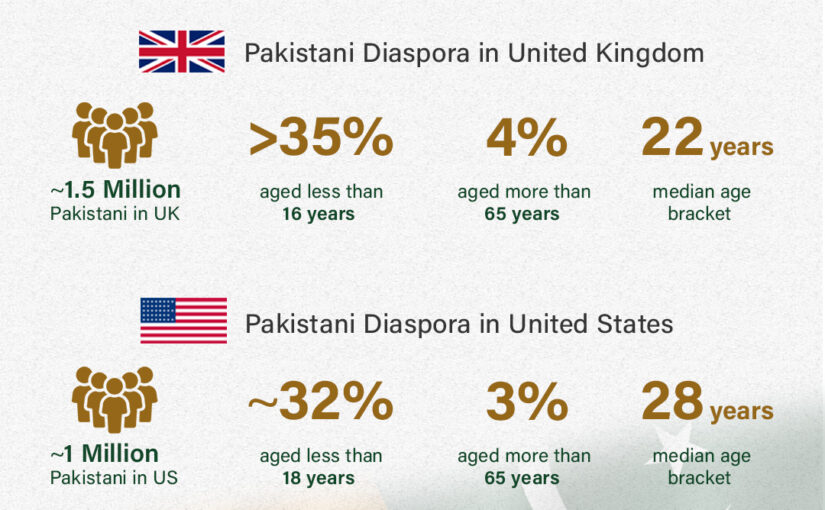
Look at who carries the Pakistani case at BP. Kabir holds a foreign passport. Q and EK write from the diaspora. Every voice that argues the Pakistani perspective here argues it from somewhere else. Not one of them speaks from inside the country: resident, middle or upper-middle class, holding a green passport with everything the green passport actually costs at the visa counter, at the airport, in what can and cannot be said at home. India, by contrast, is argued for in large part by Indians who live in India (BB is one such example). So the table is lopsided in a particular way. One side is represented by people inside the country it speaks for; the other, almost entirely by people outside it.

No photo description available.
The Great Cleft

Diasporas are powerful but deadly

Continue reading The Pakistani Voice That Isn’t in the Room

Bin Qasim’s Thousand-Year Wound

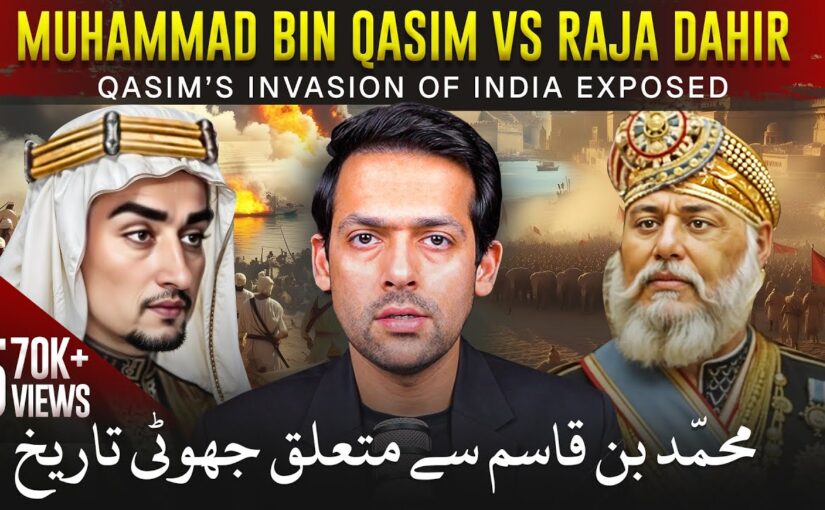
There is one fault line under everything that happens here, and it is old. Pakistan stands, whether it wishes to or not, as the proxy for the Muslims of the subcontinent, and India as the proxy for its non-Muslims. This is not a quarrel of the last election or the last war. It is a wound more than a thousand years old, set running when Muhammad bin Qasim landed in Sindh in 711, and it has been arguing with itself in the subcontinental subconscious ever since. Every thread on this site is a small, late episode of that argument.

There is a scene in The Devil Wears Prada, the cerulean one, where a colour chosen by Miranda Priestly (Meryl Streep) at the summit of fashion is followed down the seasons, runway to department store to clearance bin, until Andy (Anne Hathaway), who fishes it out is sure her choice owed nothing to any of it.

Anne Hathaway referencing the ICONIC cerulean sweater scene for her first  day filming The Devil Wears Prada 2 💙 Andy is back! , #AnneHathaway  #TheDevilWearsPrada #TheDevilWearsPrada2 #AndySachs ...

The subcontinent’s argument works the same way. Bin Qasim’s landing in 711 was a decision taken at the top of history, and it has filtered down through thirteen centuries of conquest, doctrine and memory into a comment thread, where two strangers swapping insults are certain the quarrel is about this week. It is not. It was chosen for them a thousand years ago, and they are wearing it without knowing the name of the colour.

What is new is that the argument is going quiet, and quiet is worse than loud. The subcontinent is partitioning itself a second time, in the mind. Indians increasingly talk only to Indians, Pakistanis only to Pakistanis, each inside a feed built to agree with them. The 1947 line cut the map; the algorithm is cutting the conversation. Against that, the value of Brown Pundits is simple and almost embarrassing to state. It is one of the few open places left where the two sides still argue with each other in public and mean it. That is worth defending even when the argument is ugly, because the alternative is not a calmer argument. It is no argument, and two rooms that never open the door.

Is BP sui generis on the Internet?

Continue reading Bin Qasim’s Thousand-Year Wound

Nehru Lost India, Not Jinnah

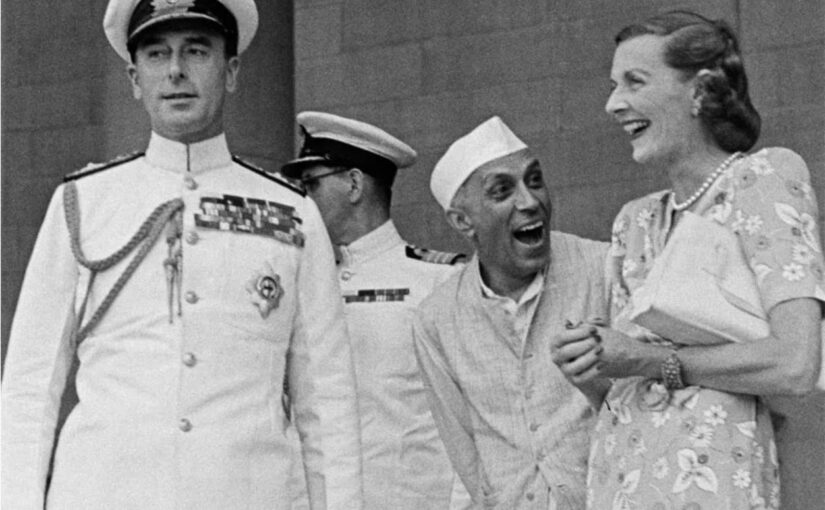
We write this from the chair of those who have just declined, again, to partition their own blog. The exercise concentrates the mind. Brown Pundits has a Saffroniate. It has a Crescentiate. It has an awkward intermediate seat between Viceroy and Prime Minister. We have chosen, repeatedly, to hold the centre.

We have observed that Nehru did not.

1. The Men.

Jinnah was self-made. He was technically brilliant. He was legalistic to the point of pedantry, which is the only kind of legalism that ever wins a constitutional argument. Nehru rode on his father’s coattails, on Gandhi’s affection, on the Mountbattens’ hospitality.

The asymmetry was decisive. One man knew the document. The other man trusted the room.

2. The Cabinet Mission Plan.

The Cabinet Mission Plan of 1946 already confederated India. Grouping A, Grouping B, Grouping C. The Centre held defence, foreign affairs, communications. Everything else devolved. This was workable. The League accepted it provisionally as the best available route to parity. Nehru wobbled, then in his July Bombay press conference reserved the Congress right to revise the groupings once seated in power. The League withdrew within weeks. The edifice collapsed.

The question the Saffroniate refuses to ask is the simple one. Why was it harder to confederate on linguistic lines than on religious lines? The States Reorganisation that the Republic executed in 1956 was already latent in 1946. Madras Presidency was a Tamil, Telugu, Malayalam, Kannada tinderbox. Bengal was Bengal. The Indus was the Indus. The Hindi belt was the Hindi belt.

Four groupings could have been negotiated. Continue reading Nehru Lost India, Not Jinnah

Open Thread: Mother Indus is on Fire

The Commentariat on the “Long Night” has been busy. The Saffroniate counts Hindu babies, the Crescentiate counts Muslim babies, both sides argue with conviction over a future neither seems to have read the Weather Report for.

A heatwave advisory graphic maps much of Pakistan’s plains into extreme-risk zones for the final week of May 2026. Jacobabad, Multan, Bahawalpur, Sukkur, D.G. Khan and Sargodha sit in an extreme zone marked 47 to 50°C. Lahore, Faisalabad, Rawalpindi, Peshawar and Islamabad sit in a high zone at 42 to 45°C. Karachi, sea-cooled, stays at a relatively merciful 35 to 38.

The Indus does not read Radcliffe. The Punjab that cooks at 45°C on the Lahore side is the same alluvial plain that sears the Amritsar side. The Thar runs through both Sindh and Rajasthan. The Gangetic plain inherits the same dome of heat a fortnight later. The cradle of Desidom that the Commentariat are fighting over, will soon turn into a Heat Dome. Conversations on who fills it faster, who outbreeds whom, ultimately elide that Radcliffe drew a paper line. The thermometer does not pause at Wagah.

What It's Like Living in One of the Hottest Cities on Earth—Where It May Soon Be Uninhabitable

Continue reading Open Thread: Mother Indus is on Fire

The Diaspora Saved The Mullahs. Pahlavi Helped.

Farhad’s thesis, delivered without prompting:

during the Woman Life Freedom protests, the Islamic Republic appeared more vulnerable than at any point in a generation. Women had started it, men had joined, opposition-minded Iranians inside the country felt the floor shifting. Then Pahlavi stepped forward, declared himself the advocate of Iranians, launched his petition, and pulled the diaspora’s attention outward at the exact moment Iranians on the ground needed it inward. He picked the wrong time. He saved the IRGC.

The Royal positioned as the alternative to the regime is the man Farhad blames for keeping the regime alive.

We are not endorsing this view. We are reporting that an Iranian who follows the country obsessively, who rallies behind Pahlavi today as the best of bad options, still holds him responsible for a historic missed moment. That is a serious accusation from a sympathetic source.

The Court In Exile

Continue reading The Diaspora Saved The Mullahs. Pahlavi Helped.

The Long Dark Night for India’s Muslims

Our own Hindufication

We write this not as outsiders pretending to diagnose India, but as people who have undergone a gentler version of the same process. Over fifteen years of family and work on the subcontinent, our own Islamicate inheritance has been quietly sifted. The Persianate was retained. The Arabic was allowed to fall away. The qawwali, the food, the manners, the ghazal, the Mughal grammar of taste. All survived. The devotional Islamicate self did not. We arrived as something close to a Anglo-Islamicate hybrid. We are leaving, slowly, as a Hindu-Persianate one. We did not plan this. We watched it happen to ourselves.

The Persian survives. The Arabic does not. The poetry survives. The prayer does not. This is the formula. Once you see it, you cannot unsee it.

We made this passage with privilege, with distance, with choice, and with somewhere else to be if we changed our minds. The Indian Muslim, the one with no other passport and no other country, is being asked to make the same passage on terms set by people who never had to make it themselves. That asymmetry is this post.

The morning song

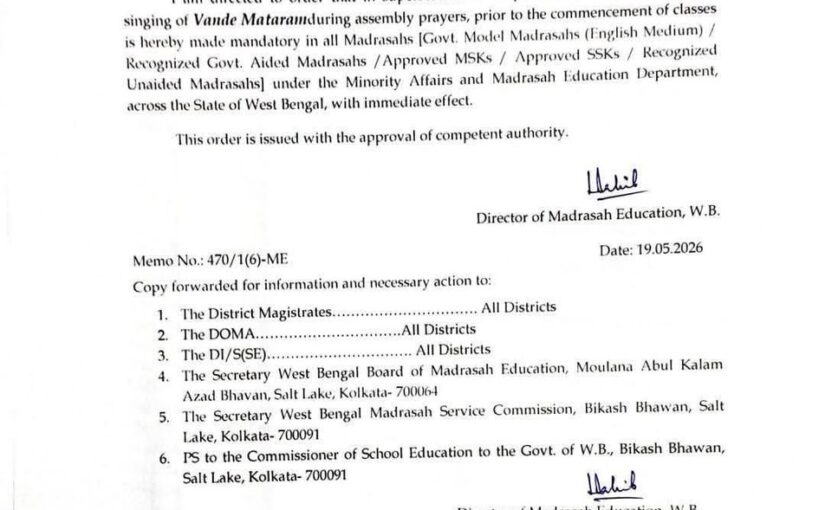
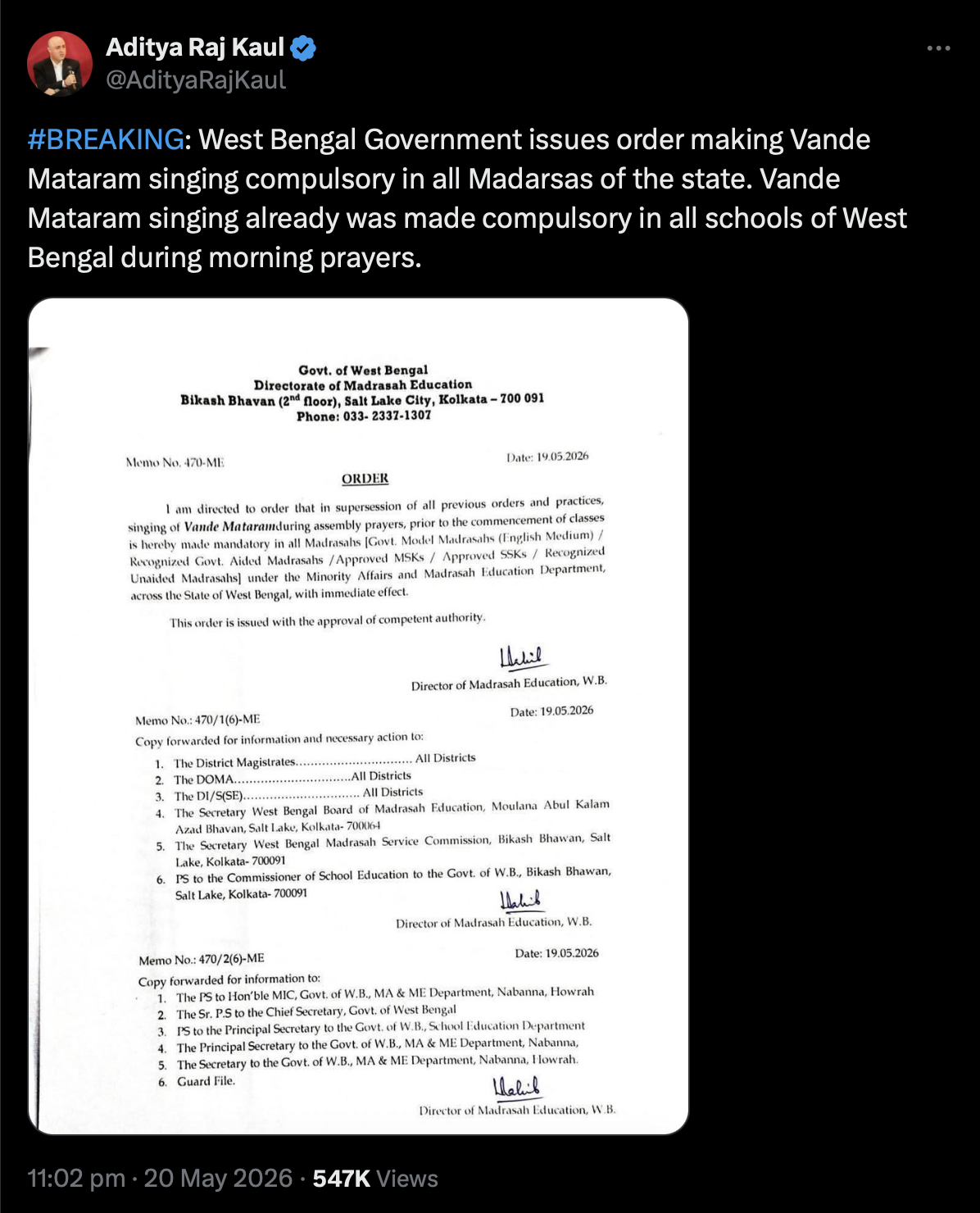
The news this week was Memo No. 470-ME, dated 19 May 2026, signed by the Director of Madrasah Education, Government of West Bengal. The order makes the singing of Vande Mataram mandatory at morning assembly in every state-recognised madrasa: government, aided, unaided, all of them. Immediate effect. Approval of competent authority.

Note the date. Suvendu Adhikari was sworn in as the first BJP Chief Minister of West Bengal on 9 May, ten days earlier, on a 207-seat mandate that ended Mamata Banerjee’s fifteen-year run. The order is ten days into the new government. Of all the actions available to a freshly-installed state administration, this is the gesture chosen. The first major item on the agenda was the Muslim schoolchild’s morning. The signal is the signal.

The Pakistani faction of our commentariat is aghast, and not unreasonably. The song is a hymn to the Great goddess Durga, drawn from a novel that called for war on Muslims, and forcing a Muslim child to recite it is a small humiliation that announces a large arrangement. One of our Pakistani commenters compared it to forcing a vegetarian Hindu to eat beef. The comparison overstates and understates at the same time. It overstates because nobody is forcing food into anyone’s mouth. It understates because food is forgotten by the afternoon, and a song sung daily for ten years writes itself into the spine.

The row is the symptom. The disease is older. Bengal is the latest frontier, not the first.

The Persianate without the Muslim

Continue reading The Long Dark Night for India’s Muslims

The High Signal Mandate

Brown Pundits is not in the news business. We are not in the takes business. We are not in the engagement business. We are in the signal business. This is our creed.

Signal is the mandate. Noise is the enemy. Every piece (like the Prussia of the Ummah) on the blog must clear that bar or it gets rapidly down-posted. We owe the reader nothing less.

The signal compounds.

What does signal mean here? Three things, in order of weight.

Continue reading The High Signal Mandate

Islamicate Civilisation is a Supreme Culture: But Who Stands to Inherit It?

This post grew out of an exchange with EK, the kind that can only happen in a forum that has paid for its openness. Kabir, to his credit, has imposed the hard internal checks that keep the blog from collapsing into the views of its editors.

The high culture built by the three great gunpowder empires (Ottoman, Safavid, Mughal) is one of the supreme achievements of human civilisation. All three were Turkic in dynastic origin, Persianate in literary and aesthetic register, and Islamic in faith. The Blue Mosque in Istanbul, the Naqsh-e Jahan complex in Isfahan, the Taj Mahal at Agra: these are not regional artefacts. They are a single coherent civilisational signature, expressed in tilework, ghazal, miniature, garden, cuisine, and chancery prose, across a belt that ran from the Bosphorus to the Bay of Bengal.

The question this post is about is simpler than it sounds. Who inherits it?

Continue reading Islamicate Civilisation is a Supreme Culture: But Who Stands to Inherit It?

The Bahá’í Position on Palestine: A Note for the Record

Comments of late have drifted, as they sometimes do here, into territory where the Bahá’ís are invoked as a rhetorical chess piece by people who know very little about them. We believe in free speech, and on this blog more than most, in authorial autonomy; contributors and commenters speak for themselves, and we are not in the business of policing opinion. But because the question of Palestine sits adjacent to much of what has been said, we thought it worth setting down what the actual position is.

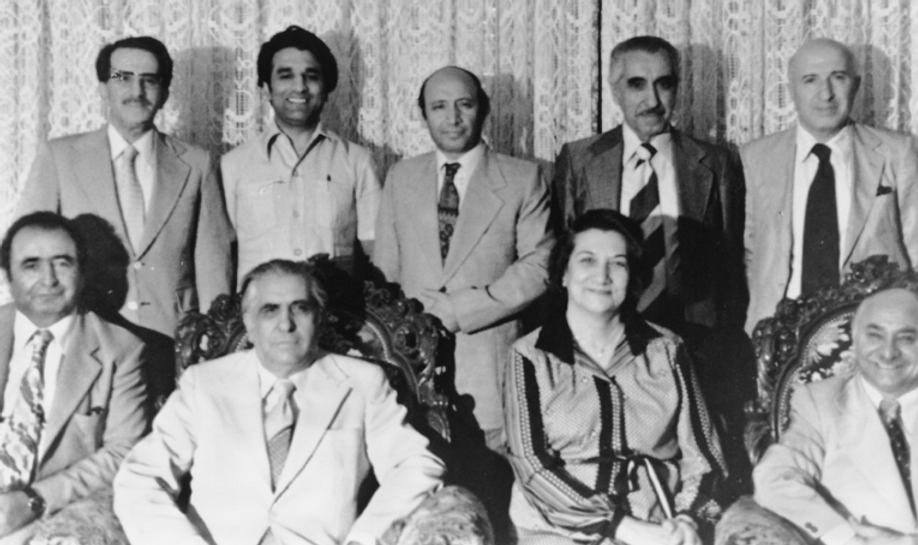
“Members of the National Spiritual Assembly who disappeared in August in 1980. All are presumed to have been killed” by Bahá’í Media Bank.

One caveat first. When we write or administer here, we do not speak for our Faith in any official capacity. We are members of it. That is the limit of our standing.

The clearest statement of the Bahá’í position comes from the pen of the Beloved Guardian of the Faith, Shoghi Effendi, who in July 1947 was asked directly by the United Nations Special Committee on Palestine to clarify the relationship of the Bahá’í community to the country and its political future. His reply, written from Haifa and reproduced in The Bahá’í World, Volume 11, is as close to a foundational text on this question as exists. We quote it at length, because paraphrase would not do it justice.

Letter to the United Nations Special Committee on Palestine

On July 9, 1947, Shoghi Effendi received a letter from the chairman of the United Nations Special Committee on Palestine requesting a statement on the relationship, which the Baha’i­ Faith has to Palestine and the Baha’i­ attitude toward any future changes in the status of the country. From Shoghi Effendi’s reply, the following paragraphs are quoted in The Baha’i­ World, Volume 11 (1946-1950), pp.43-44.1

HAIFA, ISRAEL—15 July 1947

“The position of the Baha’i­s in this country is in a certain measure unique: Whereas Jerusalem is the spiritual center of Christendom it is not the administrative center of either the Church of Rome or any other Christian denomination. Likewise although it is regarded as the second most sacred shrine of Islam, the most Holy site of the Muhammadan Faith, and the center of its pilgrimages, are to be found in Arabia, not in Palestine. The Jews alone offer somewhat of a parallel to the attachment which the Baha’i­s have for this country, inasmuch as Jerusalem holds the remains of their Holy Temple and was the seat of both the religious and political institutions associated with their past history. But even their case differs in one respect from that of the Baha’i­s for it is in the soil of Palestine that the three central Figures of our Religion are buried and it is not only the center of Baha’i­’ pilgrimages from all over the world but also the permanent seat of our Administrative Order, of which I have the honor to be the Head.”

“The Baha’i­ Faith is entirely nonpolitical and we neither take sides in the present tragic dispute going on over the future of the Holy Land and its people nor have we any statement to make or advice to give as to what the nature of the political future of this country should be. Our aim is the establishment of universal peace in this world and our desire to see justice prevail in every domain of human society, including the domain of politics. As many of the adherents of our Faith are of both Jewish and Moslem extraction, we have no prejudice towards either of these groups and are most anxious to reconcile them for their mutual good and for the good of the country.”

“What does concern us, however, in any decisions made affecting the future of Palestine, is that the fact be recognized by whoever exercises sovereignty over Haifa and Acre, that within this area exists the spiritual and administrative world center of a world Faith, and that the independence of that Faith, its right to manage its affairs from this source, the right of Baha’i­s from any and every country of the globe to visit it as pilgrims (enjoying the same privilege in this respect as Jews, Moslems and Christians do in regard to visiting Jerusalem), be acknowledged and permanently safeguarded.”

Three things are worth drawing out.

Continue reading The Bahá’í Position on Palestine: A Note for the Record

Brown Pundits