She Parked a Car With Her Husband. Fifty Years Later, She Is Still Waiting.

Before anything about this blog, its standards, or its arguments, I want to begin with a story;Ā because sometimes a single human life cuts through every debate and reminds us what any of this is actually for.

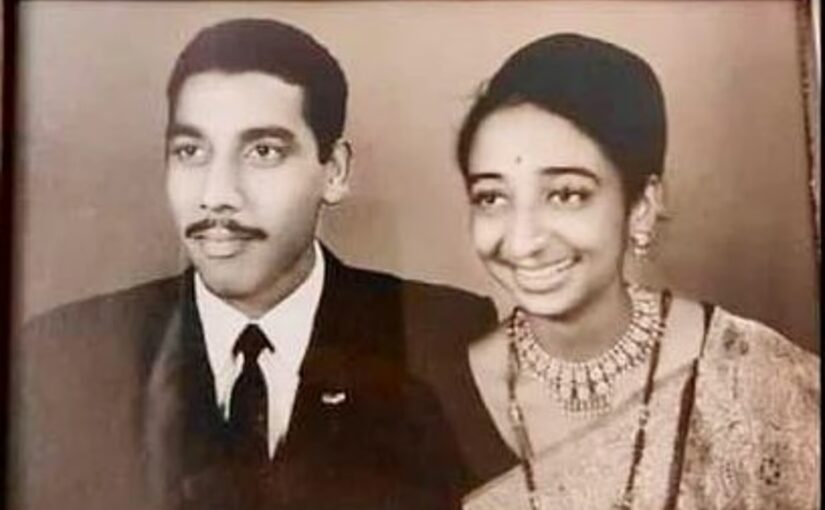
Damayanti Tambay was 21 years old, a three-time national badminton champion, when she married Flight Lieutenant Vijay Tambay in April 1970. Twenty months later, war broke out. On 3 December 1971, they drove together to a garage in Ambala cantonment to park their bottle-green Fiat. That was the last time she saw him.

On 5 December, flying a strike mission over Shorkot Airbase in West Pakistan, Vijay was hit by anti-aircraft fire and ejected. Radio Pakistan later broadcast his name among those captured. Damayanti heard it alone. She felt relief. A prisoner of war comes home eventually, she thought.

He never did.

A Loving Wife’s Unending Search Continue reading She Parked a Car With Her Husband. Fifty Years Later, She Is Still Waiting.

India Is No Longer Legible to Pakistani Liberals

There is a persistent habit among Pakistani liberals, especially those from elite backgrounds or with deep emotional ties to pre-1947 North India, of speaking about India as if it were still legible to them. It is not. India has moved on. So has Pakistan. But only one side seems unable to accept that.

The Mirage of Patrimony

Many Pakistanis of Muhajir or North Indian lineage carry an inherited sense of ownership over India. They speak as if India is a shared cultural estate, temporarily misplaced. This is a fantasy. The India of 2025 is not the India of 1947. It is not even the India of 1991. It has changed demographically, economically, politically, and, most importantly, civilizationally. Pakistanis who have not travelled to India in decades, who rely on English-language media and nostalgic family memory, do not ā€œunderstandā€ India. They are projecting onto it. Projection is not insight. It is displacement.

Code-Switching as Evasion Continue reading India Is No Longer Legible to Pakistani Liberals

Interdiction

I’ve made a decision: Kabir will no longer be allowed to comment on Brown Pundits.

This isn’t about silencing the only active Pakistani Muslim voice here. Nor is it about shutting down disagreement. It’s about something more basic: respect; for this space, for conversation, and for the people who show up in good faith.

Earlier today, I had to invoke the five-comment deletion rule after one of Sbarrkum’s replies crossed a line. He implied grotesque accusations. I’ve said it before: all life is sacred. That kind of slander won’t stand. Ever.

The admins have asked me for some time to be firmer. I’ve held back. I value openness. But Brown Pundits is not a free-for-all. We care about how people argue, not just what they argue.

I’d meant to write something calmer after yoga. Because I care about this project. I believe in it. BP must be a place of respect. That comes from a deeper idea; dharma, a commitment to plurality and balance. Even when we fall short, that’s the standard we aim for.

I’m not saying India, or the BP commentariat, always gets it right. Sometimes, on topics like caste, we speak from a place of blind privilege. And as the founder, I know my voice carries weight. That’s not always fair.

But this is the key: we must disagree with grace. And Kabir doesn’t. His tone is often scornful. He treats this space as beneath him.

Over the years, I’ve seen something: for many Pakistanis, the deepest value is ‘Izzat; honour and status. It often matters more than truth. But that ‘Izzat seems to vanish in the face of power—especially when that power is Western or Arab. Kabir speaks glowingly of ā€œthe West.ā€ But when it comes to Dharma Asia, he sneers.

That sneer has been aimed at Brown Pundits. And I won’t allow that anymore. Kabir may see BP as ā€œlesser,ā€ unworthy of his respect. You don’t get to sneer and stay.

This isn’t a permanent ban. But it is an interdiction. Kabir is welcome to focus on his Substack. I wish him well. If he ever wants to return, he can contact me directly. But that will require real contrition; not performance.

Let me end with this: this is not about politics. People here hold strong views; on India, on Palestine, on religion. That’s not the problem. The problem is contempt. Mockery. Scorn. Brown Pundits will always welcome hard conversations. But only if they’re honest. And only if they’re respectful.

On another happier note, Nigerian ingenuity:

Vantara, Caste, and the Fragile Commons

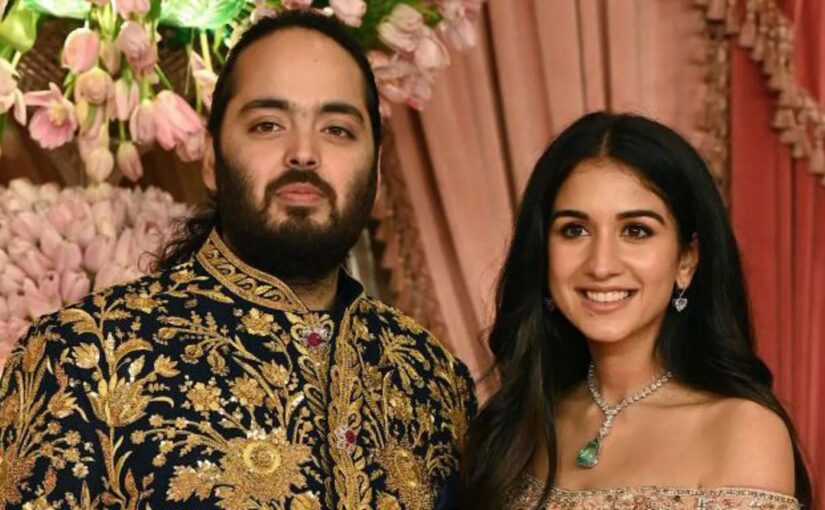
I was speaking with Dr. Lalchand about a number of things, from Anant Ambani’s wildlife project to the recent caste discourse on Brown Pundits. Both, strangely enough, converge around the theme of scrutiny; of who gets to build, who gets to critique, and who sets the rules of engagement.

Let’s start with Vantara. Anant Ambani’s wildlife refuge is coming under sustained criticism. But I ask: why shouldn’t Bharat, arguably the only major civilisation that views animals as divinely inspired, have a world-class zoo or rescue center? If done with sensitivity and vision, this could be a profound expression of India’s Hindu civilisational ethos.

Vantara houses over 200 elephants, 50 bears, 160 tigers, 200 lions, 250 leopards, and 900 crocodiles; albeit imported from across the world into the baking flatlands beside an oil refinery. The scale is staggering. Yes, there are questions: about captive animal welfare, about the case of Pratima the elephant, about transparency. But we should also be able to think of Indian megafauna conservation at global scale especially in a nation where sacred animals are part of dharmic memory.

America had its Gilded Age. The robber barons left behind libraries, parks, and museums. Can’t India do the same? Or do we reflexively dismiss anything built by wealth as vanity? Can there not be a deeper Dharma behind patronage?

And that brings me yet again to caste, controversy, and the structure of Brown Pundits. Continue reading Vantara, Caste, and the Fragile Commons

When the Commentariat lies

I’ve updated this post (Brown Pundits is not an echo chamber) after realising something important.

What began as a spirited disagreement veered into something darker. It turns out that bombay_badshah, a voice I initially assumed to be new, may not be who he claims to be (I had a hunch but so did Kabir, that BB was HS reincarnated). The posting style, the fixations, the timing; all too familiar. My suspicion is that BB may be a derivative or proxy of HS, previously banned. If true, this was not a genuine disagreement; it was entrapment, bait-and-switch.

In that light, I owe Kabir an apology. He was provoked in bad faith by someone who may be operating behind a mask. And that matters, because here on Brown Pundits, identity isn’t incidental; it shapes perspective, and we respect that. We excavate worldviews, not just opinions.

While I cannot definitively prove that BB is HS, the circumstantial evidence is strong. I will allow BB to remain but if the commentary returns obsessively to Kabir or Pakistan, I will intervene. Everyone is welcome to engage on substance. But this space will not be hijacked.

The original post remains below the jump, unedited but its context has now changed.

Continue reading When the Commentariat lies

The Pakistani Inferiority Complex

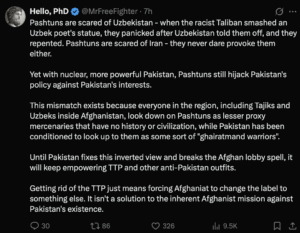
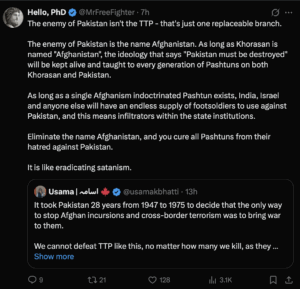
These excellent tweets exhibit a painful pattern that many of us see but few want to name.

Pakistanis, particularly its establishment and elite classes, exhibit a deep inferiority complex towards white (light) Muslims; Arabs, Turks, Persians, and Afghans. These groups are valorized, romanticized, and used as benchmarks for identity and belonging. Meanwhile, other Asian groups, especially within South Asia and Southeast Asia, are seen as lesser. This manifests not only in foreign policy but in pop culture, education, and internalized social hierarchies.

This is why, even if Partition had to happen (and it was undeniably disastrous), Pakistan still could have been something else. It could’ve been a GCC meets Pahlavi Iran construct—a sleek, semi-modernist, high-income Asian Muslim republic with cultural gravitas and economic depth.

Instead, as others have rightly pointed out, Pakistan today has one of the lowest HDIs in its region. Karachi didn’t become Dubai. Lahore didn’t become Paris. Islamabad remains a ghost town of beautiful boulevards and hollow institutions. The promise wasn’t just broken; it was never even understood.

In some ways, Pakistan inherited the worst of both its imagined lineages: neither the intellectual cosmopolitanism of Persianate high culture, nor the industrious civic ambition of Indian civilizational continuity.

This is why tweets like those from @MrFreeFighter land so hard. They expose the psychic dissonance at the heart of the Pakistani state’s anxieties; its hatred of Pashtuns, its paranoia about ā€œAfghanism,ā€ and its inability to deal with its own peripheral ethnic groups as anything but threats.

Meanwhile, Indian Muslims like bombaybadshah, though deeply patriotic to India, often voice critiques of Pakistan with a clarity born of disappointment. They represent what Pakistan could have cultivated: a civic Islam, grounded in identity but untethered to ethnic obsession.

The final irony? South East Asia, Thailand, Cambodia, even Bali, retains more civilizational Dharma than most of Pakistan. Religion is irrespective of that elusive civilisational quality of Dharma, thus the true borders of Bharat lie eastward, not northwest.

Pakistan is not the enemy of India. It is the shattered mirror. And what it reflects, feudalism, insecurity, bigotry, and colonial hangover, is what the entire subcontinent must transcend. Again anyone who reads this can see I’m not saying this from a place of hate but love.

 

Madhuri is stronger than the Ambanis

In the name of Pakistan, which is a beautiful poetic name, ā€œLand of the Pureā€, lies the tragedy of pathological purity. It is an addendum to the desire to stay pure. To remain untainted. But purity, when pursued absolutely, becomes brittle.

Madhuri Mahadevi

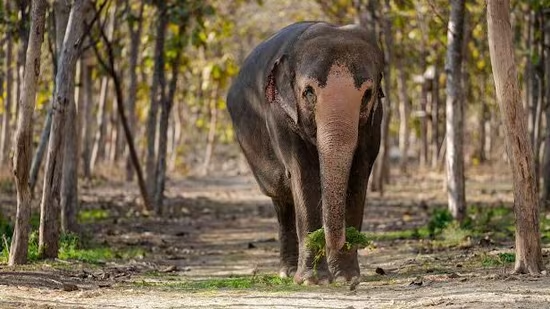
The Ambanis recently relocated Elephant Madhuri from Kolhapur’s Jain Math to the Vantara rehab centre, citing health concerns. But the move, though framed as rescue, triggered emotional protests, political pushback, and a national debate over animal welfare vs. sacred tradition.

Why did it explode? Because Madhuri wasn’t just a creature in need of savin; she was a living deity to those who loved her. Her departure wasn’t a routine animal welfare decision. It was a rupture in India’s civilizational relationship to the divine in nature. One of the most remarkable aspects of Hinduism is its seamless veneration of the natural world. The river is a mother. The cow, a guardian. The elephant, divine.

Few religions integrate reverence for nature into daily life with such tenderness and theological consistency. This story, of an elephant, a corporate empire, and a temple, speaks to a larger tension in India today: Who gets to define care? And when does ā€œrescueā€ become removal? Continue reading Madhuri is stronger than the Ambanis

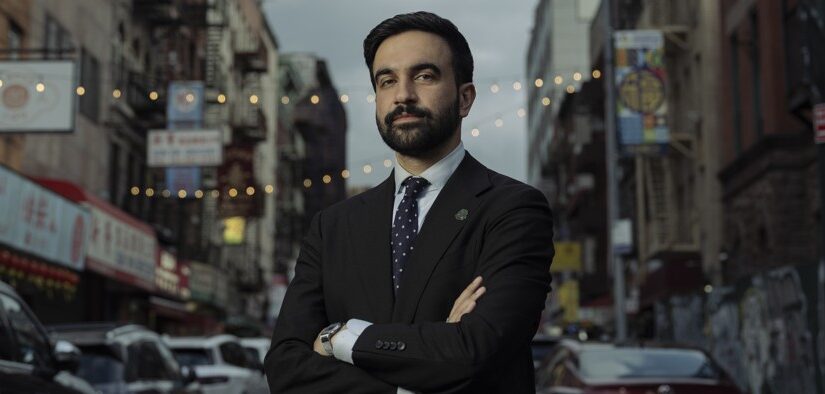
Zohran Mamdani and the Question of Civilizational Belonging

Kabir:

I would question how one defines ā€œIndianā€ culture vs ā€œHinduā€ culture (this is a real question, I’m not being snarky). Zohran speaks Urdu/Hindi, wears shalwar kameez and uses Bollywood references in his campaign. So clearly, he has no issues with Indian culture. He’s not a Hindu so he doesn’t go to temples etc. I’m not sure exactly what you expect him to do?

While Zohran Mamdani expresses outward familiarity with ā€œIndianā€ culture — speaking Hindi/Urdu, referencing Bollywood, wearing traditional attire — these are surface markers. They do not, on their own, constitute rootedness in Indian civilizational identity. Indian culture, especially post-Partition, is not simply a composite of languages and aesthetics. It is anchored in Dharma — a diffuse but pervasive civilisational ethos shaped over millennia by Hindu, Buddhist, Sikh and Jain worldviews.

Despite being born to a Hindu mother, Zohran’s public identity is strongly framed within a Muslim, Middle Eastern, and postcolonial activist context. His political and cultural instincts appear more aligned with pan-Islamic and Western progressive causes than with any articulation of Indian philosophical or spiritual heritage. His Syrian Muslim spouse, activist framing, and lack of visible engagement with Indic traditions contribute to this perception.

This is not a religious critique but a civilizational one. Just as Israel defines its national identity through a broadly Jewish character — irrespective of belief — India’s cultural self-understanding is inseparable from its Hindu roots. To be Indian, in this view, is not to perform cultural familiarity but to resonate with the metaphysical and historical rhythms of the civilization.

By that measure, Zohran — despite South Asian ancestry — does not code as civilizationally Indian, but rather as an American progressive of South Asian Muslim extraction. The distinction is subtle but important.

Browncast: Vishal Ganesan; The Hindu Case Against Hinduism?

Another Browncast is up. You can listen onĀ Libsyn,Ā Apple,Ā SpotifyĀ (and a variety of other platforms). Probably the easiest way to keep up the podcast since we don’t have a regular schedule is toĀ subscribeĀ to one of the links above!

In this episode,Ā hosts Amey and Dr. Omar Ali in conversation with Vishal Ganesan, a lawyer and thinker, about his essay “Frontier Dharma” and the meaning of being Hindu in the diaspora. Vishal discusses how his observations of mainstream media and academic discourse led him to research the historical representation of Hindus, which he found to be distorted by a lens stemming from 18th and 19th-century missionary narratives.

Vishal’s essay–Ā  The Hindu Case Against “Hinduism”: A Reflection on Dharma in the Diaspora can be found here.Ā 

(https://frontierdharma.substack.com/p/the-hindu-case-against-hinduism-a)

Auto-generated transcipt provided by our friends at scribebuddy.com

The Brown Pundits Browncast.

Dr. Omar Ali: Hi, good afternoon everyone and welcome to another episode of the Brown Pundits Browncast. We have a very special edition of the broadcast today. Vishal Ganesan, 1 of our regular Brown Pundits contributors and lurkers, who is also a lawyer and a thinker, wrote a very interesting essay on his sub stack called Frontier Dharma, and about what does it mean to be Hindu in the diaspora. And from that, I think it evolved that we will have a discussion about this topic. And we have Vishal with us today and we have Amey.

Continue reading Browncast: Vishal Ganesan; The Hindu Case Against Hinduism?

Browncast: Indic explorer on Hinduism, Dharma, etc

Image

Another Browncast is up. You can listen on Libsyn,Ā Apple,Ā Spotify, andĀ StitcherĀ (and a variety of other platforms). Probably the easiest way to keep up the podcast since we don’t have a regular schedule is toĀ subscribeĀ to one of the links above!

In conversation with Indic explorer, Mukunda and Omar discuss a lot of things related to all things “Indic” . Items include how to define Hinduism, why it does not get the respect it deserves and why its most ardent fans may need to “up their game”.. .

Indic (who prefers to remain anonymous for now) can be found on Twitter at @theindicexplor1

Brown Pundits