Sacred Texts and Jewish-Muslim Relations

From Dr Hamid Hussain

This is part of a series of my work on Jewish-Muslim relations encompassing a wide canvas of similarities in scripture, rituals, Arabic & Hebrew language, mysticism, literature, coexistence in historical context and conflict in recent times. It has been a fascinating journey tracing the sibling rivalry of Isac and Ishmael.

Hamid

Jewish Muslim Relations – Sacred Texts – The Torah and the Quran

“Lighthouses don’t go running all over an island looking for boats to save; they just stand there shining.”

                                               Anne Lamott

The Tanakh (Hebrew Bible) and the Quran are two sacred texts considered revelation from God by Judaism and Islam respectively.  Both sacred texts are considered foundational stones of faith.  Tanakh is acronym for Torah (five books of Moses called Khumash in Hebrew), Navi’im (Prophets) and Ketuvim (Writings). The Torah is called sefer (book) and the Quran um al kitab (mother of books).  Both texts share several commonalities in terms of themes, narratives, and ethical teachings and are at the same time quite different.  One can pick any side depending on what one is trying to convey.  In the inter-faith interactions, participants stress commonalities sometimes exaggerating the similarities or trying to find common ground where none exists. On the other hand, polemics with aim of denouncing the other side can give a long list of differences between two texts. Continue reading Sacred Texts and Jewish-Muslim Relations

Open Thread – 05/14/2023 – Brown Pundits

Finished my Iran sequence, Iran through the ages: civilization’s eternal crossroads, Pre-Persian Iran: from the invention of agriculture to the Aryan onslaught and We are all Zoroastrians: how Persian empires of the mind touched all humanity and One door closes, another opens: the Persian Empire’s end and the rise of the Persianate world.

The Plagues of Amwas and Justinian: The 200 years long series of plagues and pestilence and the conquest of Muslims over Rome and Persia

From Gypsy Syed.

The Plagues of Amwas and Justinian: The 200 years long series of plagues and pestilence and the conquest of Muslims over Rome and Persia

0

Part 1:


During Umar bin Khattab’s caliphal rule, early Muslims experienced a sum of disasters which convinced them that the Day of Judgement is upon them.

During the last 1400 years, every generation of Muslims have had at least some groups and/or leaders who assured others that the Day of Judgement is imminent, yet the force of this conviction of impending apocalypse was perhaps never stronger than in the year 639 of Common Era (18 of Hijri).

The primary reason for this certitude was prophet Muhammad’s two hadeeths: 1) The prophet Muhammad, holding out his middle and index fingers, said, “My advent and the Hour (of Judgement) are like this (or like these),” namely, the period between his lifetime and the Day of Judgement is like the distance between his two fingers, i.e., very short (https://sunnah.com/bukhari/68/50). 2) During the Ghazwa of Tabuk while he was sitting in a leather tent, the prophet said, “Count six signs that indicate the approach of the Hour: my death, the conquest of Jerusalem, a plague that will afflict you (and kill you in great numbers) as the plague that afflicts sheep, the increase of wealth to such an extent that even if one is given one hundred Dinars, he will not be satisfied; then an affliction which no Arab house will escape, and then a truce between you and Bani Al-Asfar (i.e. the Byzantines) who will betray you and attack you under eighty flags. Under each flag will be twelve thousand soldiers.” (https://sunnah.com/bukhari/58/18).

The prophet died in the year 632 CE, Muslims conquered Jeurasalem in 638 CE, and during the same year the regions of Levant and Arabia experienced such a severe famine that according to historian Ibn Abi Hajala, the sand of the Arabian peninsula turned black and thousands died due to hunger. He adds that caliph Umar’s body turned so weak that companions feared his death was upon him, and that in the Muslim chronicles the year 638 CE (17 of Hijri) was recalled as the Year of Ashes.

Since historically plagues have often followed famines, it is no surprise that soon after the famine a series of plagues began appearing in many Middle Eastern cities. In the Levantine city of Amwas (Emmaus Nicopolis), where Muslim army had been camping, the plague spread with such swiftness that according to several Muslim historians within a few days more than 25,000 Muslim soldiers died, including several prominent companions of the prophet. (Note: the figure of 25,000 shouldn’t be taken literally, as pre-modern historians often meant by such numbers to signify a large amount of people; there was of course no way to count the specific number of bodies.)

The most prominent among these companions was Abu Ubaidah ibn al-Jarrah, who is among the ten companions preordained by the prophet to be one of his companions in paradise. Abu Ubaidah was appointed by caliph Umar the head of Muslim army in Syria replacing Khalid Bin Waleed, and under his competent leadership Muslim army won a series of battles, moving from Jerusalem to Beirut to Damascus with lightening speed. Umar had even said that if Abu Ubaidah had stayed alive, he’d have been the one appointed as the third caliph. But after Abu Ubaidah’s unfortunate death during the infamous Plague of Amwas, Umar conferred the governorship of Damascus on the competent shoulders of Muadh ibn Jabal. But soon after even he died, along with his son Abdul Rehman and his two wives. The prophet had said about Muadh that he will lead all Muslim scholars into the gates of paradise. The person who replaced him was Yazid ibn Abi Sufyan but soon plague took his life too. The fourth person to be appointed the governor of Damascus was Muawiyah ibn Abi Sufyan who was fortunate enough to survive the plague and thirty years later announced the beginning of his own caliphate and in doing so launched the Umayyad caliphate that continued for next hundred years.

Meanwhile, during the year 639, according to several hadeeths and Arab historians, caliph Umar traveled with two military battalions towards Syria, but when he reached the borderland region of Sargh, he met Abu Ubaidah ibn al-Jarrah, Yazid ibn abi Sufyan, and Shurahbil ibn Hasana, all three of them had traveled down there from the garrison town of Amwas to inform him that a plague had spread at a brisk pace along the cities of Syria and he’d be better off returning back to Medina with his soldiers. According to the famous 9th century Arab historian Abu Jafar ibn Yazid al-Tabari, the caliph first consulted the early migrant ‘Muhajirun’ Muslims of Makkah and then the Medinans, but both groups differed. One said that it’s not wise to return after heading out to fight in the service of God, and the other said that it is a caliph’s duty to protect his soldiers and thus it is logical to return. Then Umar sought the view of those Makkans who had converted to Islam after its conquest by the Muslims. They were quick to suggest that the army should immediately head back. “This time, no two men among them disagreed, but they all said, ‘Return (to Medina) with the men; this is an affliction that may bring about our ruin.’”

Next morning, as narrated in The History of al-Tabari Volume XIII (Trans. Gautier H. A. Juynboll), when Umar got ready to leave, Abu Ubaydah said to him, “Are you fleeing from God’s providence?” “Yes,” Umar replied, “I flee from one divine ordinance to another. Don’t you see? Suppose a man goes down into a riverbed with two slopes, one fertile, the other barren, does the one who grazes his animals on the infertile slope not do so according to God’s ordinance, and does the one who grazes his animals on the fertile one not do so according to God’s ordinance?” Umar went on, “If somebody other than you had said this, Abu Ubaydah, . . . ,” (presumably Umar meant he’d have punished him). Then he went with him to a spot away from the people. While the men were thus busily readying themselves to depart, suddenly Abd al-Rahman bin Awf appeared on the scene. He had been following at a distance and had not been present yesterday. He exclaimed, “What on earth is the matter with the men?” So he was told. Then he said, “I know something about this which is relevant.” Umar said, “In our eyes you are a truthful and honest man,- what can you tell us?” Abd al-Rahman said, “I heard the Messenger of God say: ‘When it comes to your notice that there is a pestilence in a certain country, do not go near it, and if it breaks out while you are in it, do not flee from it then.’ Therefore, Abd al-Rahman concluded, “nothing should make you leave this place except those words.” Umar exclaimed, “God be praised, so leave, all you men!” Then he departed with them. (https://sunnah.com/bukhari/76/44)

What follows after the departure of caliph Umar is narrated by Al-Tabari in these words:

“According to Ibn Humayd—Salamah—Muhammad b. Ishaq— Aban b. Salih—Shahr b. Hawshab al-Ash’ari—someone from his clan who, after his father had died, was left behind to take care of his mother and was an eyewitness of the plague of Amwas, (in other words Shahr’s stepfather), “When the disease became widespread, Abu Ubaydah stood up among his men and delivered the following speech, “Men, this sickness is a mercy from your Lord, a request from your Prophet Muhammad and it has caused the death of the pious who died before you; I, Abu Ubaydah, ask God that He assign to me my share thereof.” Suddenly he suffered (an acute attack of) the disease, as a result of which he died. Muadh ibn Jabal was appointed as his successor over the people. He went on: Then, after that, (Muadh) delivered a speech in which he said, “Truly, men, this sickness constitutes a mercy from your Lord, a request from your Prophet and it has caused the death of the pious who died before you; I, Muadh, ask God that He assign thereof a share to my family.” Then his son, Abd al-Rahman bin Muadh, suffered (a sudden attack of) the plague as a result of which he died. Then Muadh stood up and prayed for a share of the disease for himself, after which it smote him. Indeed, I saw him looking at his palm, then he kissed the back of his hand and said, “I prefer not to have anything of this world (together) with what (I have) in you (i.e. my hand).” When he had died, Amr bin al-‘As was made his successor over the people. Amr stood up to address the people and said,” “Men, when this sickness strikes, it spreads like wildfire, so let us run away from it to the mountains.” Then Abu Wathilah al-Hudhali said, “by God, you are known to us as a liar. While you were still no better than the donkey I sit on, I had already become a Companion of the Prophet.” But, he went on, “by God, this time I will not reject what you say. I swear by God, we should not stay here!” Then he departed and the people went with him and scattered in all directions. Eventually God took the plague away from them. He went on: News of this opinion of Amr bin al-‘As reached Umar bin al-Khattab and, by God, he did not raise objections to it.”

In fact, Umar appointed Amr bin al-‘As head of the Muslim army in Egypt, and he famously led the Muslim conquest of Egypt within the next five years.

It is vital to give the Sargh and Plague of Amwas accounts in detail here because during the next several centuries Muslims were beset with an interminable series of plagues and pestilence, and this Sargh debate, along with three germane hadeeths, were rehashed each time by Muslim scholars in their dogged debates about how to countenance these plagues. One of those hadeeths was mentioned above by Abd al-Rahman bin Awf, and the second one is included in Sahih Bukhari according to which the prophet said, “‘No Adwa (i.e. no contagious disease); nor (any evil omen in the month of) Safar; nor Hama (a bird used to foretell future) exists.’ A bedouin asked, ‘O Allah’s Messenger! What about the camels which, when on the sand (desert) look like deers, but when a mangy camel mixes with them they all get infected with mange?’ On that Allah’s Apostle said, ‘Then who conveyed the (mange) disease to the first (mangy) camel?’” (https://sunnah.com/bukhari/76/84)

And according to the third hadeeth, “Narrated Aisha (the wife of the Prophet): I asked Allah’s Messenger about the plague. He told me that it was a Punishment sent by Allah on whom he wished, and Allah made it a source of mercy for the believers, for if one in the time of an epidemic plague stays in his country patiently hoping for Allah’s Reward and believing that nothing will befall him except what Allah has written for him, he will get the reward of a martyr.” (https://sunnah.com/bukhari/60/141)

Thus keeping in mind the judgements of prophet’s companions at Sargh, and the three aforementioned hadeeths, Muslim scholars and jurists have had three foremost opinions on plagues and pestilence: 1) that all plagues and pestilence are a gift from God to believers but God’s wrath for unbelievers, and that a Muslim who dies due to a plague is a martyr, 2) that a Muslim should neither enter a plague-infested region nor escape from it, and 3) that there is no truth to contagion, all disease and deaths are directly from God.

(Side note: I’ve got to mention here Lawrence Conrad’s excellent paper, Umar at Sargh: The Evolution of an Umayyad Tradition of Flight from the Plague. Conrad is the preeminent historian of plague and medicine in the medieval Muslim world, and in this paper he scrutinizes the evolutionary nature of the seven riwayaats of the Umar at Sargh narrative and convincingly concludes that it’s an invention of 9th century Arab historians involved in debate over the nature of plagues, that there is no doubt Muslim army was stuck with a major plague and that many prominent companions died including Abu Ubaidah, but it is doubtful if Umar had ever led an expedition towards Syria (since no rowayaat properly explains the nature of the expedition), and that even if he had taken an expedition, the debates are certainly invented. He argues that each of the seven riwayaats of the epidsode has bits added to it for literary and rhetorical purposes, and that in this case the riwayaats were adopted by later muhaddiths.

He writes, “The Umar at Sargh tradition provides a valuable example of how an account that in its earliest extant form simply seeks to report Umar’s journey and the reason for its failure, could be so elaborately revised and altered as to lose almost all contact with its original basis (insofar as we have access to this stage of the process) by the time it reached its fully developed form. Specifically, it illustrates how a sophisticated Hadith of the Prophet Muhammad could evolve from what had earlier been a simple historical khabar.” He adds, “it bears notice, however, that the Umar at Sargh materials do not support the commonly asserted position that the genre of akhbar originated from that of hadith, indeed, they illustrate development in precisely the opposite direction.” Later, “the actual journey is henceforth reduced to the role of a frame story that provides the setting for an effort to address major doctrinal and theological issues that had not drawn the attention of earlier tradents. Specifically, the tradition now raises the problem that as all things – including plague – come from God, flight from stricken places and prudent cautionary measures against the epidemic would seem at least to reflect deficient faith, or even comprise defiance of the will of God. The advice of three groups of Muslims neatly sets the stage, an altercation between Umar and Abu Ubayda, soon to fall victim to the Plague Amwas, poses the issue of divine will, and a solution is found in Umar’s parable of the herdsman in the wadi. The tradition of the Prophet, however, lacks the authority to settle the matter, and rather only introduces the problem. In this and all subsequent versions, the Qur’anic motif of consultation with the Companions proves to be crucial.” And finally, “If it seems reasonable to concede that Umar ibn al-Khattab actually did undertake a journey that was terminated prematurely by the outbreak of plague in Syria, the fact remains that even the later tradents, creative in so many other ways, were at a loss as to what to make of this journey. Only the last version, heavily embroidered in all respects, goes so far as to say that Umar was ‘on a campaign’ (ghaziyan), but which campaign? Such lack of differentiation is in itself suspect, and no other source knows of any military expedition led personally by Umar, to Syria or anywhere else.”)

All of this gets infinitely more fascinating once we expand our field of vision in both space and time from Hijaz and Syria to the greater Middle East and the Mediterranean world and from merely the 630s to the entire 6th and 7th centuries and beyond. Because around 150 years before the year 639, Christians of the Byzantine Middle East and Persia had convinced themselves that the world is about to end. (Hence, the thesis of many scholars, Stephen J. Shoemaker prominent among them, that Islam was a natural, though uniquely Arab, product of the greater Mediterranean zeitgeist of the Late Antique 6th and 7th centuries, and that the prophet Muhammad and early Muslims were motivated by their belief in an imminent apocalypse.) There were several reasons for this belief among 6th century Christians: 1) Using dates given in Bible, Christian clergy figured that the world will not age beyond 6000 years, and by calculating the ages of prophets they estimated that the age of the world had already reached 6000 years during the sixth century. 2) Christian Bible’s Book of Revelation had prophesied that right before the second coming of Jesus, the world will be enveloped in a series of wars, famines, plagues, and earthquakes. And sixth century had indeed been a long century of quite literal darkness enveloping the Mediterranean world and beyond, ushering with it several episodes of plagues, famines, earthquakes, a Late Antiquity version of climate change, indeed a “Global Cooling,” and to top it all, a century long tug of wars between the Roman/Byzantine empire and the Persian empire. These endless calamities had hollowed out both these grand old empires, politically and financially, to such an extent that a new group of warriors were able to emerge from Arabia and in quick succession topple both.


(It’s a four part series. The first part deals with the Plague of Amwas and, briefly, its impact on debates about plagues among medieval Muslim scholars, and historicity of the Plague of Amwas tradition. Second part expands to the Justinian Plague (the most fun part). Third one on the 6th century Byzantine Persian wars and the rise of Islam. Fourth part on the 4 major plagues during the Umayyad period given in Muslim historical traditions and, briefly, the rise of Abbasids.)

(If you like what I do, please consider supporting me:

ko-fi.com )

Bibliography:

History of al-Tabari: The Conquest of Iraq, SouthWestern Persia, and Egypt Vol XIII (Trans. Gautier H. A. Juynboll)

Arabic Plague Chronologies and Treatises Social and Historical Factors in the Formation of a Literary Genre, Lawrence I. Conrad

TA ‘UN AND W’ABA: Conceptions of Plague and Pestilence in Early Islam, Lawrence I. Conrad

The Comparative Communal Responses to the Black Death in Muslim and Christian Societies by Michael W. Dols

Epidemic disease in central Syria in the late sixth century: Some new insights from the verse of Hassān ibn Thābit, Lawrence I. Conrad

Abraha and Muáž„ammad: Some Observations Apropos of Chronology and Literary “topoi” in the Early Arabic Historical Tradition, Lawrence I. Conrad

Life and Afterlife of the First Plague Pandemic, Lester K. Little

Historians and Epidemics: Simple Questions, Complex Answers, Jo N. Hays

‘For Whom Does the Writer Write?’: The First Bubonic Plague Pandemic According to Syriac Sources, Michael G. Morony

Justinianic Plague in Syria and the Archaeological Evidence, Hugh N. Kennedy

Crime and Punishment: The Plague in the Byzantine Empire, 541–749, Dionysios Stathakopoulos

Bubonic Plague in Byzantium: The Evidence of Non-Literary Sources, Peter Sarris

Procopius and the Sixth Century, Averil Cameron

When Numbers Don’t Count: Changing Perspectives on the Justinianic Plague, Monica H. Green

Rejecting Catastrophe: The Case of the Justinianic Plague, Lee Mordechai, Merle Eisenberg

Ancient Yersinia pestis genomes from across Western Europe reveal early diversification during the First Pandemic (541–750), Marcel Keller and others

The Political and Social Role of Khurasan under Abbasid Rule 747-820, Elton L. Daniel

Continue reading The Plagues of Amwas and Justinian: The 200 years long series of plagues and pestilence and the conquest of Muslims over Rome and Persia

Synopsis of Afghan War and Consequences

The Big Picture

Jimmy Carter the good Christian in 1979 started a policy in Afghanistan that birthed Islamic Extremism and worldwide destabilization that still continues to this day.  Jimmy Carter and his National Security Advisor, Zbigniew Brzezinski funded (over a USD billion) and armed mujaheddin (jihadists) who would later become the Taliban. (Operation Cyclone)

Fast forward to 2001, Carter’s chickens hatched into the attacks on the U.S on September 11, 2001.  Not much different from the Indian Indira Gandhi trained and funded LTTE attacking the Indian Army and assassinating her son Rajiv Gandhi, the PM of India.

Then the next round started with George Bush bombing Afghanistan, while 9 of the 9/11 suicide terrorist were from Saudi Arabia. That was the war on Terror and axis of Evil, and much like the war on Drugs just keeps giving and giving (more on that later)

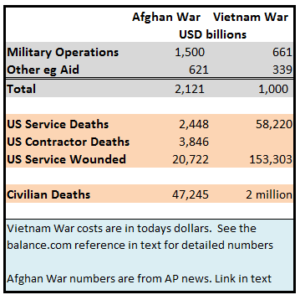
Carter’s Afghan war lead to the destruction of that developing nation.  Afghan women were launched back into the future of the 13th century, and the war killed over a million Afghan men, women and children. For over forty years Afghanistan has been a humanitarian disaster. Between 562,000 and 2,000,000 civilians were killed and millions of Afghans fled the country as refugees.

If one reads most Western Media, Head Chopper Taliban and other Islamic groups are considered barbaric. Really, so bombs dropped on Wedding groups, women and children and similar is not barbaric. The lucky ones die instantly, some other have hours or days of trauma with half their body parts whereever. The really unlucky ones manage to survive, with mind and body barely functional.  US war veterans are begging on the streets are spat on and referred to by “armchair warriors” as “fxxxing losers”. (30,177 U.S. veterans post-9/11 wars have died by suicide).

All these US wars were sold to the US public as the need to promote Democracy, Human Rights, Womens Rights (and in Carters time Capitalism).  It was basically a “Look There” to the US public while the MIC (Military Industry Complex a term coined by President Eisenhower) stole trillions. Wall Street made out like bandits too with Obomba and Trump bail outs. The smoke and mirror propaganda is falling apart, in the US and all over the world, courtesy the  Covid Pandemic and US defeat by a rag tag, flip flop wearing group.

The Numbers for Afghan War and Comparison with Vietnam


The take home points of comparison of Afghan War with Vietnam
a)  Afghan war cost was double that of Vietnam War (in todays dollars).
b) Vietnam war had 20 times US service death, i.e. boots on the ground, indicative of a determination to win.
c) Much less civilian deaths in Afghan War (approx 50 times less).  Dropping bombs for sake of expending ammunition.?

Economic Bottom Line: US has 23 Trillion in Debt,   thats a 107% Debt/GDP.


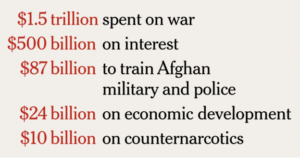
The whole reason for US being in Afghanistan was to siphon off US tax payer money.  A huge portion of the 2.2 Trillion spent.
Sold to US taxpayer as Nation Building, Womens Rights the works.
Just some 2500+ US combat deaths much much less than in Vietnam (58,000+). Too many deaths and the US public would be against the war.

Like Christianity and Civilize the Savages,  Democracy, Human Rights are just smoke and mirrors to loot from the invaded country.   However, to loot natural resources takes time and investment, and no guarantees of very profitable returns (exception Libya; instant return, the 140 tonnes of Gold was whisked away).

For the kleptocrat mentality (MIC and Wall Street) the looting of natural resources is too long a time frame. So someone figured out, much easier to steal from US public.

a) Start a war,
b) Fund with debt
c) Skim huge percentage on weapons, development programs.
d) Drop plenty of bombs to justify purchase of more.
d) Make sure casualties are low so public wont be against war.

The Brits were much better at “resource extraction” with their colonialism.   Created a brown nose class to keep the natives in check.  Built infrastructure, eg railways and “exported” natural resources back to Britain.  However, that took a good hundred years.

Wrapping it up

Even when weapons of war are not actually destroyed, their manufacture is still a convenient way of expending labour power without producing anything that can be consumed. (Orwell 1984)

This has been the biggest wealth transfer from the middle class and blue collar to the 1% and the 10%. What will happen when the tide recedes and those earning less than 60K/year find out they have been lied to, specially the MAGA crowd.

So whats next

a) The prediction of the graveyard of Empires ?
b) What form will it take, eg end of Capitalism.
c) US image as a moral leader and indispensable nation
d) US image as the foremost military power

For those who want to delve into the esoteric, this is movement of Pluto into Capricorn, that last happened around 1776. (eg Turning Point: The United States’ Pluto Return interesting history too, eg repatriation of 400K Mexican Americans around 1933).

Finally: These are not my brilliant insights. Much like Newton said, stand on shoulders of Giants. Just been reading since about 2005, Matt Tabbibi, Matt Stoller. Specially Satyajit Das and Raguram Ranjan who gave me insight into Derivatives.


Costs of the Afghanistan war, in lives and dollars
https://apnews.com/article/middle-east-business-afghanistan-43d8f53b35e80ec18c130cd683e1a38f

Note: Over 30,177 U.S. service members and veterans of the post-9/11 wars have died by suicide.
https://watson.brown.edu/costsofwar/costs/human/military/killed

From the War Nerd
The wonderful thing about this kind of spending, in the deeply corrupt lobbyist world of DC, is that it shunts tax dollars directly to the stockholders, connected military firms like Raytheon, Lockheed Martin, et al., legislators, military brass milking the DoD/corporate link, and even lowly CIA contractors like Johnny Spann —without angering a single taxpayer or benefiting them in any way.
And so, rather than upset their fellow shareholders, GWB, then Obama and Trump, just nodded and smiled at the conveyor-belt of $100 bills.  The beauty is the corruption in the US system. Book deals, Speaker fees all legal. Just many ways of laundering bribes.
https://www.nakedcapitalism.com/2021/08/the-war-nerd-was-there-a-plan-in-afghanistan.html

Afghanistan was never “Hindu”


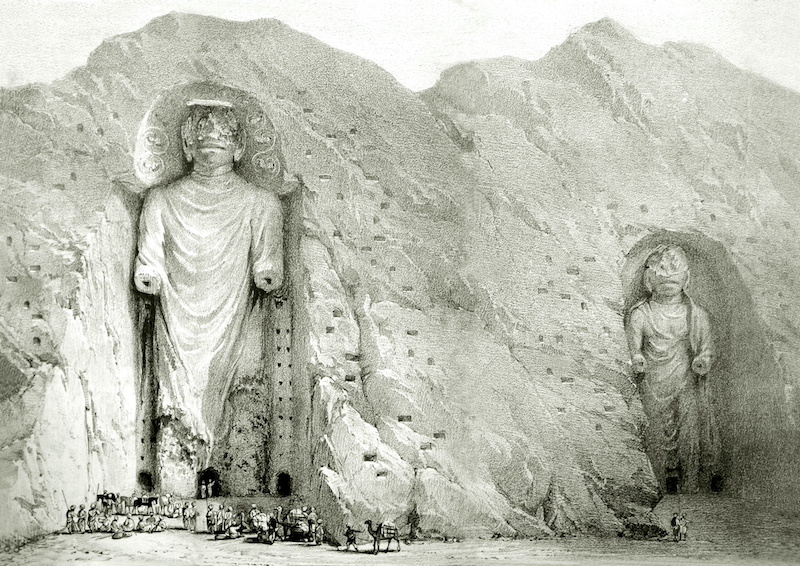
Buddhism and Islam on the Silk Road has an extensive section on Afghanistan. The Bamiyan Buddhas reminds us what the texts make clear: up until 900 AD the highlands in an around modern Afghanistan were heavily Buddhist. The Turki Shahi kings of Kabul seem to have patronized Buddhism. In contrast, their successors, the Hindu Shahi kings, seem to have tilted toward what we would call Hinduism.

Because I’m posting a Substack on Afghanistan soon the civilizational and cultural identity of Afghanistan is on my mind. After my reading and reflection, I’ve come to the conclusion that the area and the people can be thought of as a crossroads between Persian, Central Asian, and Indian. Central Asia includes both Iranic and later Turkic cultures, while the Persian influence reflects a deeply west Iranic sensibility. Finally, it has hard to deny that India and much of southern and western Afghanistan are deeply connected geographically, biologically, and culturally.

And yet some Indians keep claiming that “actually Afghanistan use to be Hindu…” This is false. At least by any comprehensible definition of “Hindu.” It is true that Afghanistan was once heavily Buddhist, but Buddhism is not Hinduism. It is true that there have long been Indians in Afghanistan, but there have been Indians in Southeast Asia as well. It is true that the Iranian pagans, like the Nuristanis, worshipped gods and practiced traditions that descend from one’s affinal to the Vedic Aryans, but the pre-Vedic religion of the Indo-Aryans was not Hinduism as we’d understand it.

To a great extent, this sort of cultural imperialism is harmless and cringe. But it’s a bit on the insensitive side given what’s going on in Afghanistan, where ironically Indian-origin Deobandi Islam is is reigning supreme…

A Shocking Decision

An interesting sidelight from Islamic history, by Ali MInai. Originally published on his blog “Barbarikon“,  reposted here with Ali Minai’s permission.

The Caliph and the Imam

A Shocking Decision

Sometime in 816 CE – year 200 in the Hijri calendar of Islam – the seventh Abbasid Caliph al-Mamun made a very strange decision. If near-contemporary historical narratives are to be believed, he offered his throne – and thus power over lands from India to Morocco – to the leader of his fiercest opponents, the Shi’a. It was a breathtakingly audacious decision – so audacious that it failed almost immediately. The eighth infallible Imam of the Shi’a, ‘Ali bin Musa al-Rida, was not interested.  Al-Mamun had to recalibrate, and he did so by nominating Ali al-Rida as his successor. The Imam demurred again, but this time the Caliph was adamant: The Imam must accept or he and his family would suffer. Imam Ali al-Rida’s family was no stranger to suffering. Almost all of his ancestors – direct descendants to the Prophet himself – had been persecuted, many martyred or imprisoned. His own father, the seventh Imam Musa al-Kadhim, had perished as a prisoner of al-Mamun’s father, the famous Harun al-Rashid of A Thousand and One Nights. Whatever the reasons, Ali al-Rida acquiesced, and on the 27th day of Ramadan in 201 AH (April 18, 817 CE), he was proclaimed “wali ‘ahd al-muslimin” – the designated successor to the 31-year old al-Mamun. Coins were soon minted asserting this new designation – the standard way of declaring authority – and the traditional black flags of the Abbasids were replaced by the green flags of the Shi’a Imams. A little more than a year later, the Imam was dead. Al-Mamun would rule for another fifteen years.

The Historical Preamble Continue reading A Shocking Decision

Fringe Harbingers of Enlightenment – Literary Experiment of Ibn Tufayl

Being among the earliest readers and admirers of Brown Pundits, it was an honor when Omar Sahib invited me to write here few months ago. Since I blog about diverse topics (like most of you), I hesitated that something might come across as irrelevant.  I’ll keep sharing my thoughts on various topics from time to time. Just starting with a piece on Ibn Tufayl’s Hayy Ibn Yaqzan.

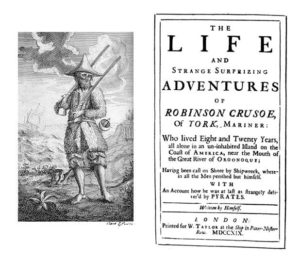
It is hard to imagine a young kid finishing high school without ever coming across The Life and Adventures of Robinson Crusoe?  Written in 1719 by Daniel Dafoe, it is among the claimants of the auspicious stature of first English novel, and widely believed as a true travelogue upon its inception.  However, there is seldom a casual reader who can trace the legend back to the 17th century roots of literary tradition with an autodidact character at its center; and few are aware about the Arab-Spanish mentor of this optimism in human reason and contemplation, Ibn Tufayl (d. 1185).
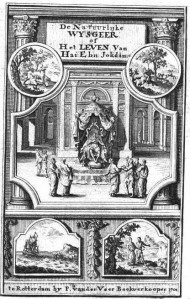
Almost six hundred years between Dafoe and him, we know very little about the life of Ibn Tufayl, except that he was a polymath, serving as a physician and adviser of Sultan Abu Yaqub Yusuf (d. 1184) of the Almohad dynasty ruling Morocco and Spain. It is unfortunate that his complete interdisciplinary work is lost, except his philosophical experiment involving an isolated autodidact, named Hayy Ibn Yaqzan; literally translated as Alive, Son of the Awake.

It is the story of a boy, the nature of whose existence is shadowy to an extent that there are two completely rivaling accounts of his origins. One account ascribes his origin to spontaneous generation from matter; the other is necessarily a legendary human drama in which a royal infant somehow grows up away from society and culture. Being isolated from all intelligent life, he gradually becomes conscious, thereby discovering shame, jealousy, aspiration, desire, eagerness to possess and practical reasoning. He experiences love through affection of his foster doe, and death, as it ultimately departs.

To know is necessarily an obligation for Hayy Ibn Yaqzan. Desperately seeking meaning, his search guides him to explore various disciplines such as anatomy, physiology, metaphysics and spirituality. He deduces the presence of God through contemplating  the unity of cosmos and its boundedness; and in his ascetic code of conduct, he seeks satisfaction and salvation.

After thirty-five years of isolation, he finally meets Absal, a hermit refugee from a land of conventional religious believers. In Absal, Ibn Tufayl modeled a religious divine who has learnt many languages to gain mastery of scriptural exegesis. Absal’s first reaction is a deep sense of fear for his faith as he encounters an exotic being. As they interact well, Absal endeavors to teach Hayy to speak and communicate, in order to make him aware of knowledge and religion.

However Absal soon discovers that Hayy is already aware of the truth, to envision which, Absal’s own intellect bears nothing except revealed symbols.

Judging Absal’s good intentions and the veracity of his message, Hayy proselytize to this religion and Absal introduces Hayy to his people. As Hayy gets familiarized with civilization, two basic questions continue to puzzle him in great deal. First, why people must need symbols to assimilate and express the knowledge of the ultimate truth; and why can’t they just experience the reality more intimately? Second, being completely oblivious to practical religion, he continued to wonder why there is an obligation to indulge oneself in rituals of prayer and purity.

He keeps on wondering why these people consume more than their body needs, possess and nurture property diligently, neglect truth by purposefully indulging in pass-times and fall an easy prey to their desires. He finally decides to accompany Absal to his land, thinking that it might be through him that people encompass the true vision and experience truth rather than believing it with their seemingly narrow vision.

What follows is a tale of a neophyte philosopher teaching ordinary people to rise above their literalism and open another eye towards reality. His interlocutors on the other hand, recoil in their apprehensions and being intellectual slaves to their prejudices, close their ears. He consequently realizes that these people are unable to go beyond their usual appetites. He also grasps that masses of the world are only capable to receive through symbols and regulatory laws rather than being receptive to unstained and plain truth. Both men eventually return back to their isolated world but this time Hayy as the teacher and Absal as his disciple. They continue searching their ecstasies until they met their ends.

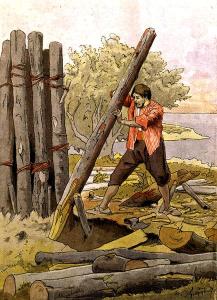
CHT167325 Robinson Crusoe Building his First Dwelling, 1930 (colour litho) by Myrbach-Rheinfeld, Felicien baron de (1853-1940); colour lithograph; Private Collection; (add. info.: Robinson Crusoe construit sa maison); Archives Charmet; German, in copyright until 2011

Ibn Tufayl’s singularly survived legacy extends in diverse dimensions and its canvas is vast. Its theological and philosophical themes were employed and transformed throughout the various phases of European enlightenment.

It isn’t just one curious aspect that many centuries later, the metaphysically preoccupied Hayy Ibn Yaqzan is transformed into a shipwrecked sailor, predominantly occupying himself with inventions and utilitarian exploration of nature. As Malik Bennabi – an acute observer of modern condition – observes, the genius of both the narratives lies in characterizing the solitude of their respective protagonists. In this respect, time for Robinson Crusoe is essentially a concrete cyclic happening of acts, such as work, food, sleep and work again.

Nov. 4. This morning I began to order my times of work, of going out with my gun, time of diversion, viz., every morning I walked out with my gun for two or three hours, if it did not rain; then employed myself to work till about eleven o’clock; then eat what I had to live on; and from twelve to two I lay down to sleep, the weather being excessive hot; and then in the evening to work again. The working parts of this day and of the next were wholly employed in making my table; for I was yet but a complete natural mechanic soon after, as I believe it would do anyone else.[1]

This is pretty much the condition of a modern individual where the void of solitude is filled with work, each of us occupied mechanically with the object at the centre of our world of ideas, diligently busy in constructing our own proverbial tables.

On the other hand, what fills Hayy’s solitude is an overwhelming amazement, the adventure starting by experiencing wonder in the ultimate nature of life and death of his beloved foster-mother, the gazelle.

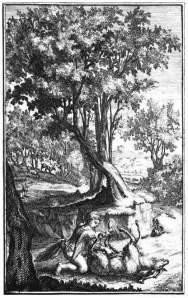
When she (the gazelle) grew old and feeble, he used to lead her where there was the best pasture, and pluck the sweetest fruits for her, and give her them to eat. Notwithstanding this, she grew lean and continued a while in a languishing condition, till at last she died, and then all her motions and actions ceased. When the boy perceived her in this condition, he was ready to die for grief He called her with the same voice, which she used to answer to, and made what noise he could, but there was no motion, no alteration. Then he began to peep into her ears and eyes, but could perceive no visible defect in either; in like manner he examined all the parts of her body, and found nothing amiss, but everything as it should be. He had a vehement desire to find that part where the defect was, that he may remove it, and she return to her former state. But he was altogether at a loss how to compass his design, nor could he possibly bring it about.[2]

Thus, it is ultimately in the nature of failure to identify this defective part where Ibn Tufayl tries to locate an ineffable reality beyond the material.  

Ibn Tufayl’s philosophical romance has been regarded as one of the pioneer autodidactic works surviving from medieval scholastic tradition [3]. But besides being an influential narrative  — with rich literary possibilities and themes such as those transformed by a modernist like Dafoe — it was a precursor to important medieval interactions between the schools of Thomas Aquinas and Averroists, and invited modern appraisals from mathematician rationalists like Gottfried Leibniz [4].

Voltaire and Quakers admired it for its appeal to reason, and Bacon, Newton and Locke were possibly influenced by it to various degrees too. Traces of Ibn Tufayl’s original literary pointers are also found in Rousseau’s Emile, Kant’s Ground of Proof for a Demonstration of God’s Existence, Jonathan Swift’s Gulliver’s Travels and Darwin’s Origin of Species among others.

Especially in the context of Muslim tradition, its contemporary value lies in rich possibilities to bridge gaps between reason and revelation. It lays down a perpetually self evolving construct where reason and reflection are the essential keys to the doors of  timeless revelation. Ibn Tufayl’s voice still echoes loud, struggling to tell us that rejecting either would imply rejecting a part of truth.

_________________________________________

  1. Daniel Dafoe, Robinson Crusoe, Penguin Classics 2003
  2. Lenn Evan Goodman, Ibn Tufayl’s Hayy ibn Yaqzan: a philosophical tale, 1972.
  3. There have been attributions to an earlier work involving similar but limited themes to Avicenna.
  4. Samar Attar, The Vital Roots of European Enlightenment: Ibn Tufayl’s Influence on Modern Western Thought, 2010

Review: Magic in Islam by Michael Mohammed Knight

This is an old capsule review I wrote a few years ago. I have been busier than usual and not writing at all, so I decided to post some old reviews..

26192917

A hot mess of a book, but still worth reading. Michael Knight is now a postmodern conventionally educated scholar, and that is beginning to show. He has obviously read VERY widely and the book contains countless extremely interesting tidbits about magic and magical ideas in Islamicate tradition. But all of this wonderful research is embedded within a curious postmodern framework that can be off-putting and irrelevant to the story. The story he COULD have told is the story of magic and related ideas in the history of Islam and Islamicate culture. THAT story would have been a fascinating and interesting tour through a history that is not well known, especially to outsiders and Western-educated Muslims (like us). And he provides some of that and that is why the book is worth reading. But he is also eager to “correct” our supposed misconceptions about religion and history and too much pleading takes up too much space in this book. Then again, many people seem to want that kind of “mandatory re-education/rectification of names”, so maybe you will like that part too. But personally, I would have preferred more historical details, fewer lectures about orientalism and “the clash of civilizations”.
Best new bit of information for me: that Ibn ul Arabi claimed he had sex with the Arabic letters in paradise. I wish i knew more about the context of that particular quote. But like many fascinating little details in the book, Michael mentions it and moves on. He has clearly read a lot, I wish he had spent more time presenting the information he has collected and less time lecturing us about how “opening space for new fields of knowledge potentially decenters traditions of jurisprudence, even forcing increased opening of an Islam outside normative Muslim legal traditions” and suchlike. Sure, that would be nice. But let us hear the story first, then we can figure out what it means for magic to be (as he describes it) “deconstructive”.
Not that I disagree with his project of “engagement and deep intersection”, just that I wanted more of the facts, less of the postmodern interpretation.

Browncast: Tim Mackintosh Smith, author of “Arabs”

You can listen on Libsyn, Apple, Spotify, and Stitcher (and a variety of other platforms). Probably the easiest way to keep up the podcast since we don’t have a regular schedule is to subscribe to one of the links above!

In this episode (split into two parts) we talk to Tim Mackintosh Smith, author of “Arabs; a three thousand year history of peoples, tribes and empires“. We talk about his book and about Arab history and contemporary reality. Check it out..

Travel Writer Tim Mackintosh-Smith on Why Seventh and Eighth Graders Should Read These Classic Arabic Travel Tales – ArabLit & ArabLit Quarterly

On Ahmadiyyas and Jains

One of my favourite examples to demonstrate why Hindus and Muslims are like chalk and cheese (or cheese and chalk- no value judgment implied by the metaphor!) is their respective treatment of Jains and Ahmadiyyas.

We all know about the plight of Ahmadiyyas in Pakistan. Not a week goes by when there isn’t a story in the media on Ahmadiyya persecution. To Indian eyes, this can be quite baffling. The Ahmadiyyas reserve a highly exalted position for Prophet Muhammad. By all socio-cultural markers: naming and dressing conventions, eating habits, praying patterns etc., they appear “Muslim”. Yet certain theological red lines are crossed- including the recognition of Indic icons such as Buddha and Krishna as prophets, but most importantly the perceived violation of the doctrine of Khatam-un-Nabiyeen: the finality of Muhammad’s prophethood. A clear case of orthodoxy trumping orthopraxy. This hostility towards the Ahmadiyyas is not a recent phenomenon and can be traced back to the views of the founding fathers of Pakistan, such as Allama Iqbal.

From a Hindu perspective, this can appear bizarre- ethnic Punjabi “Muslims” who share so much in common in both cultural and kinship terms are so hostile towards each other due to some theological disputes. There are more consequential theological disputes within sects of Hinduism. For example, within Vaishnavism, there is the Dvaita Vedanta school founded by the 13th century scholar-saint Madhavacharya which believes that the Divine (i.e. Vishnu or the supreme being) is distinct from the individual. The better known Advaita Vedanta school founded by Adi Shankaracharya is Monistic (i.e. believes in the essential unity of the Divine or Vishnu and the individual). From a theological perspective, these ruptures are perhaps as radical as those between Sunni Muslims and Ahmadiyyas. Yet, the average modern Hindu, even someone who self-identifies strongly as a Vaishnavite, would find the notion of being hostile to other Vaishnavites on the basis of doctrinal differences to be bizarre and laughable.

Continue reading On Ahmadiyyas and Jains

Brown Pundits