The Long Dark Night for India’s Muslims

Our own Hindufication

We write this not as outsiders pretending to diagnose India, but as people who have undergone a gentler version of the same process. Over fifteen years of family and work on the subcontinent, our own Islamicate inheritance has been quietly sifted. The Persianate was retained. The Arabic was allowed to fall away. The qawwali, the food, the manners, the ghazal, the Mughal grammar of taste. All survived. The devotional Islamicate self did not. We arrived as something close to a Anglo-Islamicate hybrid. We are leaving, slowly, as a Hindu-Persianate one. We did not plan this. We watched it happen to ourselves.

The Persian survives. The Arabic does not. The poetry survives. The prayer does not. This is the formula. Once you see it, you cannot unsee it.

We made this passage with privilege, with distance, with choice, and with somewhere else to be if we changed our minds. The Indian Muslim, the one with no other passport and no other country, is being asked to make the same passage on terms set by people who never had to make it themselves. That asymmetry is this post.

The morning song

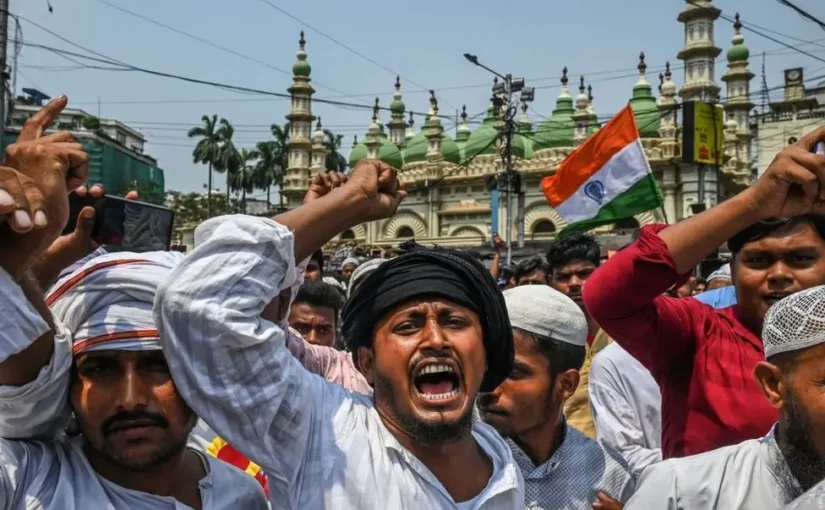
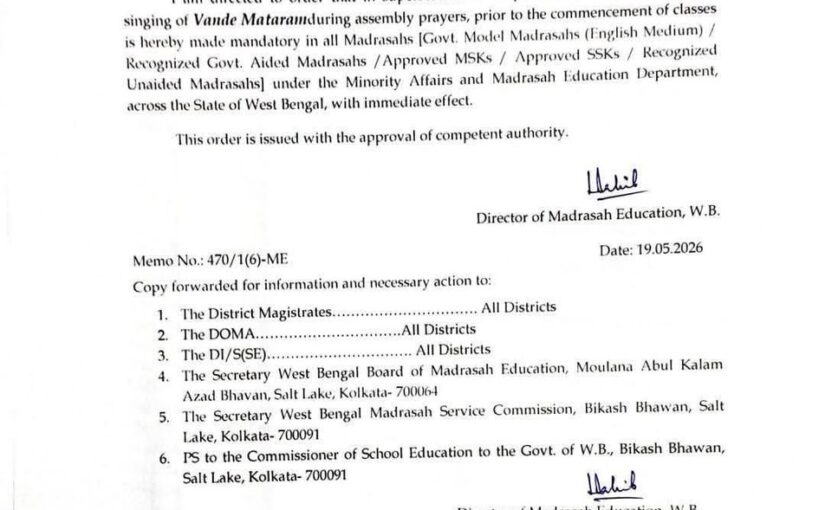
The news this week was Memo No. 470-ME, dated 19 May 2026, signed by the Director of Madrasah Education, Government of West Bengal. The order makes the singing of Vande Mataram mandatory at morning assembly in every state-recognised madrasa: government, aided, unaided, all of them. Immediate effect. Approval of competent authority.
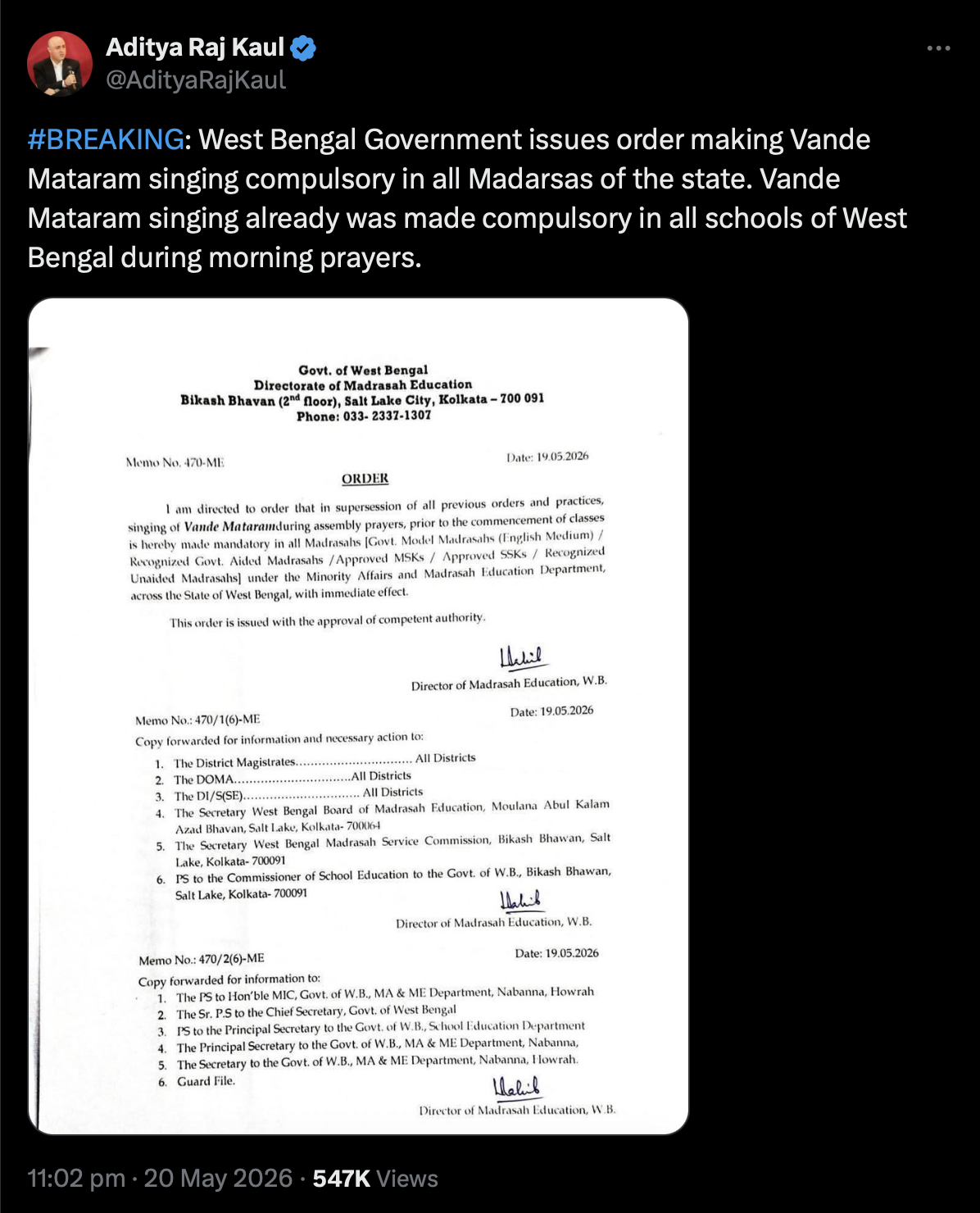
Note the date. Suvendu Adhikari was sworn in as the first BJP Chief Minister of West Bengal on 9 May, ten days earlier, on a 207-seat mandate that ended Mamata Banerjee’s fifteen-year run. The order is ten days into the new government. Of all the actions available to a freshly-installed state administration, this is the gesture chosen. The first major item on the agenda was the Muslim schoolchild’s morning. The signal is the signal.

The Pakistani faction of our commentariat is aghast, and not unreasonably. The song is a hymn to the Great goddess Durga, drawn from a novel that called for war on Muslims, and forcing a Muslim child to recite it is a small humiliation that announces a large arrangement. One of our Pakistani commenters compared it to forcing a vegetarian Hindu to eat beef. The comparison overstates and understates at the same time. It overstates because nobody is forcing food into anyone’s mouth. It understates because food is forgotten by the afternoon, and a song sung daily for ten years writes itself into the spine.

The row is the symptom. The disease is older. Bengal is the latest frontier, not the first.

The Persianate without the Muslim

Continue reading The Long Dark Night for India’s Muslims

Islamicate Civilisation is a Supreme Culture: But Who Stands to Inherit It?

This post grew out of an exchange with EK, the kind that can only happen in a forum that has paid for its openness. Kabir, to his credit, has imposed the hard internal checks that keep the blog from collapsing into the views of its editors.

The high culture built by the three great gunpowder empires (Ottoman, Safavid, Mughal) is one of the supreme achievements of human civilisation. All three were Turkic in dynastic origin, Persianate in literary and aesthetic register, and Islamic in faith. The Blue Mosque in Istanbul, the Naqsh-e Jahan complex in Isfahan, the Taj Mahal at Agra: these are not regional artefacts. They are a single coherent civilisational signature, expressed in tilework, ghazal, miniature, garden, cuisine, and chancery prose, across a belt that ran from the Bosphorus to the Bay of Bengal.

The question this post is about is simpler than it sounds. Who inherits it?

Continue reading Islamicate Civilisation is a Supreme Culture: But Who Stands to Inherit It?

The Bahá’í Position on Palestine: A Note for the Record

Comments of late have drifted, as they sometimes do here, into territory where the Bahá’ís are invoked as a rhetorical chess piece by people who know very little about them. We believe in free speech, and on this blog more than most, in authorial autonomy; contributors and commenters speak for themselves, and we are not in the business of policing opinion. But because the question of Palestine sits adjacent to much of what has been said, we thought it worth setting down what the actual position is.

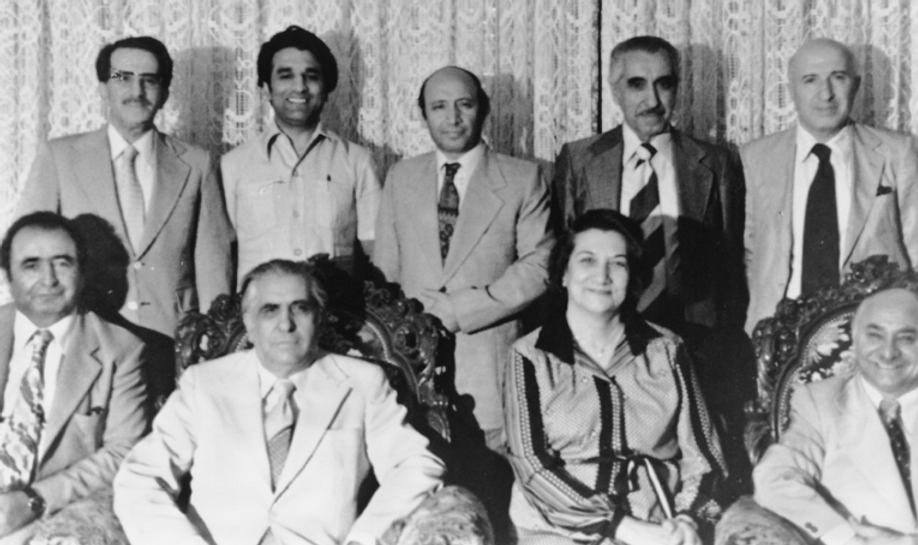
“Members of the National Spiritual Assembly who disappeared in August in 1980. All are presumed to have been killed” by Bahá’í Media Bank.

One caveat first. When we write or administer here, we do not speak for our Faith in any official capacity. We are members of it. That is the limit of our standing.

The clearest statement of the Bahá’í position comes from the pen of the Beloved Guardian of the Faith, Shoghi Effendi, who in July 1947 was asked directly by the United Nations Special Committee on Palestine to clarify the relationship of the Bahá’í community to the country and its political future. His reply, written from Haifa and reproduced in The Bahá’í World, Volume 11, is as close to a foundational text on this question as exists. We quote it at length, because paraphrase would not do it justice.

Letter to the United Nations Special Committee on Palestine

On July 9, 1947, Shoghi Effendi received a letter from the chairman of the United Nations Special Committee on Palestine requesting a statement on the relationship, which the Baha’i­ Faith has to Palestine and the Baha’i­ attitude toward any future changes in the status of the country. From Shoghi Effendi’s reply, the following paragraphs are quoted in The Baha’i­ World, Volume 11 (1946-1950), pp.43-44.1

HAIFA, ISRAEL—15 July 1947

“The position of the Baha’i­s in this country is in a certain measure unique: Whereas Jerusalem is the spiritual center of Christendom it is not the administrative center of either the Church of Rome or any other Christian denomination. Likewise although it is regarded as the second most sacred shrine of Islam, the most Holy site of the Muhammadan Faith, and the center of its pilgrimages, are to be found in Arabia, not in Palestine. The Jews alone offer somewhat of a parallel to the attachment which the Baha’i­s have for this country, inasmuch as Jerusalem holds the remains of their Holy Temple and was the seat of both the religious and political institutions associated with their past history. But even their case differs in one respect from that of the Baha’i­s for it is in the soil of Palestine that the three central Figures of our Religion are buried and it is not only the center of Baha’i­’ pilgrimages from all over the world but also the permanent seat of our Administrative Order, of which I have the honor to be the Head.”

“The Baha’i­ Faith is entirely nonpolitical and we neither take sides in the present tragic dispute going on over the future of the Holy Land and its people nor have we any statement to make or advice to give as to what the nature of the political future of this country should be. Our aim is the establishment of universal peace in this world and our desire to see justice prevail in every domain of human society, including the domain of politics. As many of the adherents of our Faith are of both Jewish and Moslem extraction, we have no prejudice towards either of these groups and are most anxious to reconcile them for their mutual good and for the good of the country.”

“What does concern us, however, in any decisions made affecting the future of Palestine, is that the fact be recognized by whoever exercises sovereignty over Haifa and Acre, that within this area exists the spiritual and administrative world center of a world Faith, and that the independence of that Faith, its right to manage its affairs from this source, the right of Baha’i­s from any and every country of the globe to visit it as pilgrims (enjoying the same privilege in this respect as Jews, Moslems and Christians do in regard to visiting Jerusalem), be acknowledged and permanently safeguarded.”

Three things are worth drawing out.

Continue reading The Bahá’í Position on Palestine: A Note for the Record

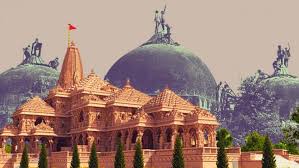
You Cannot Demolish His Mosque and Claim His High Culture

A precedent post on hybridity, custodial duty, and the elites who want it both ways

The argument running through the recent threads is sharper than the usual India versus Pakistan braggadocio. It is a claim about high culture itself. A civilisation cannot demolish a man’s mosque and claim his high culture in the same breath. The two moves cancel. The elites on both sides of the 1947 line have been performing both moves for eighty years, and the contradiction is now visible.

What high culture is

High culture is the foundational settlement of values, ordinarily anchored in religion, that a civilisation runs on. It can be syncretic in formation. Plural ownership is harder to sustain, and most attempts eventually close into a single settlement or fracture into rival ones; some imperial frames (Ottoman, Mughal, the Republic of India itself) did hold the tension for longer than the simple model would predict. The point is not that plurality is impossible. The point is that plurality is unstable, and the instability is what generates events like 1992.

England is the cleanest worked example of closure. The English high culture is a hybridisation of Anglo-Saxon, Anglo-Norman, and an absorbed Celtic remainder. Scotland and Wales sit inside the matrix without breaking it. The hybridisation closed; one settlement emerged.

Ireland is the test case in the negative. The same Anglophone substrate produced a different high culture in the Catholic south, and in the Catholic pockets of the north, because religion did the foundational work and religion would not blend. Two islands, one language family, two high cultures. Language is the medium. Religion is the substrate.

Ludwig von Mises, in Nation, State, and Economy, argued the related half. The nation is a speech community, but the speech community is shaped by what the school teaches and what the church says. Plattdeutsch villages on the Dutch border could have gone either way two centuries ago; the descendants would now be just as good Hollanders or just as good Germans, depending only on where the school and the church sat. Language carries national consciousness. The religious settlement decides which language wins.

Notre Dame: The custodial bargain Continue reading You Cannot Demolish His Mosque and Claim His High Culture

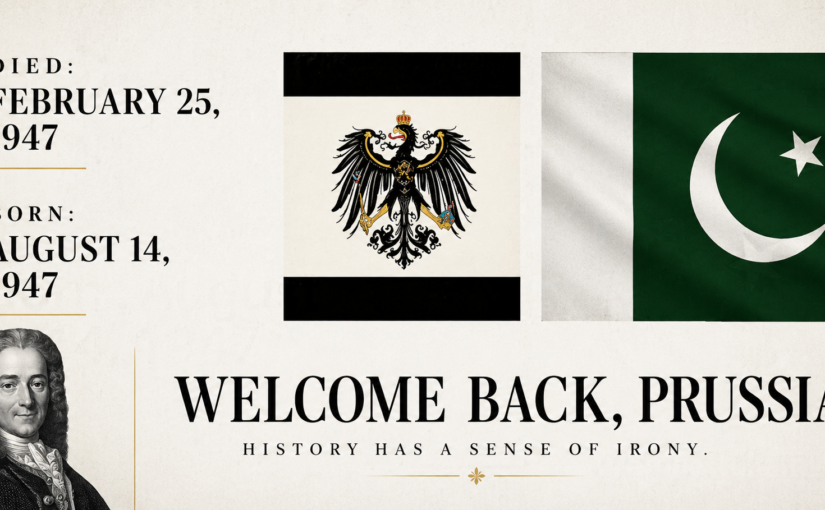
Gurdaspur and Siliguri: The Two Necks That Held

A precedent post on Pakistan’s self-exile from the subcontinent, and the geography that outlasted it

This is not anti-Pakistan polemic. Pakistan can flourish in the role she has chosen, and may continue to do so (Pakistan’s pivotal role in the US-Iran war is, on any honest reading, a legitimisation win for the current hybrid government)). The point being made here is structural, not personal.

Pakistanis are a subset of the British Raj’s Muslim population. As Punjabis, as inheritors of the Mughal cultural complex (alas one cannot destroy his Masjid and simultaneously claim to be his heir), as native carriers of the Hindustani register that becomes Urdu under one stylisation and Hindi under another, they began with a favoured position inside the subcontinent. They have traded it for a subordinate position inside the wider Muslim world. The internal hierarchies of the Islamicate, where Pakistanis rank against Arabs, Turks, and Persians, are dense and unflattering and deserve their own treatment another day.

The cause of the trade, in the end, is theological. The subcontinent runs on iconographic generosity, painted shrines, sung saints, plural deities, devotional excess. Strict iconophobia cannot live inside that civilization without breaking it. Pakistan chose the stricter line in 1947 and has progressively tightened it since. The Urdu denial, the recent insistence in some Pakistani quarters that Urdu is not really an Indian language, is the cleanest evidence of the opt-out.

Irreducibly Indo-Persian

Continue reading Gurdaspur and Siliguri: The Two Necks That Held

The 1000 Years Frame Erases 80% of India

girmit, high signal as ever as the Comment threads threaten to get engulfed in flames (the Crescentiate are being more provocative than usual). Will return to this properly in a separate post. as an aside when we see girmit, we think Kermit. Probably one of our wises voices in BP.

Indians and their gratitude for Partition

You will be hard pressed to find a normal person in India who doesn’t accept this. If you listen to young people talk they would treat the fact that India-Pakistan were once part of the same polity as some kind of surprising trivia. My point is that, while TNT was used to litigate for partition , and the results of that have been accepted by all parties, the *further* application of TNT will find no takers among liberals. An example would be a statement like “Kashmir should have gone to Pakistan because of having a muslim majority”. There are excellent reasons why one can argue for Kashmir as an independent state in 1947 or even part of Pakistan, that don’t depend on TNT. The foremost being the idea that the process of accession was corrupted somehow. J&K had the same exact right to self-determinaton as Travancore for instance. But the underlying principal is self-determination in the Wilsonian sense i suppose, not TNT. (This goes both ways, as Indians use an imperial logic of their own that a fully intact successor state to the british raj was their entitlement, which is quite outageousely grandiose to be fair).

BJP is a broad tent

Continue reading The 1000 Years Frame Erases 80% of India

Does the average muslim ‘dislike hindus’?

Admin Note: This is a Precedent Post.

“You seem to be underestimating how much the average Muslim dislikes Hindus (and vice versa). This is a sad reality.”

This comment on a thread conversation – yet again discussing partition on BP, jumped out at me. And I think it deserves to be dissected.

I for one, strongly disagree with the projection of personal animus, extrapolated all the way into the ‘average muslim’. And vice versa. I’m going to assume that Kabir is ‘only’ deigning to speak on behalf of the ‘average muslim’ of the subcontinent, and not beyond. But even then, I think this assertion is utterly inaccurate.

I do not believe that ‘disliking Hindus’ is baked into the character or mindset of the muslims of the subcontinent, whether in India, or beyond it, into Bangladesh of Pakistan. Now, I am aware of the ‘kufr’ attack lines that those suffering from Islamophobia often deploy and may even believe. But I am confident that this is the usual weaponization of the fringe by those with ignorant, or intentionally jaundiced agendas.

The Problem with Monolithic Thinking

To say that “Muslims dislike Hindus” is to treat over 500 million people across multiple countries as if they share a single mindset. This kind of thinking ignores differences in geography, class, education, political views, and personal experiences.

Communities are not monoliths. A Muslim family in Kerala may have vastly different social interactions and attitudes compared to one in Lahore or Dhaka. The same is true for Hindus across regions. Reducing such diversity to a single emotional stance erases individual agency and lived reality.

Historical Context Matters—but So Does Interpretation

It’s true that the subcontinent has witnessed periods of conflict, most notably during the Partition of 1947. That traumatic event left deep scars and continues to influence inter-community perceptions. However, it is a mistake to project historical violence onto present-day relationships without acknowledging the decades of peaceful coexistence that have followed.

In fact, millions of Hindus and Muslims continue to live side by side, working together, forming friendships, and even intermarrying. Everyday life in much of the subcontinent is not defined by hostility but by routine interaction.

The Role of Politics and Media

Modern tensions, where they exist, are often amplified by political rhetoric or media framing. Narratives that emphasize division can serve specific agendas, making it appear as though distrust is more widespread than it actually is.

It’s important to distinguish between politically motivated discourse and the attitudes of ordinary people. The loudest voices are not always the most representative.

Lived Reality: Coexistence Over Conflict

Walk through neighborhoods in cities like Mumbai, Delhi, Karachi, or Dhaka, and you’ll find markets, schools, and workplaces where Hindus and Muslims interact daily. Festivals are sometimes shared, businesses are jointly run, and friendships cross religious lines.

These everyday examples rarely make headlines, but they represent the true fabric of society.

Why Generalizations Are Harmful

Broad claims about mutual dislike do more than misrepresent reality—they can actively contribute to division. When people are told repeatedly that another group harbors negative feelings toward them, it can create suspicion where none existed.

Challenging such narratives is not about denying that tensions exist, but about refusing to let those tensions define entire populations.

A More Nuanced Understanding

A more accurate perspective acknowledges that:

Historical conflicts exist, but so does long-term coexistence
Political narratives can distort social realities
Individual experiences vary widely
Cultural interdependence is a defining feature of the region

If we are to understand the subcontinent honestly, we must move beyond simplistic narratives and recognize the complexity—and humanity—of its people. Resorting to ignorant tropes about ‘muslims dislike hindus and vice versa’ not only should be avoided, but deserves to be countered forcefully.

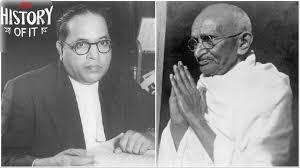
Men of State, and the Great Mahatma

A Precedent Post on Gandhi, Ambedkar, and the Authority to Speak

Kabir is right to push back on the deliberately provocative, “pure evil.” It misses what QeA & Nehru were and what Gandhi & Ambedkar were.

This post sets four Precedents.

One. QeA and Nehru were men of state. Neither evil, neither saint. To be evaluated by the standards appropriate to men who build and run states.

Two. Gandhi was a man of Dharma. He is a saint. Comparing him with QeA and Nehru on their terms is a category error.

Three. Ambedkar is the fourth figure. Not a man of state in the QeA or Nehru sense; not a man of Dharma in the Gandhian sense. He is a constitutional saint, in the Mahatma’s register.

Nehru and QeA may be criticised. They may not be disrespected. Gandhi and Ambedkar are a different order. Discussion of them on this blog proceeds from profound respect for their achievement: the redemption of the soul of India after a thousand years of slavery.

*Thousand years of slavery is not Precedent but rhetorical flourish. It is worth noting that all of the Pakistani commentators on BP would be subordinated “Hindustani Muslims” in the hierarchical world of the Mughals, who explicitly favoured foreign-born Turani and Irani nobles over the converted Indian majority.

Four. SD is not to be quoted on this blog. Initials only where strictly necessary. Reasons at section XII.

Part I. The Distinction

I. The Man of State

The modern state is a Westphalian inheritance: territory, a monopoly of violence, legal personality. A man of state operates inside that frame. He does not step outside it.

QeA was a man of state. He was perhaps the finest constitutional negotiator the subcontinent produced in the twentieth century. He read the Government of India Act the way a master reads a score. In his Fourteen Points of 1929, drafted in response to the Nehru Report’s dismissal of the Muslim minority, he foresaw with brutal clarity that a Westminster majority in a plural society could become a permanent tyranny once the demographic count was fixed.

According to Mohammad Ali Jinnah, “The Committee has adopted a narrow minded policy to ruin the political future of the Muslims. I regret to declare that the report is extremely ambiguous and does not deserve to be implemented.”

There is a reason Pakistanis venerate him to the extent they do. Without QeA, the Muslims of the subcontinent would have remained a set of regional identities & class interests: Punjabi, United Provinces aristocrats, Bengali. He forged a single Islamicate identity out of them and politicised it into a state. In the history of the Ummah, and indeed the world, this is almost unique.

The Two Nation Theory was not his starting point. In 1916, at Lucknow, Sarojini Naidu called him the Ambassador of Hindu-Muslim Unity, and the phrase was earned. He reached for the Two Nation Theory two decades later, when the softer constitutional instruments had been closed off by Congress intransigence and Viceregal haste.

The tragedy of QeA is that the state he called into being never settled its founding question. A secular Muslim who ate pork and drank whisky summoned an Islamic state and then, on 11 August 1947, tried to unsummon it in a speech that Pakistan has spent the rest of its history editing out of its school curriculum. The confusion was structural from day one. It is structural still.

II. The Architect and the Scaffold

Nehru was a man of state of a different temperament. Harrow, Cambridge, Inner Temple. Fabian socialist. Scientific temper. Where QeA built a state around a community, Nehru built one around an idea: that a civilisation as old as India could be poured into a parliamentary republic and would accept the mould. It largely did. We owe him this.

Continue reading Men of State, and the Great Mahatma

Founder Sites and Institutional Sites: A Note on Sikh Sacred Geography

This post is to be treated as Precedent on two matters.

First, on moderation

We have been alerted by Hamza that a number of Pakistani commentators on this site have been using anti-Dravidian racialised language against South Indian communities. This will not be tolerated on Brown Pundits.

Any comment that uses racialised language against Dravidian, Tamil, or South Indian communities will be removed, and the offending commenter will have twenty comments removed instantly as an automatic fine. There is no warning phase.

This is personal as well as editorial. DLV’s family was driven out of Sindh by Muhajirs at Partition. It was the Dravidians and the Tamils of Chennai who welcomed them, gave them a second home, and treated them as their own. Any racialised language against those communities on this site will be met with the full weight of the moderation tools available.

To Kabir’s credit, as far as we are aware, he is the only regular Pakistani voice on this blog who has never used racialised language of any kind, even in sharp disagreement. He remains institutional and high-minded even when the argument turns to nuclear rattling. He does not share in the wider Desi pathology with regards to skin colour and race, and that exception is worth naming. It may be the American side of him. Whatever the source, it is the standard this site expects of every commenter, Pakistani, Indian, Bangladeshi, or otherwise.

Second, on substance

The post below establishes a framework for how this site will discuss the sacred geographies of Partition going forward. The recent Kabir-Kishore exchange on Sikh holy places, is the occasion, but the framework is intended to apply across all such disputes: Hindu sites in Pakistan, Muslim sites in India, Sikh sites on both sides of the Wagah, Buddhist sites across the subcontinent. Future BP posts on sacred geography should refer back to the founder-institutional distinction laid out here.


Founder Sites and Institutional Sites: A Note on Sikh Sacred Geography

A recent exchange on this site sets out two claims about Sikh holy places. The first says Sikhs lost most of their sacred sites to Pakistan in 1947. The second calls that claim nonsense. Both are right, and the disagreement turns on a distinction neither has named: founder sites versus institutional sites.

The Pakistan-side Holy Sites

Continue reading Founder Sites and Institutional Sites: A Note on Sikh Sacred Geography

Pakistanis = Indian Muslims With Sovereignty?

Part 1: Who Can Speak for the Muslims of India

Part 2

BB has made a comment calling Pakistanis “strayed Muslim Indians“; which does not quite make sense, because Pakistanis are both Indic & Islamic, uniquely so. One cannot deny the highly syncretic and distinct Muslim subculture that has come about from a very long and deep history in India. It cannot be subsumed into an Indian identity in any meaningful way without acknowledging that distinctiveness.

But the phrasing opens a useful equation.

Pakistanis = Indian Muslims with sovereignty.

Continue reading Pakistanis = Indian Muslims With Sovereignty?

Brown Pundits